
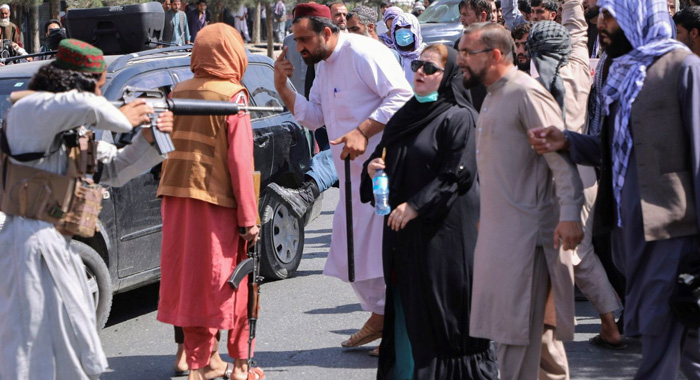
A senior Taliban official has issued a renewed and explicit warning to Afghan citizens to remain silent and refrain from speaking out against the Taliban, underscoring an intensifying crackdown on dissent, freedom of expression, and political activity across the country.
Abdul Kabir, the Taliban’s Minister of Refugees and former Deputy Prime Minister for Political Affairs, delivered the warning during a meeting with residents of Khost, Paktia, and Paktika provinces, urging communities to actively prevent individuals from criticizing the Taliban. He stated unequivocally that the regime “will not allow anyone whether in the mountains, the plains, or the streets to speak out against the Taliban.”
The remarks come amid four years of sustained repression, during which dozens of journalists, civil society activists, political opponents, and women protesters have been arrested, imprisoned, or forcibly silenced. The Taliban have systematically banned public protest, criminalized political affiliation, censored media content, and outlawed criticism of the regime, effectively eliminating space for dissent.
Media professionals and rights advocates describe the Taliban’s governance as authoritarian and intolerant of scrutiny, noting that independent voices are silenced rather than heard—despite widespread poverty, unemployment, and humanitarian distress that have forced many families to sell their possessions to survive.
Hamid Obaid, head of the Afghan Journalists Protection Organization, stated that such warnings reflect the Taliban’s long-standing rejection of freedom of expression. He noted that all media operating inside Afghanistan are subject to strict filtering and censorship, with only content aligned with Taliban narratives permitted for publication. “Critical journalism has been completely banned, and the public is exposed to a single, state-imposed narrative,” he said.
Former diplomat Fayyazuddin Ghiasi described the Taliban as an extremist group that has historically suppressed dissent and continues to do so after regaining power. He stated that journalists, women protesters, and human rights activists have been detained, abused, and in some cases killed, adding that the group’s ideology and structure are fundamentally opposed to democratic norms, human rights, and international conventions.
Civil society voices warn that repression may silence society temporarily but will ultimately deepen public anger. Afghan citizens have expressed concern that the Taliban’s fear of protest movements—both domestically and abroad—has driven increasingly harsh measures to suppress even the mildest criticism.
The warning follows earlier directives by Taliban Justice Minister Abdul Hakim Shariai, who ordered the revocation of all political party licenses, declared any mention of political parties a criminal offense, and warned that critics of the Taliban would face severe punishment. He has also accused critics who question the absence of a constitution or legal framework of religious disbelief.
Over the past several years, Taliban authorities have arrested women and girls who protested peacefully, forced televised confessions, and imposed sweeping restrictions on women’s participation in public life and the media. Multiple reports by Afghan and international monitoring organizations indicate that journalists face intimidation, detention, and coercion, while media outlets are compelled to publish only Taliban-approved content.
Annual assessments by press freedom organizations describe Afghanistan’s media environment as devoid of pluralism, marked by censorship, surveillance, and fear. Journalists have lost independence, access to information is tightly controlled, and society is increasingly subjected to a one-voice policy enforced through repression.
Observers warn that the latest statements by Taliban leadership further entrench a climate of fear and signal that freedom of expression, political participation, and basic civil liberties remain red lines under Taliban rule, raising serious concerns for human rights, accountability, and Afghanistan’s future stability.



