
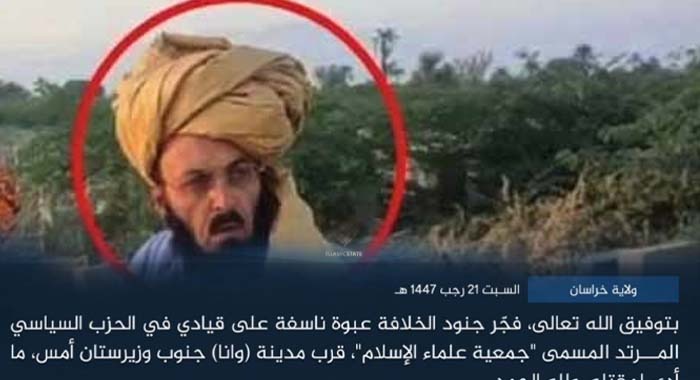
The Islamic State Khorasan Province’s (IS-KP) claim of responsibility for the bombing in Wana is not a routine militant statement. It is a calculated signal. By publicly owning the attack days after it occurred, the group has repositioned the incident from a localized act of violence into part of a broader ideological and operational campaign unfolding across Pakistan’s former tribal districts.
According to the claim, the attack was executed through an improvised explosive device planted near a religious seminary in Wana Bazaar, deliberately targeting a cleric affiliated with a mainstream religious political party. The delayed admission has shifted attention away from the incident itself and towards what the group intends to communicate: presence, capability, and intent.
Security officials note that such claims are rarely impulsive. They are timed to maximize psychological impact, reinforce credibility among sympathizers, and assert relevance in contested militant terrain. In this case, the messaging is unmistakable. IS-KP is not merely operating, it is choosing its targets carefully and advertising those choices.
The cleric later succumbed to his injuries in Dera Ismail Khan, a development already reported earlier. What is new, and what matters strategically, is the explicit declaration that the attack was part of an organized effort rather than an anonymous act of terror.
Why Clerics Are Becoming Prime Targets Again
IS-KP’s decision to publicly claim responsibility exposes a deeper shift in militant strategy. The group is prioritizing ideological assassinations over indiscriminate violence. Religious figures linked to mainstream parties and local influence structures present a unique threat to extremist movements. They command legitimacy, shape community opinion, and reject absolutist interpretations of religion.
By targeting such individuals, IS-KP aims to dismantle competing sources of religious authority. The objective is not only to eliminate individuals but to intimidate an entire class of influencers. Fear replaces debate, silence replaces resistance, and communities are left ideologically unguarded.
This tactic is not new, but its reappearance in South Waziristan is significant. For years, the region was considered comparatively insulated from IS-KP’s core operational zones. The claim challenges that assumption. It suggests that the group has rebuilt facilitation networks, improved reconnaissance, and found space to operate amid political distraction and security fatigue.
Equally important is the symbolic geography of Wana. As a market town and political nerve center of South Waziristan, it offers visibility and resonance. An attack there, followed by a formal claim, sends a message far beyond the immediate blast radius. It signals that no space, even those with deep religious and political roots, is off limits.
The claim has also reopened uncomfortable questions about the broader environment enabling such attacks. Persistent intelligence gaps, inconsistent counterterrorism prioritization, and rising political polarization have created exploitable seams. Militancy thrives where attention fractures and accountability blurs.
IS-KP’s statement should therefore be read not only as a confession but as a challenge. It is an assertion that the group remains ideologically defiant, operationally capable, and strategically adaptive. More importantly, it is a warning that the next phase of militancy may rely less on spectacle and more on surgical intimidation.
If the response remains reactive rather than anticipatory, and if protection of vulnerable religious and community figures is not treated as a strategic necessity, such claims will multiply. The attack in Wana, and the message attached to it, underline a hard reality: the militant threat is evolving, and the battlefield has shifted from mass fear to targeted silence.



