
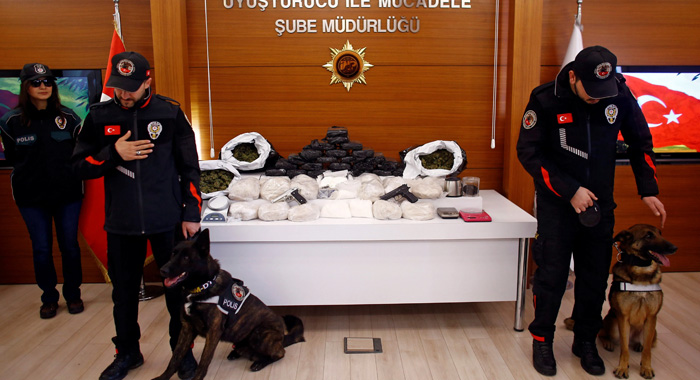
A newly released report by Turkey’s Anti-Narcotics Department has revealed that Afghanistan continues to occupy a central position in the production and trafficking of illicit drugs destined for European markets, despite official restrictions on poppy cultivation.
According to the report, titled “Turkey Drugs Report 2025,” narcotics originating in Afghanistan remain a persistent and significant challenge for regional and European security. The findings underscore Turkey’s role as a critical transit country along the world’s most active drug trafficking corridors.
The report identifies the Balkan route alongside Turkey’s southern and northern corridors—as the most frequently used pathways for the trafficking of Afghan-origin opiates. These routes form a well-established network that begins in Afghanistan, passes through Iran and Turkey, and ultimately feeds into European drug markets.
Officials note that the Balkan route, in which Turkey serves as a pivotal transit hub, remains the most heavily utilized and strategically important drug trafficking corridor linking Asia to Europe. Its continued use reflects the adaptability and resilience of transnational criminal networks involved in narcotics production and distribution.
Turkey’s Interior Ministry emphasized that the country’s unique geographic location bridging Asia, the Middle East, and Europe places it on the frontline of the fight against international drug trafficking. As a result, Turkey ranks among the leading countries in the seizure of Afghan-origin heroin en route to Europe.
While the report does not disclose the precise volume of Afghan-origin narcotics intercepted specifically within Turkish territory, official data reveals that more than 15 tons of heroin were seized nationwide between 2022 and 2024, highlighting the scale of the challenge and the intensity of ongoing counter-narcotics operations.
The findings reinforce concerns that Afghanistan remains deeply embedded in global drug supply chains, posing long-term security, public health, and law enforcement challenges for countries across the region and beyond.
Turkish authorities reaffirmed their commitment to intensifying border security, intelligence cooperation, and international collaboration to disrupt trafficking networks and curb the flow of narcotics toward Europe.
The Turkey Drugs Report 2025 serves as a stark reminder that despite policy shifts and enforcement measures, the international drug trade continues to evolve—demanding sustained, coordinated, and cross-border responses.



