
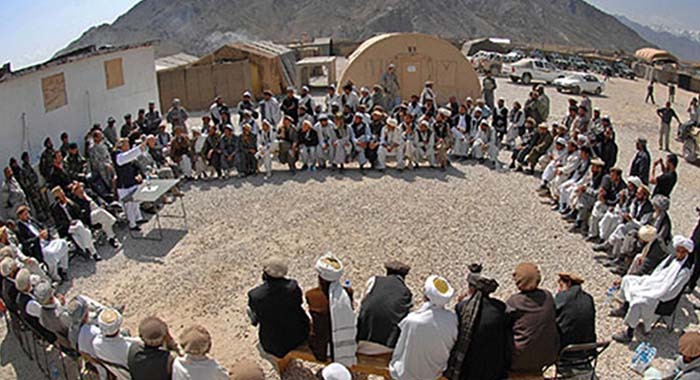
A high-level grand jirga held at the Bara Rifles Headquarters underscored the urgency of a security operation in Tirah, alongside critical decisions and concerns related to the repatriation of Afghan refugees, amid growing anxiety over militancy and regional stability.
The jirga was attended by the Inspector General Frontier Corps, Deputy Commissioner Khyber, District Police Officer Khyber, and 112 elders from the Afridi and Mullagori tribes. Discussions centered on the deteriorating security situation, the necessity and modalities of a potential operation in Tirah, and the implementation of the government’s Afghan refugee return policy.
Addressing the gathering, the IG Frontier Corps emphasized that restoring durable peace required decisive action against militant elements and urged full cooperation from local communities during any security operation or related displacement. He stressed that no obstacles should be created in the repatriation of Afghan refugees, advising locals to refrain from renting houses or shops to undocumented refugees to ensure an orderly return process. He also called for close coordination between residents, civil administration, and security forces during displacement, while reiterating that terrorists must not be given shelter under any circumstances.
Tribal elders acknowledged the security challenges but raised serious concerns regarding the conduct and impact of any operation. They rejected phased or partial displacement, insisting that if an operation is launched, relocation must be carried out collectively, under a clearly defined policy, and with complete facilities for affected families. They warned that ambiguity could exacerbate resentment and undermine cooperation.
On border security, the elders demanded comprehensive deployment of forces along border areas and adjoining regions to prevent militants from slipping into Bara or Orakzai during operations. They also stressed the need for full, transparent, and timely compensation for damage to homes and property resulting from security actions.
The issue of Afghan refugees featured prominently in the jirga. Elders called for a clear, uniform, and consistent state policy on Afghan refugees and border management, warning that confusion and uneven enforcement were fueling insecurity and mistrust. They argued that counterterrorism responsibilities should not be shifted onto civilians, who lack both the resources and protection to confront armed groups.
Additional concerns included allegations of irregularities at the Mullagori Bridge on the Machni–Mohmand Agency Road, where restrictions during the day and alleged bribery at night were termed unacceptable. Elders also pointed to what they described as a double standard in law enforcement, claiming stricter action against narcotics-related offences than against terrorism.
Despite official assertions that Bara remains peaceful, jirga members highlighted the open display of weapons at social events as evidence of lingering insecurity. They cautioned that repeated displacement, inadequate compensation, and persistent threats have deepened a trust deficit between the state and the local population.
Concluding the jirga, tribal elders demanded that any security operation be preceded by an empowered consultation process, accompanied by a written plan covering displacement, compensation, and rehabilitation. They called for uniform and genuine action against terrorists, clarity on Afghan refugee policy, and concrete steps to rebuild trust between the state and the people.



