
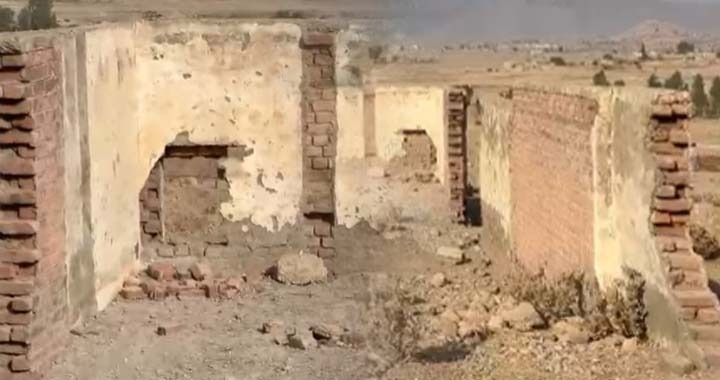
Seventeen years after a terrorist attack reduced a government school to rubble in Khyber Pakhtunkhwa, the building remains abandoned, highlighting what critics describe as the provincial government’s misplaced priorities at a time when militancy is resurging and national unity is critical.
The school is located in Bazaar Zakha Khel, a locality in District Khyber that lies on the route to the Tirah Valley, a region historically vulnerable to terrorism, weak governance, and prolonged insecurity. The school was destroyed during the wave of militant violence in 2008, yet no reconstruction work has begun to date.
Hundreds of children in the area remain deprived of basic education. There is no temporary school, no alternative arrangement, and no emergency plan from the education department. The locality is remote, and access to private schools is virtually impossible, leaving children with no formal learning options.
Parents and local elders say their concerns have repeatedly been conveyed to the authorities, but no action has followed. They warn that prolonged neglect in such a sensitive area is pushing children into an education vacuum, a condition long exploited by extremist groups.
The situation has intensified criticism of the PTI-led KP government and the chief minister, particularly over recent political decisions that, according to security analysts, have weakened the province’s counterterrorism posture. The public announcement regarding the return of bulletproof vehicles provided by the federal government to KP police was widely interpreted as a political statement rather than a security-driven decision. Although it later emerged that the vehicles had not actually been returned, the political messaging had already been delivered.
At the same time, the KP government’s opposition to a proposed security operation has raised concerns about the absence of a unified front against terrorism. Observers argue that this stance has created ambiguity at a critical moment and reinforced perceptions of political softness toward militant elements.
Critics say the provincial government’s political focus remains fixed on the release of the party’s founder, while governance, security coordination, and social sectors such as education continue to suffer. They argue that the failure to rebuild a terror-damaged school on the Tirah route reflects a broader pattern of neglect rather than an isolated oversight.
Education experts stress that schooling is one of the most effective long-term tools against radicalization. Denying education to children in conflict-prone areas, they warn, undermines counterterrorism efforts and allows extremist narratives to take root.
Residents are now demanding immediate reconstruction of the school and the declaration of an education emergency in the area. They insist that restoring classrooms in District Khyber is not merely a development issue but a security imperative that the provincial government can no longer afford to ignore.



