
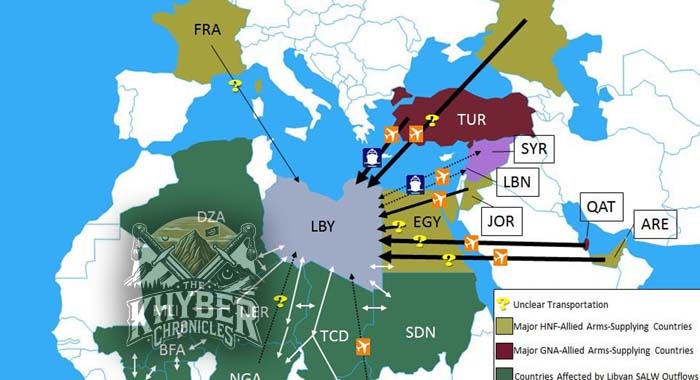
More than a decade after the fall of Muammar Gaddafi, Libya remains trapped in a cycle of fragmentation, proxy warfare, and institutional collapse. While internal divisions are often cited as the primary cause of Libya’s instability, this explanation obscures a far more decisive factor: the systematic and sustained violation of the United Nations arms embargo by regional and global powers. The Libyan conflict has evolved into one of the clearest examples of how international law collapses when geopolitical interests outweigh accountability. Despite repeated UN resolutions, expert panel reports, and public documentation, weapons, military equipment, and foreign fighters continue to flow into Libya with remarkable regularity.
The result is not merely the prolongation of conflict, but the normalization of impunity. States that publicly champion international norms are simultaneously undermining them on Libyan soil. The arms embargo, imposed in 2011 to prevent Libya from descending into militarized chaos, has become one of the most openly violated sanctions regimes in modern history. From armed drones and fighter jets to small arms and mercenaries, Libya has effectively become an open-air marketplace for foreign military intervention.
At the heart of this breakdown lies the direct involvement of multiple states, each pursuing its own strategic objectives while disregarding the devastating consequences for Libyan sovereignty and civilian life.
The United Arab Emirates has emerged as one of the most assertive violators of the embargo. Its involvement in eastern Libya has been extensive, sophisticated, and sustained. The UAE has supplied armed drones, including Wing Loong I and II systems, alongside missiles, armored vehicles, and aircraft. Beyond equipment transfers, it has gone further by constructing and operating airbases in eastern Libya, effectively embedding itself into the military infrastructure of the conflict. These actions represent not passive support but active participation, reshaping the battlefield and escalating the war’s technological intensity. Emirati drones played a decisive role in shifting military balances, particularly through precision strikes that dramatically increased civilian vulnerability.
Turkey, on the opposing side of the conflict, has likewise played a central role in violating the embargo. Its military support to western Libyan factions has included Bayraktar TB2 drones, armored vehicles, air-defense systems, and a wide range of weapons. Turkish intervention altered the trajectory of the war, halting advances by rival forces and reinforcing Tripoli-based authorities. While Ankara frames its involvement as legitimate assistance to an internationally recognized government, the reality remains unchanged: the transfer of weapons and military systems occurred in direct contravention of UN restrictions. Turkey’s actions underscore a broader pattern in Libya, where legality is selectively invoked while international obligations are ignored.
Russia’s role in Libya has been both opaque and consequential. Rather than overt state deployment, Moscow has relied heavily on private military contractors to supply weapons, manpower, and operational expertise. Through these networks, fighter jets such as MiG-29s and Su-24s were deployed, alongside air-defense systems, landmines, and heavy arms. These assets significantly escalated the conflict and introduced advanced military capabilities previously absent from the Libyan theater. The use of contractors has provided Russia with plausible deniability, yet the strategic impact of its involvement is undeniable. Libya has become another arena where Moscow tests a model of indirect intervention that blurs the line between state and non-state warfare.
Egypt’s involvement reflects a more traditional form of regional intervention, driven by security concerns along its western border. Cairo has supplied small arms, ammunition, and armored vehicles, while allowing cross-border transfers into eastern Libya. In addition to matériel support, Egypt has provided training and logistical assistance to the Libyan National Army (LNA). While Egyptian officials often justify these actions as counterterrorism measures, they nonetheless constitute clear violations of the embargo. Rather than stabilizing Libya, such support has entrenched military factions and deepened the country’s divisions.
France’s role is particularly striking given its vocal support for international law and multilateralism. The discovery of French-made Javelin anti-tank missiles at LNA bases raised serious questions about Paris’s involvement. Although French authorities claimed the weapons were not intended for transfer or use by Libyan forces, their presence on active frontlines tells a different story. This episode illustrates the double standards that plague international engagement with Libya, where strategic alliances often override legal commitments.
Jordan has also been implicated in supplying armored vehicles and weapons, alongside providing training and logistical support. Though its involvement has drawn less public scrutiny, it forms part of a broader regional network sustaining the conflict. Such contributions, even when framed as limited or technical assistance, feed into the same destructive cycle by empowering armed actors over political processes.
Sudan occupies a unique position in the Libyan war, serving both as a supplier and a transit route. Weapons have been moved through Darfur into southern Libya, while Sudanese mercenaries have been recruited and deployed by various factions. The porous borders and longstanding conflicts in Sudan have made it a critical conduit for arms trafficking. This dynamic has not only destabilized Libya but has also exacerbated insecurity across the Sahel, demonstrating how the Libyan conflict radiates instability far beyond its borders.
Belarus, though less prominent, has been linked to the supply of military equipment and aircraft, often connected to Russian logistical networks. Its involvement reflects the expanding web of actors willing to profit from or politically exploit Libya’s collapse. These connections further complicate efforts to enforce sanctions, as responsibility is diffused across interconnected supply chains.
Qatar’s role belongs largely to an earlier phase of the conflict. Between 2011 and 2014, Doha supplied arms to Islamist factions during and after the uprising. While its involvement has since diminished, the legacy of those early transfers continues to shape Libya’s fragmented security landscape. The initial flood of weapons during this period laid the groundwork for militia entrenchment and long-term instability.
Iran’s involvement, though limited in scale, has included small arms shipments. Even such modest contributions underscore the broader failure of embargo enforcement. In a conflict already saturated with weapons, every additional supply reinforces the message that international restrictions are optional rather than binding.
Collectively, these actions reveal a stark reality: the UN arms embargo on Libya has been rendered largely symbolic. Violations are documented, acknowledged, and yet rarely punished. The absence of meaningful consequences has transformed Libya into a permissive environment for foreign intervention, where power politics eclipse the rule of law.
The human cost of this failure is borne almost entirely by Libyans. Civilians have been killed by drone strikes, displaced by fighting, and trapped in a war economy sustained by foreign weapons. Political processes have repeatedly collapsed under the weight of militarization, as armed groups backed by external patrons see little incentive to compromise.
Libya’s tragedy is not simply a story of internal discord but a damning indictment of the international system’s inability or unwillingness to enforce its own decisions. As long as powerful states continue to arm their preferred factions, peace in Libya will remain elusive. The embargo’s erosion sends a dangerous message beyond Libya as well: that international law applies selectively, and that strategic interests can override collective responsibility.
Until this reality is confronted with genuine accountability, Libya will remain a battlefield shaped not by the will of its people, but by the weapons supplied by those who claim to support peace while profiting from war



