
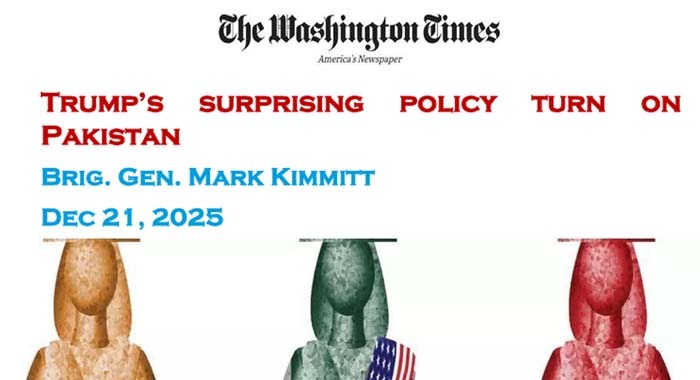
A detailed analysis published by The Washington Times has described 2025 as a watershed year in Pakistan–United States relations, marking a dramatic transformation in Washington’s strategic outlook toward South Asia. According to the article, Pakistan has moved from being viewed as a problematic or sidelined state to becoming a central strategic partner in U.S. regional policy, signaling the end of the long-standing “India First” approach.
The article notes that this unprecedented policy shift occurred under President Donald Trump’s renewed leadership and was shaped by a combination of geopolitical realities, counterterrorism cooperation, and evolving regional dynamics. It highlights that such a rapid turnaround in Pakistan’s image and strategic relevance in Washington is rare and almost without precedent in U.S. foreign policy.
According to The Washington Times, the initial U.S. strategy had focused on elevating India through frameworks such as the Quad, with expectations that Pakistan would remain marginalized. However, developments within India—including domestic political challenges, restrictions on civil liberties, inconsistent military performance, and diplomatic rigidity gradually raised doubts in Washington about India’s reliability as a regional stabilizer.
The article identifies covert counterterrorism intelligence exchanges as the first point of thaw in Pakistan–U.S. relations. These exchanges reportedly provided Washington with tangible evidence of Pakistan’s substantive cooperation, helping to rebuild trust at the strategic level. Momentum further accelerated in March 2025, when President Trump publicly praised Pakistan during a national address—an endorsement that significantly altered policy discussions within Washington.
Islamabad, the article states, capitalized swiftly on the opening. Limited cooperation initiatives were transformed into strategic gains, and engagement steadily deepened. What began as transactional interaction evolved into a strategic partnership, driven by mutual interests rather than short-term exchanges.
The decisive turning point, according to The Washington Times, came during the brief but intense Pakistan–India military confrontation in May 2025. Pakistan’s military performance reportedly surprised U.S. policymakers, including President Trump himself. The article highlights Pakistan’s discipline, strategic focus, and asymmetric capabilities as exceeding American expectations, prompting Washington to reassess Pakistan as a serious and credible regional actor.
Following the May conflict, the article states, President Trump’s strategic map of South Asia was effectively redrawn. Pakistan began to be viewed as an “emerging asset” capable of anchoring the U.S. vision for South Asia, rather than a peripheral player. Pakistan’s military modernization, restructuring of its command architecture, and the operationalization of the Chief of Defence Forces role gained new global significance.
In this context, The Washington Times places particular emphasis on Field Marshal Syed Asim Munir, highlighting both his role as Chief of Army Staff and as the country’s senior military leader. The article describes him as a central figure in reshaping Pakistan’s strategic profile and notes his growing prominence within U.S. decision-making circles.
The article further contrasts the reactions of India and Pakistan following the ceasefire. India’s reportedly cold response to U.S. mediation efforts displeased President Trump, while Pakistan’s willingness to acknowledge and appreciate American diplomatic facilitation strengthened Islamabad’s standing in Washington.
Field Marshal Asim Munir is described as emerging as a prominent figure within President Trump’s inner strategic circle. The article characterizes their rapport as a half-joking “bromance,” while also referring to the Field Marshal as a “disciplined dark horse” and a “deliberate mystery.” Notably, The Washington Times points out that a White House luncheon meeting marked the first such engagement with a Pakistani military chief, underscoring the depth of the evolving relationship.
The article also highlights the red-carpet reception accorded to Field Marshal Asim Munir at U.S. Central Command headquarters, where he held high-level strategic discussions with senior American military leadership.
Looking ahead, The Washington Times reports that as 2026 approaches, Pakistan is being positioned close to the core of President Trump’s grand strategy. The country is seen as a discreet yet credible channel for engagement with Iran, a potentially influential player in Gaza-related calculations, and a more visible actor in broader regional diplomacy.
The article concludes by asserting that the “India First” era in Washington has effectively ended, and that the sustainability of the new U.S. policy will depend on the future conduct of both New Delhi and Islamabad. It emphasizes that Pakistan—and particularly Field Marshal Syed Asim Munir—played a decisive role in reshaping U.S. policy and rebalancing South Asia’s strategic equation in 2025.
According to The Washington Times, the year will be remembered as a moment when Pakistan decisively re-entered Washington’s strategic calculus—not as a liability, but as a partner of consequence.



