
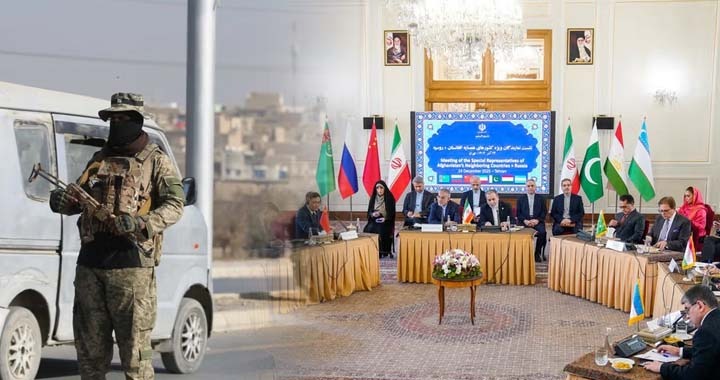
The recent dialogues in Tehran, during a meeting of Afghanistan’s neighbouring countries once again underlined a reality that the region can no longer afford to ignore: stability in Afghanistan is no longer an Afghan-only question. It is a regional security imperative, with consequences stretching far beyond Kabul. Iran’s Foreign Minister Abbas Araghchi was direct in his assessment, calling Afghanistan’s stability a “strategic necessity” for all neighbouring states. Representatives from Pakistan, China, Russia, Tajikistan, Uzbekistan and Turkmenistan gathered to discuss precisely this concern. Yet, the Taliban chose to stay away.
That absence was not procedural. It was political.
At a time when regional powers are trying to create structured dialogue mechanisms, not only to manage borders and trade but also to prevent Afghanistan from once again becoming an epicentre of instability, the Taliban’s refusal to attend sends a troubling signal. Dialogue was on the table. The Taliban flipped it over.
Iran’s position, echoed by several participants, rested on a clear principle: no extra-regional blueprint can resolve regional crises. Imported solutions have failed Afghanistan before. Regional ownership, coordination and sustained engagement are the only workable path forward. The logic is sound. Afghanistan, if stabilised, can become a bridge between Central and South Asia, a corridor for energy, trade and connectivity. If destabilised, it becomes a fault line.
Tehran went a step further. Ahead of the meeting, Iran facilitated discussions among anti-Taliban Afghan political groups, resulting in a joint declaration calling for political dialogue. Former Afghan foreign minister Hanif Atmar described the gathering as a rare opportunity to initiate an intra-Afghan political process under UN cooperation. The message was unmistakable: guns have exhausted their utility, politics must take over.
But while diplomats spoke of dialogue, a very different tone emerged from Kabul.
Tajmir Jawad, the deputy head of the Taliban’s intelligence agency, issued another of his now-familiar warnings. He claimed that domestic and foreign actors were conspiring against Afghanistan, insisted that the Taliban does not seek war, yet threatened overwhelming retaliation if conflict is “imposed.” His language was defiant, absolutist and revealing. It reflected a mindset that still views power as something to be defended through intimidation rather than legitimacy.
This contradiction lies at the heart of Afghanistan’s current crisis.
Within Taliban ranks, especially among lower-level fighters and supporters, a powerful myth has taken hold: that the Taliban defeated the United States and its allies, and therefore owes no one explanations, compromises or accountability. This belief is not just historically questionable, it is strategically dangerous. Even many Afghans, like much of the world, struggle to accept that a fragmented insurgent group militarily defeated the most advanced war machine in history. The US withdrew for its own reasons. That distinction matters.
But myths, once internalised, shape policy.
The danger today is that this sense of perceived invincibility has hardened into arrogance. It explains why the Taliban dismiss regional forums, why they resist political inclusion, and why they believe coercion alone can sustain rule. History offers a harsh rebuttal. Afghanistan has never punished dialogue, but it has repeatedly punished hubris.
Regional countries, too, must be questioned.
For years, many believed that engaging the Taliban quietly, accommodating them cautiously, or waiting for moderation to emerge organically was the safest course. That assumption has not aged well. Terror networks remain active. Political exclusion persists. Humanitarian suffering deepens. If every regional forum ends with statements but no consequences, then dialogue becomes performative rather than transformative.
The international community also bears responsibility. Mixed signals, selective engagement, and moral ambiguity have allowed the Taliban to believe that time is on their side. It may not be.
To the Taliban, the warning is simple and urgent.
Talk now. Not after blood is spilled again. Not after cities burn. Not after hundreds of thousands of innocents, inside and outside Afghanistan, pay the price.
This time, war will not remain confined within Afghan borders. The region is already too interconnected, too fragile, too exposed. The old battlefield conditions no longer exist. Support networks have thinned. Strategic patience has worn out. For minimal political gains, the Taliban has already alienated a long-tested friend like Pakistan. More isolation will not bring security, only siege.
The Doha experience should have been a lesson. Agreements ignored today return tomorrow as consequences.
If the Taliban believes it can play a double game, balancing defiance with selective engagement, it is misreading the moment. Pressure is no longer limited to Pakistan. Iran, China, Central Asia, Russia and even Western intelligence circles are converging on the same concern: Afghanistan cannot be allowed to slide back into being a sanctuary for instability.
Dialogue is still possible. But the window is narrowing.
If the Taliban chooses statements over substance, threats over talks, and isolation over inclusion, then it should also prepare for a future where Kabul once again becomes a contested city, not a seat of uncontested power.
History does not forgive those who mistake temporary control for permanent authority.



