
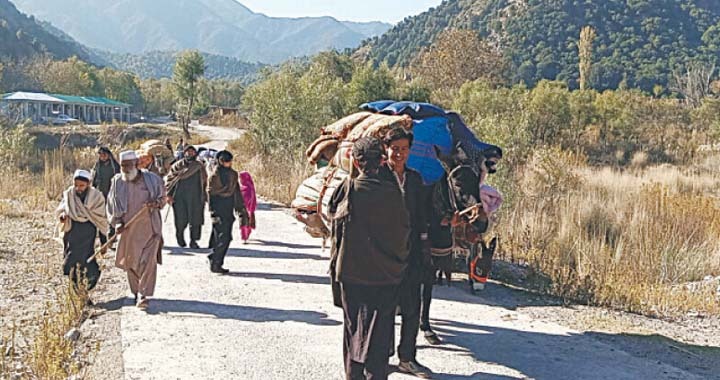
Security authorities are moving closer to launching a large scale military operation against terrorist groups in the Tirah Valley, as preparations intensify to ensure civilian safety through coordinated and largely voluntary relocation. Officials, working closely with local tribal elders, say arrangements are being made for families who have already moved or are in the process of relocating to safer areas.
Most residents have vacated the valley voluntarily, responding to repeated warnings and assurances from the authorities. However, a number of families remain in their homes due to financial constraints, logistical difficulties, or uncertainty about post operation arrangements. Security officials have cautioned that those who choose to stay may face serious difficulties once the operation begins, stressing that the advisory is aimed at preventing civilian harm rather than coercion.
Efforts are underway to provide transport, avoid civilian casualties, and complete the operation swiftly. Parallel to these measures, discussions with community representatives continue, though no final agreement has yet been reached. During talks, residents demanded financial assistance, formal recognition as internally displaced persons, and guarantees against future forced evacuations. Some local political figures opposed the operation and chose to stay away from negotiations, complicating consensus building.
Relocation towards designated safe zones has continued in the meantime, while authorities and tribal elders are finalising operational plans and post operation return mechanisms.
A Valley at the Heart of Pakistan’s Security Challenge
The planned operation comes against the backdrop of Tirah Valley’s long standing role as a strategic corridor for militancy, smuggling, and narco terror networks. Situated along the porous Afghanistan border in Khyber district, Tirah has repeatedly featured in intelligence assessments as a transit and staging area for militant groups, including factions of the TTP and Lashkar e Islam.
Only days earlier, residents had agreed in principle to support relocation after authorities assured them of addressing 27 key demands, backed by guarantees from senior civilian and military leadership. Under those assurances, families were promised a return within two months, a financial package of PKR 700,000 per household, transport and essential supplies, compensation for damaged homes, and major investments in education, healthcare, roads, and utilities. Tirah Maidan’s designation as a provincial constituency and a special economic package for business losses were also part of the commitments.
Security officials argue that these guarantees reflect an effort to balance counterterrorism objectives with civilian welfare. Speaking recently in Tirah, the Inspector General of Frontier Corps KP North underscored the human cost of securing the region, noting dozens of martyrs and hundreds of wounded personnel over the past year alone in nearby Bagh Maidan. According to officials, the convergence of drug trafficking, local political manipulation, and militant facilitation has made Tirah one of the most complex security environments in the country.
Recent incidents have reinforced these concerns. Videos circulating on social media have highlighted alleged facilitation by certain local elements, while investigations into past attacks, including routes used in assaults on Peshawar and the planning of the APS tragedy, have repeatedly traced linkages back to Tirah based networks. Authorities say this history underscores the urgency of decisive action.
Tribal jirgas held in recent weeks reflect a parallel push for cooperation. Elders have pledged not to shelter militants and to facilitate operations, while military officials have reiterated that civilian homes are not targeted and that surveillance is focused on militant movement. Temporary market closures and evacuation measures have been agreed in some areas to allow unhindered operations.
For policymakers and security planners, Tirah represents more than a local challenge. Analysts warn that without firm action, the valley could again serve as a launchpad for attacks across Khyber Pakhtunkhwa, particularly in Peshawar, barely two hours away. At the same time, authorities recognise that lasting stability will depend on follow through, safe returns, reconstruction, and the restoration of normal life once the operation concludes.
As preparations enter their final phase, the coming days are expected to determine whether Tirah’s latest chapter marks another cycle of displacement and militancy, or a turning point toward sustained security and governance in one of Pakistan’s most sensitive border regions.



