
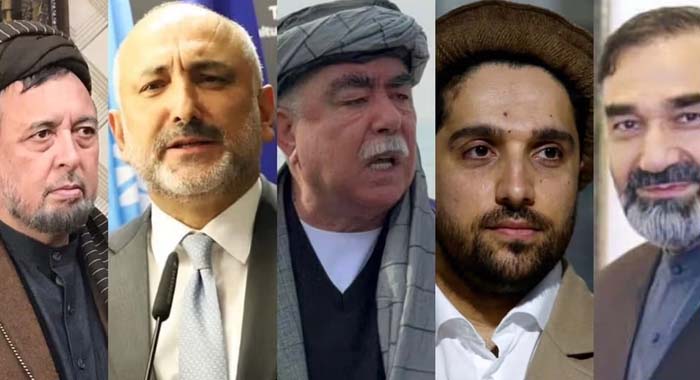
A broad coalition of senior Afghan political leaders has jointly called for United Nations supervised intra-Afghan peace talks, warning that the country’s deepening crisis cannot be resolved under the Taliban’s unilateral and increasingly repressive rule. The statement, titled “National Consensus of Afghan Political Parties and Movements,” was released on Tuesday during an online meeting attended by Ahmad Massoud, Abdul Rashid Dostum, Ismail Khan, Hanif Atmar, Mohammad Mohaqiq and Atta Mohammad Noor, all of whom stressed that Afghanistan’s future cannot be left in the hands of a regime that has isolated the country, dismantled institutions and stripped citizens especially women of their basic rights.
The declaration follows reports that the Islamic Republic of Iran had recently encouraged several former Afghan officials to explore reconciliation with the Taliban, though no direct negotiations have taken place. Instead, the joint political bloc used this opportunity to present a unified alternative vision for Afghanistan’s future and a clear rejection of the Taliban’s current governance practices. The signatories argue that the Taliban’s rigid and exclusionary policies have pushed the country toward economic devastation, political suffocation and a humanitarian emergency, making a UN-led political process the only credible path forward.
In their joint statement, the leaders emphasised that Afghanistan’s crisis must be resolved through genuine negotiations, leading to a binding, lasting and inclusive political agreement that restores stability. They insist that the United Nations, backed by the UN Security Council and regional actors, must oversee this process, as the Taliban have shown neither the willingness nor the capacity to govern responsibly or earn the trust of the Afghan people. According to the declaration, any future Afghan government must derive legitimacy from consensus and representation, not intimidation or force, and international recognition should only be extended once clear commitments to peace, governance reforms and human rights are fulfilled.
The signatories stressed that Afghanistan’s sovereignty can only be restored through a legitimate and representative governing system, something they say the Taliban have failed to uphold. They reiterated that free nationwide elections, a new constitution, and the preservation of Afghanistan’s independence and territorial integrity are essential components of any viable political roadmap. They accused the Taliban of turning the country into a battleground influenced by foreign rivalries, further weakening Afghan sovereignty and deepening instability.
Human rights, which have deteriorated sharply under Taliban rule, form a prominent part of the declaration. The leaders demanded the immediate reversal of the Taliban’s bans on women’s and girls’ education and employment, calling these policies a national disgrace and a deliberate attempt to exclude half the population from public life. They condemned the widespread arrests, intimidation and torture of former government employees, and criticised the growing incidents of forced displacement, land grabbing and the secretive exploitation of Afghanistan’s natural resources. The statement highlights that under Taliban administration, freedom of expression has been systematically suffocated and humanitarian aid has been mismanaged, often diverted or restricted due to opaque Taliban controls.
The declaration calls for increased humanitarian assistance but insists that aid distribution be handled transparently and free from Taliban interference. Donor countries are urged to resume paused assistance only under the supervision of an independent and neutral monitoring mechanism to prevent further misuse. The leaders also urged the Taliban to address the urgent demands of the Afghan population by agreeing to intra-Afghan dialogue, respecting human rights and reversing their oppressive policies. They warned that if the Taliban continue to ignore the will of the Afghan people, the public “will be compelled to resort to legitimate means” to rescue the country from the current situation created under Taliban mismanagement.
The statement concludes with an appeal to political and civil groups across Afghanistan to support the aims of the National Consensus and to stand united in opposition to unilateral Taliban rule. It calls on neighbouring states, regional powers and the international community to back the aspirations of the Afghan people rather than the agendas of an unaccountable ruling group. The United Nations is urged to ensure full participation of Afghan political, civil and social actors in any future UN-led political process.
Recent regional developments underscore the urgency of a new political path. Several opposition figures have travelled to Iran for consultations, while Neda Mohammad Nadeem, the Taliban’s Minister of Higher Education and a close ally of Hibatullah Akhundzada, has also visited Tehran. Yet despite these parallel movements, there are still no signs of direct talks between the Taliban and opposition leaders. Analysts note that the Taliban’s diplomatic engagements appear driven more by regime survival than a genuine commitment to national reconciliation, while Tehran remains concerned about Pakistan’s increasing contacts with Afghan opposition groups. Many regional observers believe that although Iran hosts discussions with Afghan leaders of differing political backgrounds, it does not view the collapse of the Taliban regime as desirable—further complicating the regional landscape.
The National Consensus declaration marks one of the strongest collective challenges yet to the Taliban’s grip on power and signals a renewed effort by major Afghan political actors to mobilise international support for a political settlement that reflects the will of the Afghan people rather than the dictates of an isolated and authoritarian regime.



