
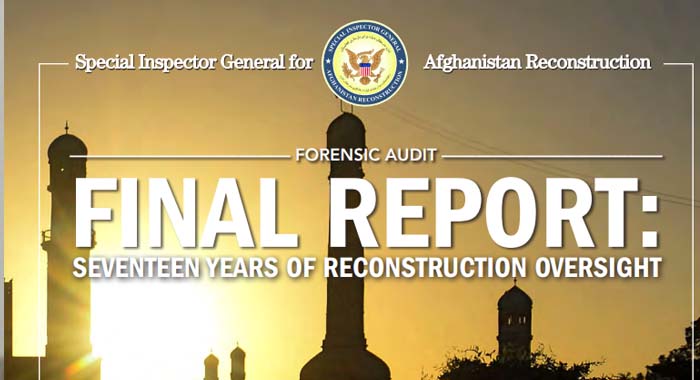
The United States’ two-decade-long investment in Afghanistan, totaling more than $148 billion, has largely failed to achieve its intended goals, according to the final report released Wednesday by the U.S. Special Inspector General for Afghanistan Reconstruction (SIGAR). The watchdog agency warned that widespread corruption, mismanagement, and weak oversight systematically undermined American efforts to build stability, democracy, and effective governance in the war-torn nation.
The report details how much of the military equipment, infrastructure, and facilities funded by the United States eventually fell into the hands of the Taliban after the militant group regained control in 2021. Approximately 60 percent of U.S. spending was directed toward security programs, including aircraft, armored vehicles, weapons, training, and logistical support for Afghan forces. Despite this massive investment, SIGAR concludes that the Afghan security apparatus collapsed under persistent internal dysfunction and corruption.
Beyond the security sector, billions of dollars were allocated to infrastructure projects, energy initiatives, hotel construction, and humanitarian aid. Yet, many of these projects were left unfinished, mismanaged, or rendered useless, demonstrating systemic weaknesses in governance and oversight. SIGAR emphasizes that rampant corruption, nepotism, and an inability to implement basic standards of accountability contributed heavily to the failure of these initiatives.
The report paints a bleak picture of Afghanistan as a country where billions of dollars in aid and reconstruction funds were squandered, and where institutional decay made sustainable development and governance nearly impossible. SIGAR stresses that unrealistic expectations, poor planning, and endemic corruption meant that even well-intentioned programs were doomed from the start.
In its final assessment, SIGAR underscores that Afghanistan’s collapse should serve as a stark warning for the United States and other nations engaged in reconstruction missions. Policymakers are urged to confront the failures transparently, learn from mistakes, and avoid repeating strategies that proved ineffective over two decades of war and nation-building efforts.
“This final report confirms what many observers feared: despite massive investment, Afghanistan’s governance structures and institutions were unable to sustain even minimal stability,” the report states. “Future reconstruction efforts must carefully evaluate partner nations’ capacity for accountability, transparency, and effective governance before committing significant resources.”
The SIGAR findings highlight the challenges of international intervention in a country beset by corruption, entrenched power networks, and persistent insecurity. Afghanistan’s inability to utilize the extensive support provided by the international community reinforces the narrative of the country as fragile, mismanaged, and ill-prepared for self-sustained development.
As the United States and global partners review the lessons of Afghanistan, the report serves as a grim reminder of the limits of foreign aid and the consequences of overlooking corruption and institutional weakness in fragile states.



