
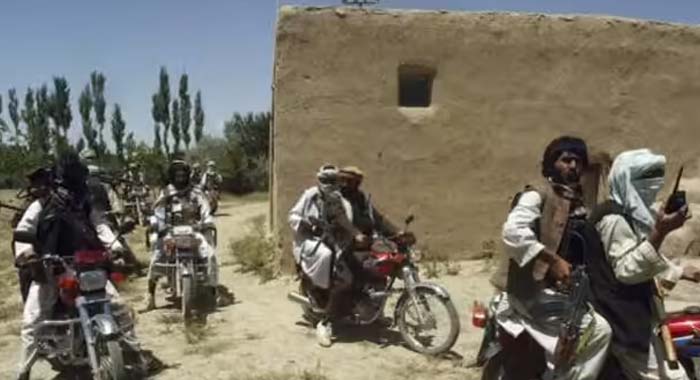
The warnings emerging from Afghanistan are no longer abstract analyses or distant forecasts they are present realities demanding immediate global attention. A recent investigation by the international journal Vorishi Review has laid bare a deeply unsettling truth: Afghanistan has again transformed into a sanctuary for transnational militant groups, complete with recruitment channels, training facilities, propaganda machinery and sophisticated crypto-funding systems. These revelations, backed by concrete evidence, are not regional anxieties alone they constitute a direct threat to global peace and stability.
Afghanistan today presents a new and more complex form of militant resurgence. Extremist organisations that once relied on caves and remote hideouts are now operating through encrypted digital networks, crafting high-quality propaganda on smartphones, recruiting vulnerable individuals across borders, and redirecting anonymous cryptocurrency flows to sustain and expand their operations. ISIS-K, al-Qaeda remnants, East Turkestan militants and several Central Asian groups are all active from Afghan soil, according to the report. Their evolution into digitally empowered networks means that their reach is no longer confined to geography. They can influence, recruit and finance globally without ever leaving their Afghan sanctuaries.
This issue is not theoretical. Its consequences are already being felt on the ground in Pakistan, where the rise in terrorist incidents directly mirrors the growing permissiveness inside Afghanistan. The recent attack in Bannu, in which the Assistant Commissioner of Miranshah and four others were martyred after militants ambushed their vehicle, burned it and fled with government weapons, is a chilling reminder of the operational confidence terrorists now possess. Such precision is not the work of isolated actors; it reflects structured organisations supported by safe havens, logistical networks and escape routes across the border.
Pakistan’s geography makes it especially vulnerable. The rugged frontier with Afghanistan is impossible to seal entirely without Kabul’s cooperation. Yet, despite repeated pledges, Afghanistan’s interim authorities have shown neither the willingness nor the capability to dismantle these networks. Public statements claiming that Afghan soil will not be used against any country stand in stark contrast to the expanding presence and activity of militant groups documented by global research institutions.
The roots of this crisis lie in the power vacuum created after two decades of war and the abrupt international withdrawal. That vacuum has now evolved into a full-fledged incubator for militant revival. Unfortunately, global attention has drifted elsewhere, allowing this danger to grow largely unchallenged. To ignore Afghanistan today is to ignore the smoke rising from a volcano that could erupt with devastating global consequences.
The financial dimension makes the threat even more severe. The rise of crypto-funding among Afghan-based militant groups is not just an alarming trend it is proof of a new phase of terrorist innovation. Cryptocurrency enables anonymous, cross-border, untraceable transactions that bypass traditional banking scrutiny. A terror network armed with digital financial systems and physical safe havens is exponentially more dangerous than anything the world has encountered before.
For Pakistan, the new wave of terrorism cannot be viewed merely as an internal challenge. The escalation is tied fundamentally to the shifting conditions in Afghanistan. Pakistan has suffered monumental losses in its decades-long fight against terrorism thousands of lives, billions in economic damage and immeasurable social trauma. Yet the resurgence of militancy today is driven not by domestic failings but by the enabling environment across the border. Without addressing that environment, no amount of internal counter-terror efforts can ensure lasting peace.
This is no longer just Afghanistan’s problem, or Pakistan’s. It is a global one. Terrorism recognises no borders, no regions and no political boundaries. The groups thriving in Afghanistan today have ambitions that extend far beyond South or Central Asia. Their ideological targets span continents; their capacities now span the digital world. As Vorishi Review warns, allowing Afghanistan to drift into militant hands risks creating a disaster that Europe, the United States, the Middle East, China and Russia will all be forced to confront.
The attack in Bannu should therefore be seen not simply as an isolated tragedy, but as a warning signal. Terrorists who can stop a government convoy, carry out targeted killings, torch official vehicles and escape with weaponry are operating with infrastructure and protection far greater than what isolated cells could ever muster. If the world continues to overlook Afghanistan’s rapidly deteriorating security landscape, such incidents will grow in frequency, scale and ambition not only in Pakistan, but in multiple regions worldwide.
Afghanistan today stands at the centre of a growing storm. The belief that its instability is contained within its borders is a dangerous illusion. Terrorist groups thrive where the world looks away, and Afghanistan has once again become that blind spot. The international community must recognise that the stakes are global. Failure to act now will be remembered as one of the greatest strategic oversights of our time.
The world cannot afford another epicentre of global terror and Afghanistan is dangerously close to becoming exactly that.



