
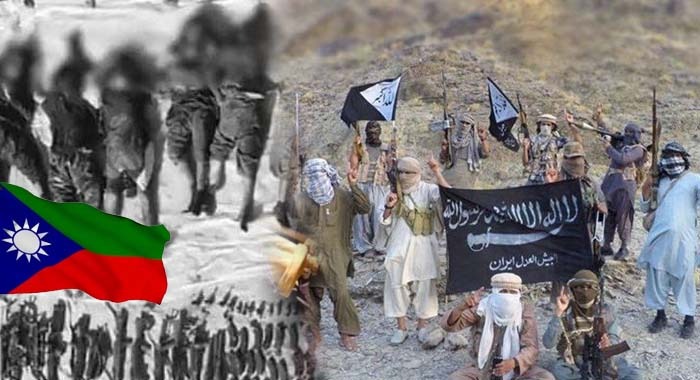
The collapse of the banned Balochistan Liberation Army (BLA) as an effective terror network has triggered a desperate regional response. India and Israel, long accused of sponsoring BLA’s violence, have reportedly folded two additional terrorist outfits, Jaish al Adl and Ansar al Furqan, into the group in an attempt to salvage its fading operations. The move comes after sustained reversals inflicted by Pakistan’s security forces across multiple fronts.
According to sources, the merger includes a coordinated operational arrangement. Jaish al Adl will assist BLA in carrying out attacks inside Pakistan, while BLA will provide weapons, ammunition, and logistical support for Jaish al Adl’s activities inside Iran. The groups have also unveiled a joint flag, signalling an attempt to project unity after months of internal fragmentation and battlefield losses.
Iran, aware of the increasing militant cross movement in its southeastern region, is preparing to deploy a rapid reaction brigade capable of engaging up to four thousand fighters. The mobilisation reflects regional concern that the newly consolidated network may attempt operations across both sides of the border.
The desperate alliance comes at a time when the true nature of these groups has become visible to the people of Pakistan and Balochistan. The exposure of BLA’s internal brutality, foreign funding, exploitation of women and children, and coercion of tribal communities has shattered any remaining illusion of political legitimacy. Communities once portrayed as sympathetic have rejected militant sanctuaries. Tribes across Awaran, Kech, Chagai, Panjgur, Bugti and Lango territories have confronted these outfits openly and refused to act as human shields for foreign agendas.
This rejection has been reinforced by the realisation that India, Israel, and now segments of the Afghan Taliban have facilitated anti Pakistan violence. Their involvement has created a nationwide environment where there is no space left for these networks to breathe. Collective awareness has grown, and so has collective resolve.
Pakistan’s security forces, backed by steadfast public support, have made it clear that the fight will continue until terrorism is eliminated from the country. The state, its institutions, and its citizens are aligned in purpose. The BLA’s collapse is not symbolic. It is operational, ideological, and structural. No regional merger can reverse it.
Even if militant factions from across the world attempt to reinforce the banned BLA, none can rescue it from the fate that Pakistan’s security forces and the unity of its people have already sealed. The nation stands as a solid wall. The outcome for any group that chooses to wage war against Pakistan will mirror the fate of the BLA. The path ahead for these networks is not expansion. It is decimation.



