
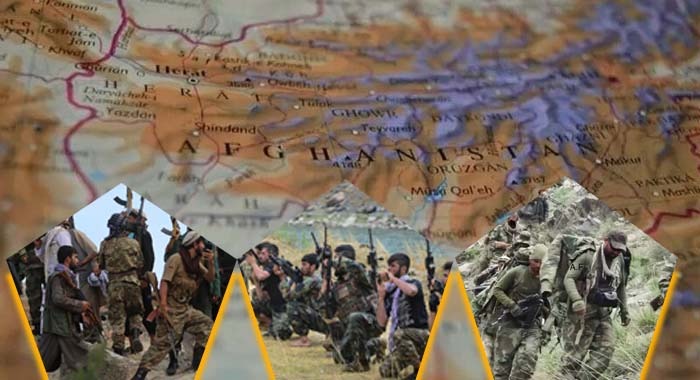
Four years after the Taliban swept back into Kabul, Afghanistan is once again becoming what the world once vowed it would never allow: a vast, largely unpoliced sanctuary for international terrorist groups. The evidence is no longer anecdotal, fragmentary, or politically convenient; it is overwhelming. What was once a problem confined largely to Pakistan is now radiating across borders, affecting Central Asia, the Middle East, and even Western capitals.
Recent events underscore the severity of the threat. On November 27, a drone attack on Chinese engineers working in Tajikistan was traced back to Afghan soil a stark reminder that the jihadist ecosystem incubating in Afghanistan has grown confident enough to strike foreign nationals in foreign countries. Just a day earlier, two National Guard soldiers were killed in Washington, D.C, by an Afghan immigrant. The perpetrator, Rahmaullah Lakawani, was later revealed to have connections with extremist networks operating inside Afghanistan. While the connections may be indirect, the trend is unmistakable: the geography of terror is expanding.
Repeated warnings have long signaled this looming danger. The United Nations Monitoring Team’s quarterly reports have consistently detailed the resurgence of militant groups once thought dismantled. SIGAR, the U.S. oversight body for Afghanistan reconstruction, has arrived at similar conclusions: Afghanistan today hosts a dense archipelago of terrorist outfits, many foreign, many growing, many operating with a freedom they do not enjoy anywhere else.
At the United Nations Security Council last week, Denmark’s deputy permanent representative Sandra Jensen Landi issued a blunt assessment. The Tehrik-i-Taliban Pakistan (TTP), she warned, poses a “serious threat” to Central and South Asia. Her estimates place some 6,000 TTP fighters inside Afghanistan, benefiting from the logistical and substantive support of the Taliban’s de facto authorities. Her warning, however, did not end with TTP. ISIL-Khorasan (ISKP), Al-Qaeda, Eastern Turkistan militants, and Central Asian jihadist groups remain active, expanding propaganda networks, boosting recruitment pipelines, and even experimenting with cryptocurrency-based financing. This is not a trickle of isolated cells; it is a complex, adaptive ecosystem and it is growing.
Russia, perhaps more exposed than most neighboring powers, has sounded the alarm with unusual urgency. Sergei Shoigu, the secretary of Russia’s Security Council, declared Afghan-based extremist networks a “serious concern” for bordering states. Moscow’s envoy to the U.N., Vassily Nebenzia, warned that ISKP is not only expanding its influence but actively “fueling tensions” in the region, aided by foreign financing and empowered by weapons abandoned during the Western withdrawal.
The numbers are staggering. Nearly 13,000 foreign fighters are now estimated to be inside Afghanistan: more than 6,000 from the TTP, 3,000 aligned with ISKP, hundreds associated with Al-Qaeda and AQIS, and hundreds more from groups rooted in Tajikistan, Uzbekistan, China, and the Middle East. Fighters from Iraq and Syria, including former ISIS operatives, are relocating to Afghanistan and, in some cases, transiting onward into Central Asia through routes such as Kunduz. AQIS has formally aligned itself with TTP, while Al-Qaeda in the Arabian Peninsula (AQAP) reportedly uses Afghanistan as a staging ground for recruitment and operations.
For decades, global jihadist movements have been battered by international pressure. Afghanistan, however, has emerged as a refuge, a recruiting ground, and a launchpad simultaneously. It is not merely the convergence of local and global militants that is alarming; it is the speed with which the environment has become permissive, allowing these groups to operate with impunity.
The Taliban regime, ideologically sympathetic to many of these factions, has demonstrated little ability and even less will to control them. Tens of thousands of unemployed Taliban fighters have joined outfits like the TTP, while extreme poverty drives young Afghans into the hands of recruiters operating without fear of enforcement. Even if the Kabul leadership wanted to clamp down, it is unclear whether it possesses the cohesion necessary to enforce discipline across the country. The result is a structural collapse rather than a simple security lapse.
What we are witnessing is more than the resurgence of old threats. Terrorist groups with local aims, such as the TTP, coexist alongside global actors like ISKP and Al-Qaeda. Their strategic goals may diverge, but their operations reinforce one another. The recent attack in Tajikistan is not an anomaly; it is a preview of the region-wide threat emanating from Afghanistan.
The regional stakes are immense. Pakistan has borne the brunt of Afghan-based militancy for years, suffering attacks and infiltration by the TTP and other groups. Central Asian states, from Tajikistan to Uzbekistan, face increasing risks as foreign fighters transit through or recruit locally. China is concerned about Eastern Turkistan militants using Afghan territory to plan attacks. Iran, Russia, and other neighbors are alarmed at the potential for destabilization along their borders. And the Western world cannot ignore these threats, as drones, digital propaganda, and transnational cells render geographic distance irrelevant.
A coordinated regional strategy is no longer optional; it is imperative. Pakistan, China, Iran, Russia, Central Asia, and Western powers must collaborate to implement intelligence-sharing, border security, and counter-radicalization measures. Without such cooperation, Afghanistan risks becoming a country-sized haven for terrorism a staging ground for attacks across continents.
The historical lessons are clear. In the 1990s, an ungoverned Afghanistan incubated Al-Qaeda, producing the network that would carry out the September 11 attacks and destabilize the region for decades. The world swore never again. That promise is now being broken. Failure to act decisively could have consequences far greater than previously experienced.
Ultimately, the challenge is as much ideological as it is military. Militants in Afghanistan are exploiting governance vacuums, economic despair, and the absence of accountability to rebuild networks that threaten global security. Neutralizing these groups will require more than strikes or military operations; it will demand long-term engagement, regional coordination, and robust strategies addressing recruitment, financing, and propaganda.
The stakes are uncomfortably high. Afghanistan is no longer a local problem or even a regional problem; it is increasingly a global problem. And if the world continues to treat it as the former, the consequences will inevitably extend far beyond South Asia.
The world made a promise: Afghanistan would never again be allowed to serve as a sanctuary for global terrorism. That promise is being broken. The time to act is now, or the cost of inaction may be immeasurable.



