
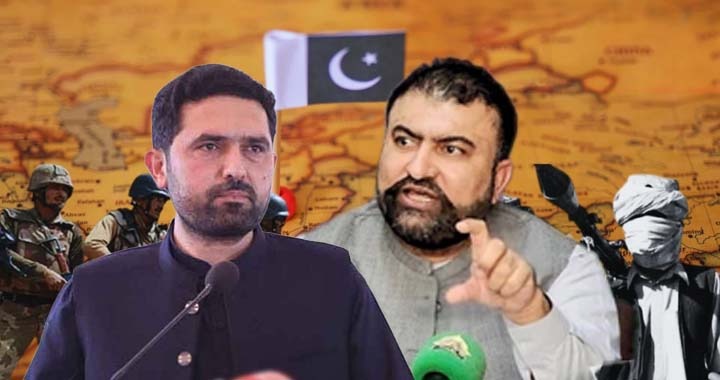
Director General Inter Services Public Relations Lt Gen Ahmed Sharif Chaudhry has warned that Pakistan’s counterterror gains cannot be sustained unless the National Action Plan is implemented uniformly across all provinces. He said Balochistan has established a structured and functional NAP mechanism, while Khyber Pakhtunkhwa has yet to develop a similar system, creating operational gaps that militant networks are exploiting.
During a comprehensive security briefing to senior journalists on November 25, the DG ISPR said Pakistan is confronting an externally enabled terrorism wave originating from Afghanistan. He accused the Afghan Taliban regime of allowing its soil to be used for terrorist infiltration into Pakistan with full facilitation from authorities in Kabul.
He said concerns over Afghanistan are now global and not limited to Pakistan. Citing the recent attack on Chinese engineers in Tajikistan, carried out from Afghan territory, he said Beijing has formally demanded accountability while the Taliban expressed regret but took no disciplinary action. This, he said, reflects the weakness of Taliban rule and the existence of unregulated militant networks across Afghanistan.
The DG ISPR said Pakistan has provided actionable evidence to the Taliban showing that al-Qaeda, Daesh and several other organisations continue to operate openly from Afghan soil. He said these groups acquire weaponry and funding inside Afghanistan and then conduct attacks against Pakistan. He said Islamabad has asked for a verifiable, third party monitored mechanism, consistent with the Taliban’s Doha commitments, but Kabul has not responded.
Rejecting the Taliban’s claim that militants of “Fitna al-Khawarij” are Pakistani migrants now living as “guests” in Afghanistan, he said the argument is illogical. Armed militants attacking Pakistan cannot be treated as guests, he said, and if they are Pakistanis, they should be handed over for trial.
Quoting SIGAR findings, he said the United States left behind military equipment worth 7.2 billion dollars, adding to Afghanistan’s destabilising potential. He said Afghanistan has failed to establish a functional state and continues to shelter non state actors who threaten the region.
Commenting on Pakistan’s border management challenges, Lt Gen Chaudhry said the 1,229 kilometre frontier in KP includes some of the world’s most difficult terrain. The twenty crossing points and vast distances between military posts complicate surveillance. Fencing, he added, is only effective when supported by observation and firepower.
He said the scale of counterterror operations this year illustrates the gravity of the threat. Security forces conducted 12,857 intelligence based operations in KP and 53,309 in Balochistan. A total of 1,873 terrorists were killed, including 136 Afghan nationals.
Turning to the National Action Plan, the DG ISPR said Balochistan has developed a coordinated implementation architecture that operates through steering, monitoring and implementation committees at provincial, divisional and district levels. In contrast, KP lacks an equivalent structure, which affects the consistency of operations against terror networks.
He said the crackdown on Iranian diesel smuggling, which had become a major financial engine for militant groups, has already reduced smuggling volumes from 20.5 million litres per day to 2.7 million litres. This has cut off a critical source of terror financing.
He added that 86 percent of Balochistan’s territory, spanning 27 districts, has been brought under police jurisdiction. Continued community engagement, he said, is producing steady improvements that strengthen civilian law enforcement.
The DG ISPR said Pakistan is also facing a parallel challenge in the information domain, as foreign based social media accounts run real time propaganda to destabilise the country.
He concluded that defeating terrorism is entirely achievable, but only if federal and provincial governments operate under a single, unified and fully integrated NAP mechanism. Seamless coordination between intelligence and security agencies, he said, is essential for long term stability.



