
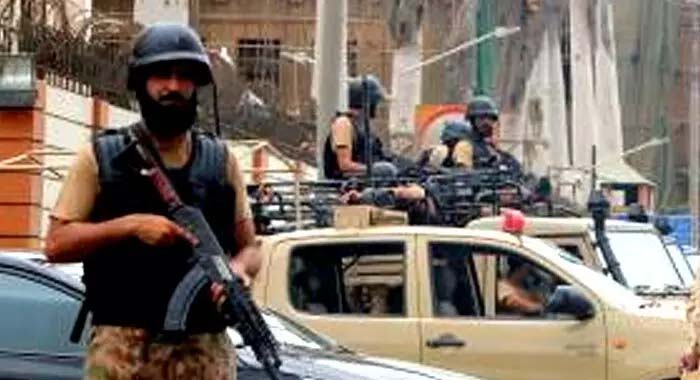
The attempted terrorist attack on the Frontier Constabulary Headquarters in Peshawar, carried out by three militants on a single motorcycle, is a stark reminder that Pakistan continues to face a severe and escalating security threat. The assault, which claimed the lives of three personnel and left eleven others injured, was repelled only because of the extraordinary bravery of security forces, who killed all three attackers before they could inflict greater damage. But this incident is much more than a foiled attack it is an alarm bell for the entire nation.
According to CTD investigators, the heavily armed militants arrived together on one motorcycle, carrying Kalashnikov rifles and more than eight hand grenades. The motorcycle used in the attack has been seized, and the bodies of the attackers have been sent for DNA testing to determine their identities, networks and potential facilitators. The goal is not limited to understanding who carried out this attack, but to uncover the entire chain that supports, shelters and enables terrorism within the country.
What makes this assault particularly concerning is how easily three armed militants managed to reach the vicinity of a sensitive installation without checks or obstacles. While the rapid response of security forces prevented a far greater catastrophe, the breach raises critical questions about surveillance, monitoring and preparedness. The presence of grenades, automatic weapons and a coordinated plan indicates that this was not an isolated or impulsive attack it was meticulously organised.
The broader context of this attack cannot be ignored. Pakistan’s new wave of terrorism is increasingly linked to the situation across the border in Afghanistan. For years, Afghan soil has provided safe havens to anti-Pakistan groups, particularly the Tehreek-e-Taliban Pakistan (TTP). The interim Afghan government had pledged to the international community that its territory would not be used against any country, yet the pattern of attacks, the influx of militants and the variety of modern weapons used all point to a grim reality: Pakistan is facing a well-organised, well-supported and ideologically motivated network operating with cross-border facilitation.
India’s role in this equation has also been widely discussed. Its longstanding strategy of undermining Pakistan through proxies, influence networks and intelligence footprints in Afghanistan is no secret. Over the years, under the guise of investment and development assistance, India established structures that served dual purposes one of them being the support of anti-Pakistan elements. Even today, these networks continue to function in various forms, exploiting Afghanistan as a launching pad for destabilisation efforts. This is not only a threat to Pakistan’s security but a grave challenge to regional stability.
Pakistan, in contrast, has consistently shown goodwill toward Afghanistan hosting millions of refugees, supporting peace negotiations and extending every possible gesture of neighbourliness. Yet the response from the Afghan interim government has been marked by increasing hostility, negligence and silence in the face of rising TTP activity. This growing mistrust is damaging not only bilateral relations but the prospects of peace for the entire region. Afghanistan must realise that allowing its territory to be used for proxy warfare will ultimately undermine its own long-term stability.
Another critical dimension of Pakistan’s internal security struggle lies in the presence of facilitators within the country. These individuals sometimes hiding behind religion, politics or social respectability—act as the oxygen supply for terrorism. Without internal support, logistical guidance and ideological grooming, terrorist outfits cannot sustain themselves. The state must treat facilitators with the same seriousness as gun-wielding militants. One attacks from the front; the other from the shadows. Both are equally dangerous.
This moment also demands a frank assessment of security lapses. Sensitive installations, government buildings and vital public places require stronger surveillance systems, biometric verification, modern monitoring technology, and a more coordinated intelligence grid. The threat is evolving; the response must evolve even faster.
Yet technology and tactics alone cannot defeat terrorism. This is a national war, not the responsibility of the security forces alone. When political parties are divided, when society is polarised, and when national unity is fractured, terrorists find space to operate. National security is not a partisan issue. On matters of terrorism, Pakistan needs one voice, one strategy, and zero tolerance for internal discord.
The investigation into the Peshawar attack must go far beyond the immediate incident. Key questions must be answered: Where did these militants come from? Who provided them with safe passage? Who armed them? Who indoctrinated them? Who facilitated their movement within the city? Until every layer of this network is dismantled, peace will remain fragile.
Afghanistan must also introspect. It must fulfil the commitments it made to the world. It must prevent its soil from being used by anti-Pakistan groups. Continued negligence will only fuel greater tensions—tensions that will ultimately harm Afghanistan as much as Pakistan. Terrorists are loyal to no state, no society and no principle. Left unchecked, they devour the very lands that host them.
This war is far from over. But Pakistan has demonstrated, time and again, that it has the resolve to prevail. This is a country built on sacrifice, defended by immense courage, and strengthened by resilience. The lives lost in Peshawar are a painful reminder of the cost of security but also a testament to the bravery of those who stand guard over the nation.
Pakistan will overcome this challenge but only if the state, its institutions and its people move forward with unity, clarity and determination. The message must be unambiguous: there will be zero tolerance for terrorism, zero tolerance for its facilitators, and zero tolerance for any state or non-state actor that supports violence against Pakistan.
The attack on the FC Headquarters was not just an assault on a building. It was an attack on the nation. And the nation must respond with the resolve it has shown throughout its history firm, united and unwavering.



