
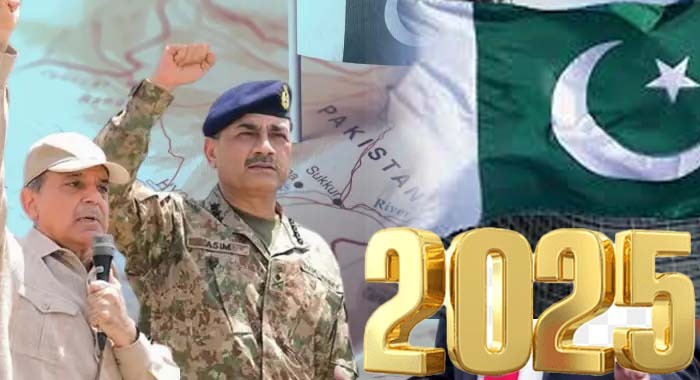
The year 2025 proved to be a highly significant and turbulent period for Pakistan, marked by serious security challenges, political upheaval and major regional developments. Observers say early indicators suggest that 2026 may follow a similar trajectory.
During the year, Pakistan faced grave internal security threats and political instability, particularly in Khyber Pakhtunkhwa and Balochistan, while at the same time witnessing a sharp rise in its regional and global strategic relevance following the brief Pakistan-India conflict in May.
According to official statements, nearly 7,000 terrorist incidents were reported in Khyber Pakhtunkhwa and Balochistan during 2025. Foreign Minister Ishaq Dar said that around 4,000 security personnel and civilians were killed in these attacks. In response, security forces carried out more than 100,000 intelligence-based operations, according to DG ISPR Lt Gen Ahmed Sharif Chaudhry.
Despite the high number of attacks, security officials said militant groups were prevented from capturing territory or establishing strongholds, unlike in previous years. They added that most militant activity relied on cross-border movement and hit-and-run attacks, largely operating from Afghan territory.
A security assessment report said that during the year, 1,059 militants were killed, 250 injured and 410 arrested. About 65 per cent of terrorist incidents and counterterrorism operations were reported in Khyber Pakhtunkhwa, with actions conducted in 21 districts, including major operations in Bajaur and Mohmand.
Reports by the United Nations, SIGAR, the European Union and the United States stated that more than 25 militant groups were operating from Afghan soil in 2025, with over 16 involved in attacks against Pakistan. These included the banned Tehreek-e-Taliban Pakistan (TTP), Islamic State Khorasan, Jamaat-ul-Ahrar and the Balochistan Liberation Army (BLA).
On the issue of cross-border terrorism, Pakistan reportedly carried out around 10 air strikes inside Afghanistan during the year, targeting locations in Khost, Paktika, Nangarhar, Paktia, Kabul and Kandahar. These actions sharply worsened bilateral relations, prompting mediation efforts by Qatar, Turkey, Saudi Arabia, China and Russia. However, no major breakthrough was reported by December 31.
Following the May 9 conflict, Pakistan launched a counteroffensive on May 10, after which several countries, including the United States, acknowledged Pakistan’s military and air power capabilities. Subsequently, Pakistan signed multiple defence-related agreements with various countries.
In this context, Army Chief General Asim Munir was first elevated to the rank of Field Marshal and later appointed Chief of Defence Forces.
Alongside diplomatic and defence developments, the government and military establishment also focused on internal political consolidation. During 2025, strong measures were taken against Pakistan Tehreek-e-Insaf (PTI), Baloch insurgent groups, PTM and Tehreek-e-Labbaik Pakistan (TLP), significantly weakening or effectively sidelining them.
In December, former prime minister Imran Khan and his wife were each sentenced to 17 years in prison in a case, while TLP and PTM were banned. In the same month, former ISI chief and ex-corps commander Lt Gen (retd) Faiz Hameed was sentenced to 14 years of rigorous imprisonment by a military court over various charges.
Analysts say these developments further strengthened Field Marshal Asim Munir’s grip on power, with both domestic and Western media outlets describing him as one of the most powerful figures in Pakistan’s history.
Observers believe that, given the trajectory of 2025, state authority and security-driven governance are likely to further intensify in 2026.



