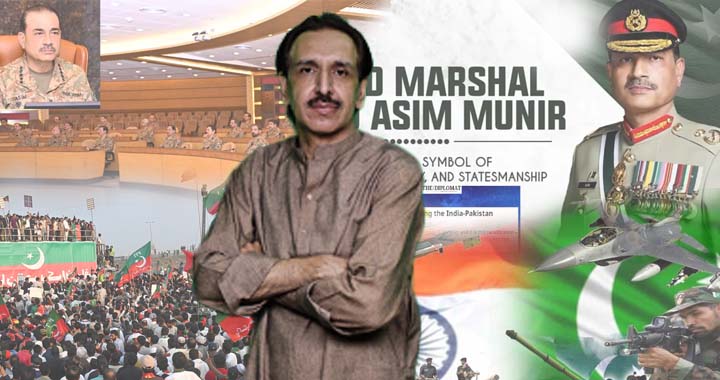
The Diplomat, in one of its recent reports, mentioned that the year 2025 has proved to be a turning point for Pakistan, the year in which Pakistan once again emerged as an important, strong, and reliable country at the international level.
Now the question arises, why did Pakistan become the centre of international attention? We have been saying this for a long time that during 2025, especially after May 2025, Pakistan’s international and regional importance increased significantly. There is no comparable example in Pakistan’s history. Perhaps the new state level relationships with the Middle East and other countries are also the result of Pakistan’s emergence as a key regional power.
For example, the UAE is a very large and influential country. Within the Islamic bloc and at the international level, its relationship with the United States gives it added strategic weight. The same applies to Qatar and Saudi Arabia. These three countries are now relying on Pakistan’s defence capabilities and strategic planning, while they themselves face complex challenges. Pakistan has taken a leading role in Middle Eastern issues and disputes.
In this context, it is notable that since the 1970s there has been no serious debate of this nature in Pakistan. After the 1970s, for the first time, Libya has turned to Pakistan, and this is not routine business. By accepting Pakistan’s defence capabilities, Libya has entered into a four billion dollar agreement, which is currently under process. Field Marshal Asim Munir himself has been involved in this engagement.
Similarly, Pakistan’s influence has increased considerably in countries around India, such as Nepal, the Philippines, Tibet, and especially Bangladesh. This is the same Bangladesh about which Indira Gandhi once said that the two nation theory had been drowned in the Arabian Sea. Now it is being said that Bangladesh is also moving towards a defence agreement with Pakistan, similar to Pakistan’s defence cooperation with Saudi Arabia. This was Bangladesh’s desire and initiative, to which Pakistan has responded positively by providing defence equipment. It is even being reported that four to five aircraft have been supplied.
Pakistan’s Value in the New Global Order
In this entire scenario, the most important point highlighted by The Diplomat is Pakistan’s value and importance in the eyes of the United States. Before this, the Financial Times, a highly influential British publication with deep focus on defence and security affairs, also acknowledged this shift. Earlier, the Washington Times published a similar assessment. All three reports share common ground, highlighting the leadership and personality of Field Marshal Asim Munir.
Another common point in these reports is Pakistan’s response to India on May 10, after which it became evident that India had effectively slipped into a third category. The Financial Times explicitly noted that in the context of US South Asia policy, developments after May 10 showed that America’s dependence on India is not only declining but effectively coming to an end.
A further shared conclusion in these reports is that Pakistan, something we have been stating for over a year, has for the first time maintained a balance in its relations with both China and the United States. The Financial Times and Washington Times also pointed out that Pakistan has successfully balanced its relations between Iran and Saudi Arabia. This confirms that Pakistan’s foreign policy is moving in a positive and mature direction.
In this context, even former US President Donald Trump has repeatedly stated that India has fallen, repeating this again just two days ago. While we say that Pakistan downed seven aircraft, Trump claims Pakistan downed eight. He has also openly described Field Marshal Asim Munir as his favourite.
All this suggests that Pakistan is now in a leading position. People already knew Pakistan was a strong and well organised country, and that its military leadership is bold and decisive. However, people like us, who are often accused of being state centric, struggled to convince others of this reality.
Now a narrative has emerged in Indian media claiming that Pakistan has taken over Bangladesh. At one point, Indian media openly discussed breaking Pakistan through proxies, launching operations like Sindoor 2, and using Afghanistan. Today, the same media claims that Pakistan is taking revenge in Bangladesh for what India previously did in Afghanistan through proxies.
At the same time, China has also become active again. Indian mainstream and serious media now argue that due to Pakistan’s diplomatic gains and lobbying, India has been strategically surrounded by China, the Philippines, Sri Lanka, and Bangladesh. Perhaps even Pakistan’s leadership did not anticipate that the country would gain such significant international value.
There are two or three fundamental traits by which leadership is tested. The first is decision making. Launching such a large scale counter strike against India was a major risk, especially given that in purely numerical terms, Pakistan could not afford a prolonged conflict. In the past, any other general might have appealed to the United States for intervention, as was done after Kargil when the prime minister was sent abroad.
Field Marshal Asim Munir, however, refused to bow. He held his ground, defied conventional calculations, trusted his professional judgment, his leadership, and his army, and delivered results.
The second test is how a leader manages internal crises. As the head of the army in a security state, he had to deal with PTI, Tehreek e Labaik, PTM, TTP, and other destabilising elements. His policy of firm control during times of crisis is commendable.
The third test lies in international relations. Countries that were displeased with Pakistan during Imran Khan’s era, including China, Qatar, Saudi Arabia, and even the United States, were re engaged. In rebuilding these ties, Asim Munir’s personality played a more decisive role than political leadership. In doing so, he fulfilled all three core requirements of effective leadership. His faith is strong, his confidence is evident, and unlike previous generals such as Bajwa, Field Marshal Asim Munir remains a professional. He speaks directly and makes firm decisions.
Yesterday’s corps commanders conference was particularly significant. Such conferences include not only corps commanders but also ISI and MI chiefs and operational commanders. My reading is that two clear messages were delivered, effectively warnings rather than statements.
First, on internal security and political non conformity, it was made clear that no element would be allowed to create a divide between the nation and the army or between the state and the people. Any attempt to erode trust will be dealt with forcefully. This implicitly refers to PTI. For the first time, the conference also addressed propaganda and media warfare, declaring zero tolerance for such activities.
Second, terrorism was placed high on the agenda. Terrorist groups operating in Pakistan will be dealt with harshly, and even harsher measures will follow.
Third, Pakistan’s international role was outlined, clarifying how the country must position itself globally.
In summary, two conclusions are clear. Terrorist groups in Pakistan will face uncompromising action. Secondly, illusions of negotiations with PTI, promoted by analysts and opposition figures, have been decisively put to rest. There will be no talks, no agreements. The establishment has made this clear between the lines.
Another important signal was the praise for the Balochistan government’s counter terrorism efforts and development policies, indirectly highlighting the lack of trust in the Khyber Pakhtunkhwa government.
I can assure you that the comments aired nightly on mainstream media are not taken seriously by the establishment. PTI or any political party is not viewed as a threat when global publications like The Economist, Washington Times, Financial Times, and New York Times acknowledge Pakistan’s leading position. The establishment will not waste its strategic investment on a single prisoner.
There will be no negotiations. Imran Khan will face trial in connection with Faiz Hameed and related cases. His upcoming trial over the May 9 riots will not be limited to him alone but will also include senior PTI leadership. Over time, PTI and Imran Khan’s political relevance will continue to weaken.