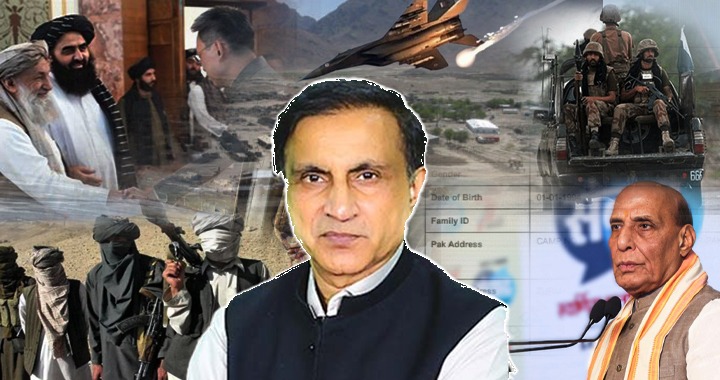
The attack in Domel, Bannu, marks a disturbing continuation of terrorism and its support by the Afghan Taliban despite an overall decline in large-scale incidents. The target was a police station, but due to effective security measures, including barriers and defensive arrangements, the attackers failed to strike their intended objective. The blast instead affected nearby civilian homes, resulting in the martyrdom of innocent people, including women and a child, while several others remain critically injured.
This incident highlights a shift in tactics. When security forces are hardened targets, terrorists turn towards civilians. It reflects both their operational failure and their willingness to inflict maximum harm on unprotected populations.
Although there has been a reported reduction of around 65 percent in terrorist incidents, such attacks demonstrate that the threat persists. The decline is real, but it is not decisive. Networks remain active, and their capacity to strike has not been eliminated.
At the same time, international reporting has pointed towards the continued presence of safe havens in Afghanistan for groups such as the banned Tehreek-e-Taliban Pakistan. This reinforces Pakistan’s consistent position that these groups are not operating in isolation but are being facilitated and allowed space across the border.
Pakistan’s response has been firm and consistent. Operations under Operation Ghazab Lil Haqq continue with the objective of dismantling terrorist infrastructure, preventing infiltration, and protecting civilian lives. There is no indication of any pause in this campaign.
Despite this, Pakistan has kept diplomatic channels open, though with clear caution shaped by past experience. Multiple rounds of talks in Doha, Istanbul, Riyadh, and Kabul did not produce lasting outcomes, largely due to a lack of implementation and verifiable commitments.
Currently, engagement is taking place in Ürümqi, with China acting as a facilitator. Both sides are present, but Pakistan has deliberately avoided direct, high-level negotiations. This reflects a calculated approach, based on previous failures.
Pakistan has set clear conditions for any meaningful progress. There must be a public and unequivocal disassociation from the banned TTP. Afghan territory must not be used for planning or launching attacks against Pakistan. Most importantly, these commitments must be verifiable. Statements without action are no longer acceptable.
This position extends directly to international stakeholders.
Pakistan has made it clear that continued support from the United States and Qatar must be conditional. If financial and political backing continues without requiring concrete action against terrorist groups, it risks enabling the very networks responsible for violence. Pakistan’s stance is explicit: such support must either be tied to verifiable counterterror measures or reconsidered altogether.
Developments on the ground further validate these concerns.
In North Waziristan, a recent infiltration attempt was foiled and eight terrorists were eliminated. Identification confirmed that two of them were Afghan nationals. This is not an isolated case but part of a broader and consistent pattern of cross-border involvement.
Similarly, attacks on security posts in Bajaur and Kurram indicate that these groups remain active and coordinated. Whenever there is a perceived opportunity, they attempt to exploit it through both cross-border incursions and internal attacks.
Their strategy is evident. One front remains active along the border, while another operates inside Pakistan. This dual approach is designed to maintain pressure and create instability.
The issue is not limited to physical presence alone. There is credible evidence of safe houses and operational networks inside Afghanistan. In many cases, these are embedded within civilian areas, complicating counterterror responses and increasing risks.
The ideological dimension further complicates the situation. Within the Afghan Taliban, there are differing views. One group supports distancing from such elements in order to stabilize relations with Pakistan. Another continues to justify their presence based on past alliances and shared conflict history.
This internal division results in inconsistent actions and unclear policy direction.
At the same time, the broader regional picture cannot be ignored.
Pakistan is not dealing with a single-source threat. There is persistent hostility from India, which continues to pursue destabilizing approaches against Pakistan. Alongside this, there are serious concerns regarding Israeli involvement in the wider regional context, particularly in intelligence and technological domains.
These elements contribute to a larger environment of instability, with Afghanistan acting as a permissive space. This makes the challenge multi-layered and externally influenced.
Despite these pressures, Pakistan has maintained strategic balance. Counterterrorism operations continue, while diplomatic engagement remains open, though conditional.
China’s involvement reflects its interest in regional stability and economic connectivity. However, economic incentives alone cannot address security challenges.
Pakistan has made it clear that trade and cooperation cannot come at the cost of national security. Even limited border openings have been disrupted by hostile actions, raising serious concerns about intent and control.
The broader geopolitical environment adds further complexity. Tensions involving Iran, the United States, and Israel create an uncertain regional backdrop. In such conditions, internal stability becomes even more critical for Pakistan.
Pakistan’s policy remains firm.
Operations under Operation Ghazab Lil Haqq will continue without interruption. There will be no ceasefire that allows terrorist groups to regroup. Engagement will remain conditional, structured, and based on verifiable outcomes.
At the same time, Pakistan continues to emphasize that a stable Afghanistan is in its own interest. Economic cooperation, trade, and regional connectivity remain possible, but only if the issue of terrorism is addressed in a meaningful and verifiable manner.
However, the internal situation in Afghanistan suggests that immediate change is unlikely. The absence of a representative political structure, economic fragility, reliance on external aid, and internal divisions indicate that the current trajectory may continue.
Until there is a fundamental shift in policy, approach, and governance, the situation is likely to remain the same.