
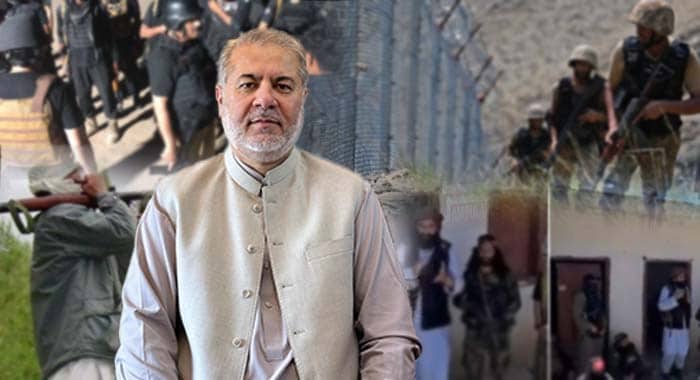
Recent developments along Pakistan’s western frontier show that the security challenge facing the country is no longer limited to conventional attacks. Terrorist organizations have adopted new methods, combining physical presence, propaganda, psychological warfare and exploitation of local vulnerabilities.
The recent video released by Tehreek-e-Taliban Pakistan (TTP) chief Noor Wali Mehsud, showing his presence and interactions in Kurram and Khyber districts, carries significance beyond the content itself. The purpose appears to be creating an impression among local populations that the organization still maintains influence and operational space inside Pakistan.
The manner in which the video was recorded also indicates an attempt to counter the perception that the TTP leadership operates only from outside Pakistan. By showing interactions with local people and asking about their villages and tribal identities, the group appears to be projecting a message of accessibility and presence.
This is not a new phenomenon. Pakistan’s tribal districts have historically remained a major battleground against terrorism. Through major military operations, including Zarb-e-Azb, these areas were cleared of organized terrorist networks. However, security gains require continuous support through governance, development, law enforcement capacity and public engagement.
Security Vacuum Creates Space for Terrorist Narratives
The merger of former tribal areas with Khyber Pakhtunkhwa was a major administrative decision, but the expected transformation in governance and development has remained incomplete. The people of these areas continue to face economic difficulties, limited opportunities and administrative challenges.
Such conditions create space that terrorist organizations attempt to exploit. They use grievances, unemployment and lack of state presence to build influence and promote their narratives.
A strong border management system is also essential. Pakistan has invested heavily in strengthening border security, but difficult terrain and gaps in implementation continue to create challenges. These vulnerabilities are exploited not only by terrorist networks but also by criminal groups involved in smuggling and other illegal activities.
Statements by Afghan Taliban officials advising Pakistan to resolve the TTP issue through dialogue also raise important questions. Dialogue can be considered as one tool in conflict resolution, but it cannot replace the responsibility of states to prevent their territory from being used against neighboring countries.
Any engagement must be based on clear objectives, state authority and protection of national security interests. Those willing to abandon violence and return to peaceful life should be provided an opportunity through a proper framework, but those continuing armed activities and attacking civilians and security forces must face the state’s response.
Afghanistan’s Internal Challenges and the Question of Stability
The situation inside Afghanistan also reflects deeper challenges facing the Taliban government. Reports of resistance activities in areas such as Badakhshan and other provinces show that dissatisfaction exists among sections of Afghan society.
However, social media claims and battlefield realities are not always the same. While opposition groups continue to challenge the Taliban politically and militarily, the immediate possibility of a major threat to Taliban control remains uncertain.
The greater challenge for the Taliban may come from internal weaknesses, including economic difficulties, restrictions on citizens, lack of accountability and growing public frustration.
A government cannot maintain long-term stability only through control. Public confidence requires economic opportunities, justice, accountability and institutions capable of addressing people’s concerns.
The situation of ordinary Afghans struggling with unemployment and economic hardship reflects the gap between claims of stability and realities faced by citizens.
KP’s Security Requires Governance, Not Political Competition
In Khyber Pakhtunkhwa, increasing terrorist attacks, particularly in southern districts, have again highlighted the importance of security being treated as a primary governance responsibility.
At a time when law enforcement agencies are confronting terrorist threats, political priorities must not overshadow public safety. The provincial government’s role is not limited to issuing statements after attacks. It requires direct engagement with security institutions, affected communities and families of victims.
Security challenges cannot be addressed through political blame games. A chief executive must work closely with relevant institutions, understand operational realities and ensure that available resources are being effectively utilized.
The emergence of drone technology has added another dangerous dimension to the threat. Terrorist organizations are increasingly using commercially available drones for surveillance and attacks. These systems are relatively inexpensive and do not require advanced training, making them accessible to non-state actors.
This changing battlefield requires better technology, stronger intelligence coordination and modern countermeasures.
The Battle Requires a Comprehensive Response
Pakistan’s security challenge today exists on multiple fronts. It involves armed attacks, digital propaganda, recruitment networks, governance weaknesses and technological adaptation by terrorist groups.
The state’s response must therefore also be multidimensional. Military operations remain necessary against armed groups, but long-term stability depends on effective governance, development, public trust and institutional coordination.
The people of Khyber Pakhtunkhwa, especially those living in former tribal districts and southern areas, have paid a heavy price in the fight against terrorism. Their security cannot become secondary to political interests.
The lesson from recent developments is clear: terrorism survives where gaps exist. Closing those gaps requires a united national approach combining security action, governance reforms and protection of citizens from extremist narratives.



