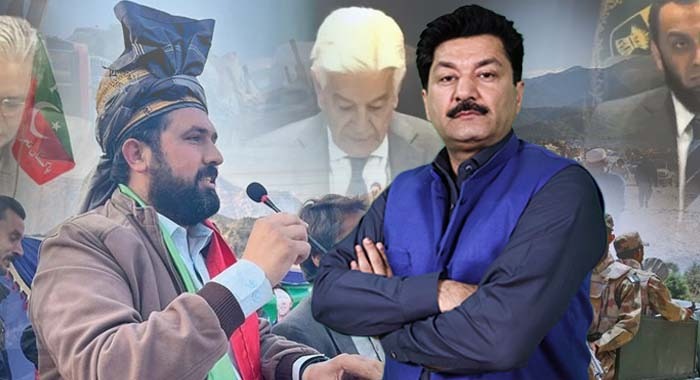
The people of Khyber Pakhtunkhwa are facing severe hardships. The cold is intense. But a fundamental question arises, who is responsible for this situation, and who is opposing what is happening? These are the questions we are examining today. We are also discussing the position of the Chief Minister of Khyber Pakhtunkhwa, Sohail Afridi. On one hand, he is opposing the operation, while on the other, statements from the administrative machinery tell a different story. This dual policy needs to be understood. There are thousands of people who have nothing to do with politics, propaganda, or terrorism.
In reality, they are victims. First, they were victims of terrorism, and now they have become victims of politics as well. These innocent people, what is their fault? They have been subjected to an enormous test. At a time like this, they were forced onto the roads. On top of that, harsh weather arrived and snowfall began. They cannot see a clear path ahead, nor can they return behind. They are trapped, unable to move forward or backward, while snow continues to fall. In such circumstances, it is said that the operation is not being accepted, yet it is being imposed. So on what basis is this hypocrisy taking place? What were the people of Tirah told that compelled them to leave?
Snowfall is not new to that area; it happens every year. So why did people leave on such a massive scale this time? Negotiations continued for weeks. With whom were these negotiations taking place? The jirga placed tough demands. That same jirga met the local population, held meetings with the Chief Minister at the CM House in Peshawar, and also engaged with the Deputy Commissioner, the military, the administration, and other relevant provincial officials. This has been discussed repeatedly, including in vlogs, where the initial list of demands was shown.
The jirga demanded that if a house was completely destroyed due to the operation, the owner should receive eighty lakh rupees. If a house was partially damaged, compensation of forty lakh rupees was demanded. These figures were later reduced. Complete destruction was fixed at thirty lakhs, partial damage at ten lakhs. Seven lakh rupees per family were demanded, which was reduced to three and a half lakhs, with two and a half lakhs as a lump sum and fifty thousand rupees per month thereafter. It was also agreed that people would be able to return from 5 February.
These negotiations did not happen overnight. There was no sudden loudspeaker announcement forcing people to leave immediately. Dates were clearly given, from 10 to 25 January, to vacate the area, after which an operation would take place. Whether it was to be a full-scale operation or a limited one, intelligence-based operations were already ongoing. During this period, incidents in Tirah clearly indicated the presence of militants and their forces. When the matter was raised in the assembly, the Chief Minister stated that government representatives were not part of the negotiations. It was pointed out that the Deputy Commissioner attended several sessions.
The response was that he was there only for facilitation. Facilitation of what, when the issue was an operation? Then four billion rupees were issued. It is unclear whether there will be an audit. Subsequently, a press release from the Ministry of Information and Broadcasting stated that the federal government did not instruct the people of Tirah to relocate. Now thousands of people are confused and worried. Whom should they listen to? Where should they go? If they return, they fear the operation may begin.
If they move forward, the weather poses a serious threat. How long can they survive outside in such conditions? It appears that if there was preparation for this operation, officials have stepped back. Immediate action does not seem likely. Snowfall continues, and militants are present. Videos show them standing in snow, waving flags and carrying weapons. This indicates their presence even in extreme conditions. The idea that an operation would begin immediately after 25 January now seems unlikely.
Meanwhile, videos surfaced of assistant commissioners and deputy commissioners asking people not to leave if their homes were intact and to stay until 5 February. This has added to the confusion. People are unsure whether to stay or relocate. They fear returning home due to the security situation, especially considering militant access to drone technology. Four billion rupees have been issued, which is a positive step, but it must be distributed transparently. There must be a clear and unified statement. Until provincial and federal institutions sit together and resolve these issues collectively, the people of Tirah Valley and the entire province will remain victims of confusion.
When street movements occur, the Chief Minister delivers aggressive speeches, both publicly and on the assembly floor. He speaks of calling jirgas, first of Afridi tribes and then of Pakhtunkhwa. Instead of playing different cards, it would be better to bring all stakeholders under one roof and take a unified decision. The government repeatedly says that everyone should sit together and agree, yet this is not happening. This lack of coordination is obvious. The people of this province have the right to know what is happening.
Terrorism is a serious issue, but it is being taken lightly and turned into a political tool. There should be no politics on terrorism. This province has suffered immensely. No matter where you look, public rallies, the assembly, or ministerial statements, there is no talk of efficiency. Everything is political. Statements are thrown back and forth, creating a strange and dangerous atmosphere.
Instead of focusing on momentum for political dates, attention should be given to governance. Four billion rupees were issued for the people of Tirah Valley, which is commendable. But what about the rest of the province? What projects exist for them? Cabinet meetings are held, agendas are issued, yet those agendas are hidden. These funds did not come from an individual minister; they were decided by the provincial government through the cabinet. There is nothing to hide in this process.
If negotiations took place, and provincial representatives were present even as facilitators, then the government was involved. Opposition leaders have pointed out that policy decisions were made earlier and that policies do not change with faces.
Tirah Valley holds immense geographical importance. It borders Afghanistan, lies close to Peshawar, and connects to Kurram and Orakzai. Its terrain offers natural hideouts, making it an ideal location for militants, especially in winter conditions when operations become difficult. Similar experiences in Bajaur and other areas show that jirgas attempted negotiations, urging militants to leave or return to Afghanistan. When these efforts failed, the government arranged negotiations.
This is perhaps the first time such detailed agreements and assurances were made before an operation. People want peace and dialogue, but they fear fake encounters, collateral damage, and destruction of their homes. Past operations have left scars. Operations must deliver results. Destroying areas without securing them benefits no one. Political parties must play a responsible role.
This is not a matter for point scoring. It concerns governance and public safety. This did not happen suddenly. Media discussions have long indicated the possibility of an operation and demolitions. Yet conflicting statements from ministers have deepened confusion. If there is to be any military action, it must be clearly owned and led through proper channels.
The current situation, where governments appear to confront each other rhetorically, creates space for hostile elements to exploit. While governments argue, people suffer and militants celebrate. This province is part of Pakistan. The army is our own. Soldiers, officers, and police personnel are being martyred daily.
This situation demands seriousness, not blame games. Dual policies and contradictory statements are deeply harmful. Allegations regarding sympathy toward the TTP, past negotiations, and releases belong to the past. What matters now is clarity and seriousness. Politics has many arenas, but this should not be one of them. Precious lives are being lost daily. The pain is borne by families, while decisions are made far away in comfort.
Policy must be clear. This is not about one party or one government. Political leaders must stop creating scenes and start acting responsibly. The situation is approaching a point of no return. This conflict benefits no one, not Pakistan, not the province, not any political force. There is no realistic possibility of governor’s rule. Such a move would be undemocratic and harmful.
Statements about threats to the Chief Minister’s life are alarming and terrifying. This language spreads fear and hatred within the state. If political momentum is desired, it should not come at the cost of governance. People are asking about the state of governance, the condition of the province, and the suffering of the people of Tirah and the southern districts. One hopes that the date of 8 February arrives soon, protests subside, and the government of Khyber Pakhtunkhwa finally focuses on improving governance.