(Aqeel Yousafzai)
For weeks, Tirah Valley has returned to Pakistan’s national conversation not as a distant memory of past militancy, but as an unresolved present tense. Reports, political commentary, television debates, and conflicting narratives have created a familiar yet deeply troubling question: what exactly is happening in Tirah, and why does it matter now more than ever?
This is not a rhetorical inquiry. Tirah is neither symbolic nor peripheral. It is a strategically sensitive region of Khyber District, bordering Peshawar’s eastern security arc, historically exploited by militant networks during periods of state disengagement. Any ambiguity about Tirah’s status today does not remain confined to its valleys; it radiates outward, affecting Peshawar’s security calculus, public confidence, and the credibility of governance in Khyber Pakhtunkhwa.
Tirah was not left untouched in the post-2014 counterterrorism operations. It was part of broader security efforts aimed at dismantling militant infrastructure across erstwhile FATA. While not every pocket was permanently militarised, the area was denied as a sanctuary, which is the central objective of counterinsurgency: prevent regrouping, re-entrenchment, and projection of violence. What has alarmed analysts and political observers in recent months is not merely the resurgence of discussion around Tirah, but the absence of clarity. When questions arise about whether an operation is being considered or worse, whether the area is being politically “managed” rather than secured it signals uncertainty at the policy level.
Tirah cannot be treated as an isolated geographic problem. Its terrain allows movement, concealment, and logistical connectivity. Any perception that militant presence is being tolerated, negotiated with, or deferred for political convenience has implications far beyond Khyber District. Operation or Abandonment Public discourse has increasingly framed Tirah in binary terms: either a full-scale operation will take place, or the area will be effectively ceded to non-state actors under the illusion of political accommodation. This framing itself reflects a deeper governance failure. No responsible state hands over territory. Equally, no responsible counterterrorism policy treats kinetic operations as the sole instrument of control. The issue, therefore, is not whether an “operation” is announced for headlines, but whether state writ is visible, sustained, and non-negotiable.
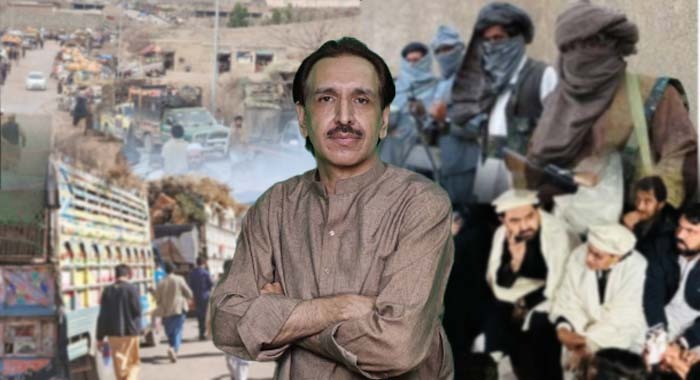
Claims circulating in media discussions that hundreds of militants are freely operating in Tirah must be treated carefully. Such numbers are often speculative, derived from intelligence chatter rather than verified public data. However, even the perception of unchecked militant regrouping is sufficient to trigger insecurity, displacement, and political anxiety. Security is as much about psychological assurance as physical control. One verified and deeply concerning reality is civilian displacement. Thousands of residents have reportedly moved out of Tirah due to insecurity and fear of escalation. This movement has occurred at a time when harsh winter conditions including snowfall and rain in upper Khyber regions compound humanitarian vulnerability.
Here, the criticism is not directed at security institutions, but at civil administration and political leadership. When populations are displaced temporarily or otherwise the state’s first visible response must be relief, coordination, and communication. Silence creates suspicion. Delay breeds resentment. The contrast noted by commentators between intense political mobilisation around high-profile detainees and the relative invisibility of displaced citizens from Tirah has not gone unnoticed. Whether fair or not, this perception damages the legitimacy of governance.
Another troubling dimension is the politicisation of security discourse. When electoral considerations enter discussions of territorial control, the result is strategic incoherence. Elections are instruments of democratic legitimacy but they cannot substitute for security governance, nor can they be conducted meaningfully in areas where the state’s authority is contested. The suggestion that political priorities might override security imperatives whether accurate or exaggerated reflects a dangerous disconnect between governance layers. Security policy cannot oscillate with political pressure, street agitation, or media cycles. The state’s responsibility is singular: no space for militancy, no ambiguity in writ, and no transactional compromises over territory.
It is also necessary to correct exaggerated or inaccurate claims that circulate in heated debates. Assertions that Pakistan’s institutions are paralysed, internally divided, or negotiating from weakness do not align with observable realities. Pakistan’s security apparatus today operates from a position of institutional continuity, not collapse. Counterterrorism coordination while imperfect is far more structured than in the pre-2014 era. Claims of imminent state failure or territorial surrender often reflect political rhetoric rather than operational fact. That said, strength without communication creates space for speculation. The absence of clear, unified messaging on Tirah has allowed narratives some alarmist, some politically motivated to flourish unchecked.
No discussion of Tirah can ignore the broader regional context. Cross-border militancy, shifting dynamics in Afghanistan, and the unresolved presence of TTP elements remain structural challenges. However, it is inaccurate to suggest that Tirah’s situation is solely a by-product of Afghan developments. Local governance, intelligence monitoring, and administrative presence matter. External factors complicate but do not absolve internal responsibility.
The path forward does not lie in televised threats, speculative timelines, or binary declarations. It lies in visible governance: Continuous security presence without spectacle, Transparent communication with affected populations, Humanitarian response proportional to displacement, Political restraint from exploiting security narratives, Clear reaffirmation that no territory is negotiable, Most importantly, Tirah must not become a talking point. It must remain a governed space.
Pakistan has paid dearly in the past for strategic ambiguity. Areas once dismissed as peripheral eventually became central to national trauma. Tirah’s geography places it too close to major urban centres for complacency, and its history makes neglect a proven mistake. The question, therefore, is not whether an operation will be launched or denied. The real question is whether Pakistan has learned enough to ensure that no valley however remote becomes a question mark again. Because when the state hesitates to speak clearly, others rush to define the silence. And in regions like Tirah, silence has never been neutral.