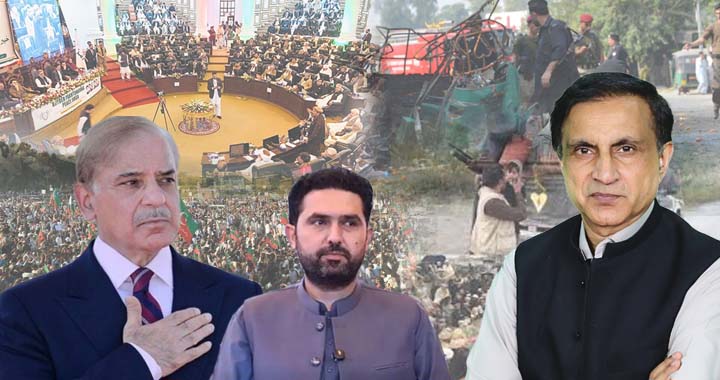
The ongoing security situation in Khyber Pakhtunkhwa is no secret. Everyone can see it. From North and South Waziristan to Bannu, Dera Ismail Khan, Lakki Marwat, and even Chitral, terrorism is visible everywhere. In Tank, police officers were martyred just the other day. On the one hand, the security situation is deteriorating.
On the other hand, when we talk about governance, let me explain how governance is actually functioning. Just two or three days ago, a naib qasid was appointed as a sub-engineer. Social media immediately raised the question: how can a peon be made a sub-engineer? Is this what governance looks like? People openly questioned this decision, asking what kind of governance this is. The PTI used to speak of merit. It used to claim that it would rule on the basis of merit and justice. What kind of justice is this, where a naib qasid is elevated to the post of sub-engineer?
The chief minister took immediate notice and ordered that the chief engineer be made an OSD, and that an inquiry be conducted. Let me share another telling example. The chief minister visited Lady Reading Hospital. You may recall the incident where a doctor was seen using a mobile phone during duty hours. The chief minister ordered his dismissal. What happened next? Was the doctor dismissed or not? Instead, another inquiry was initiated. The chief minister conducted his own inquiry.
Meanwhile, the sports department issued a notification stating that computer operators would be promoted to district sports officers in three phases. How can a computer operator be appointed as a district sports officer? A district sports officer is appointed through the Public Service Commission after passing a competitive examination. This is the established procedure.
The real issue is that bureaucrats are not cooperating with the government. In fact, they seem to be creating a new controversy every day by issuing flawed and questionable orders. One day it is the sports department, the next day the youth department follows the same path by appointing individuals from lower cadres to senior posts. The chief minister appears unable to comprehend what is happening around him.
He used to speak at length about governance. Governance only works when bureaucrats cooperate with the political leadership. He himself has said that he did not come to govern but to change the system. If this is the change, then the system has indeed been altered. Then he said he came to secure the release of Imran Khan. Two or three months have passed. What has happened since then?
He said he called for meetings. He claimed his guests were kidnapped, then said they were released. He said he would find out who kidnapped Sanam Javed. Tell me, which order of the chief minister is actually being implemented? There is a parallel system in place. No one seems to take the chief minister’s directives seriously.
One must ask whether the ministerial leadership, particularly Sohail Afridi, is involving itself in matters that are entirely irrelevant. What is their seriousness? They claim they want to run a movement. No one knows where this movement is headed. First, it was a long march, about which nothing is clear. Now it is a street movement. How long will this street movement last, and where will it go across the province?
There is no visible action. PTI itself stands divided. One group questions what the party leadership is doing while Imran Khan remains in jail for over two years. Another group seems content, enjoying internal politics and power. Tell me honestly, do you see any serious effort that could move things forward? There are no negotiations, nothing concrete is happening.
Even on negotiations, Sohail Afridi said yesterday that it is not his concern, and that the decision to negotiate or run a movement will be taken by Mehmood Khan Achakzai and Allama Raja Abbas. If these figures are to decide everything, then they might as well run the government themselves.
The state of governance is alarming. Hospitals are in poor condition. Schools lack basic facilities, furniture, and even child-friendly spaces. This is visible on social media every day. The real focus of Tehreek-e-Insaf appears to be confrontation with the establishment. Their social media platforms routinely target the army. Influential YouTubers echo the same narrative.
Why target the army? Why not target those who are destroying peace? On that front, there is silence.
It is true that the situation in Balochistan has improved. Why? Because the people, the government, and the army are on the same page. In KP, ministers claim there will be no operation, yet security operations are clearly underway. If the army is deployed and comes under attack, or civilians are targeted, is it expected to stand by silently? Protecting lives and territory is its mandate.
Even today, PTI leaders complain that an operation is underway in Tirah without taking them onboard. Trust is built through engagement. Without it, political relevance fades. That is exactly what has happened to PTI.
In the last cabinet meeting, compensation for displaced families was approved. So why this double narrative? You say one thing publicly and do another privately. If you believe you are not trusted, then stop pretending to be part of the process.
In Tirah, the government said there would be no operation. A jirga was held, and the jirga itself demanded action against terrorists. The people agreed to temporary displacement, subject to clear conditions: time-bound return, financial assistance, and compensation for damaged homes. These decisions were taken collectively.
The government’s absence from this process has rendered it irrelevant. When policies lack clarity, people stop cooperating. Today, the people of KP are not standing with the PTI government. They stand with institutions they believe can restore peace.
PTI’s past jirgas achieved nothing. After the incidents of May 9 and October 26, legal cases remain pending. If courts uphold merit and justice, outcomes will follow accordingly. PTI leadership knows that the moment a protest or long march is announced, Governor’s Rule will be imposed, and movement will be restricted, just as it was previously.
They also know that KP is their last stronghold. If they lose this province, they lose everything: political leverage, funding, and organisational space. Their recent gatherings have shown dwindling public support.
Politics must be about public welfare. Governance exists to serve people. When peace is absent and governance collapses, people inevitably turn away.
The prime minister has openly offered negotiations. Leaders like Mehmood Khan Achakzai and Allama Raja Abbas have also expressed readiness. Negotiations are proposed on two points: electoral reforms and the appointment of the chief election commissioner. PTI itself remains divided on whether to negotiate.
Within PTI, those who speak of dialogue are branded traitors. The party increasingly takes cues from social media rather than political wisdom. No political movement can survive if it waits for social media approval before every decision.
The government has made it clear that Imran Khan’s release is a judicial matter. Negotiations cannot override court verdicts. Trust deficits remain so deep that no one knows what Imran Khan’s final position will be.
His recent tweet once again attacked the entire system, using language that undermined whatever little space for reconciliation may have existed.