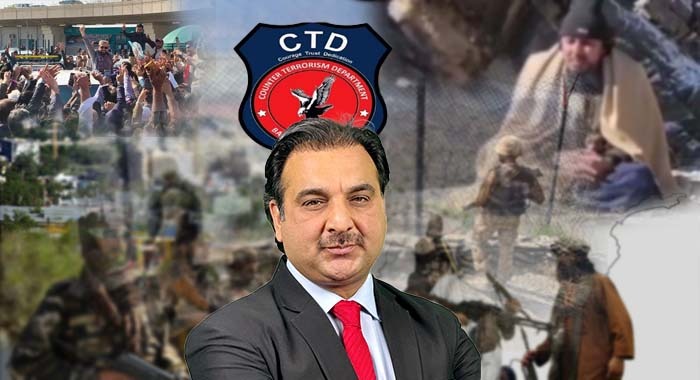
“I would like to send a message to all our Mujahideen that the Afghans are our brothers. We have been comrades and have fought wars together. I would like to urge our Afghan comrades who are willing or attempting to come to Mohmand, or to Pakistan, not to do so, and instead remain in their own country and serve it.”
This video message, recently released by Sarbakaf Mohmand, a senior commander of the proscribed Jamaat-ul-Ahrar, is far more significant than it appears at first glance. Recorded from an undisclosed location in Mohmand, the message was ostensibly addressed to Afghan fighters, urging them not to cross into Pakistan after the establishment of what he termed an Islamic system in Afghanistan. In reality, the message was neither theological nor advisory. It was political, defensive, and deeply factional.
The timing of the message is critical. It emerged amid persistent reports of internal divisions between Jamaat-ul-Ahrar and the banned Tehreek-e-Taliban Pakistan (TTP), divisions that have been quietly but steadily widening over the past several years. Simultaneously, unverified reports circulating on militant Telegram channels claimed that Sarbakaf Mohmand had been arrested, either by the Afghan Taliban or by a faction loyal to TTP chief Noor Wali Mehsud. The video served to counter those rumors, establish his freedom of movement, and reassure his followers that Jamaat-ul-Ahrar remains intact.
To understand why Sarbaqaf felt compelled to issue such a message, one must revisit the origins of Jamaat-ul-Ahrar itself. The group emerged in 2014 after serious ideological and operational differences surfaced between Mullah Fazlullah, then head of the TTP, and Umar Khalid Khurasani, the leader of Jamaat-ul-Ahrar. Those differences were not superficial. They reflected divergent approaches to leadership, targeting, and control. Following the split, Jamaat-ul-Ahrar carried out a series of deadly attacks inside Pakistan, openly claiming responsibility and operating independently of the TTP.
These parallel paths continued for years. After the assassination of Mullah Fazlullah and the rise of Mufti Noor Wali Mehsud as TTP chief, efforts were made to reunite splinter factions in order to consolidate strength. In August 2020, Jamaat-ul-Ahrar and its sub-group Hizb-ul-Ahrar formally rejoined the TTP, pledging allegiance to Noor Wali Mehsud. The move was presented as a return to unity, but it rested on fragile foundations.
That fragility was exposed in 2022 with the killing of Omar Khalid Khurasani in Afghanistan. Following his death, senior Jamaat-ul-Ahrar figures, including Ehsanullah Ehsan, openly accused Noor Wali Mehsud of acting as an informer and facilitating Khurasani’s killing. These accusations were denied, but the damage was irreversible. Trust collapsed, and unity became transactional rather than ideological.
By late 2023 and early 2024, tensions intensified once again, this time over media control and operational autonomy. Jamaat-ul-Ahrar’s media wing, Ghazi Media, clashed with the TTP’s Umar Media, which accused Jamaat-ul-Ahrar of violating organizational policy and undermining central command through its messaging. These disputes reflected deeper grievances about marginalization within the TTP structure.
Alarmed by the prospect of another split, the TTP leadership attempted damage control in March 2024 by assigning Jamaat-ul-Ahrar leaders to key positions. The gesture was tactical and temporary. By the final months of 2025, differences resurfaced with greater intensity.
At the core of the dispute were three issues. Funding, organizational sidelining, and exclusion from strategic decision-making. Jamaat-ul-Ahrar leaders complained that financial support flowing to the TTP, whether through Afghan Taliban patronage or other external channels, was being monopolized by Noor Wali Mehsud and his close associates. Key administrative and operational positions, they argued, were systematically denied to their leadership.
The Kabul meeting held on January 3 and 4, 2026, under Afghan Taliban protection, proved decisive. Chaired by Noor Wali Mehsud, the meeting reportedly focused on operational planning for the coming year. Senior Jamaat-ul-Ahrar commanders were sidelined. Their exclusion confirmed long-standing suspicions and deepened resentment.
Ehsanullah Ehsan’s subsequent public letter laid these grievances bare. He accused the TTP leadership of abandoning ideology for money, of reducing jihad to a profit-driven enterprise, and of limiting violence to selective regions rather than pursuing what he described as a broader campaign. The letter was not an appeal for reform; it was a declaration of ideological rupture.
It is against this backdrop that Sarbaqaf Mohmand’s video message must be read. His appeal to Afghan fighters not to come to Pakistan was less about restraint and more about signaling. It was a message to Noor Wali Mehsud that Jamaat-ul-Ahrar no longer accepts his authority or strategic direction. Reports suggesting that Jamaat-ul-Ahrar may separate, merge with other factions, or re-emerge under a new banner are therefore not speculative, they are consistent with the trajectory.
Fragmentation within militant groups does not bring peace. It brings competition, escalation, and attempts to assert relevance through violence. The state’s response, including placing bounties on militant leaders, reflects the seriousness of the threat, but it also highlights how deeply entrenched these networks remain.
Meanwhile, Khyber Pakhtunkhwa continues to suffer. Security personnel, government employees, and ordinary citizens are being martyred, while political leadership appears disengaged. The province is burning, yet its chief executive is frequently absent, travelling to Lahore and Karachi while violence ravages his own backyard.
Even Waziristan is treated as distant, despite the chief minister belonging to the region. The message this sends is damaging. Leadership cannot be exercised from drawing rooms while the province bleeds. This is the moment for ownership, for security meetings, for apex committee sessions, and for visible seriousness.
Enough has happened. Now delivery matters.
If there is no state, there will be no politics. And if terrorism continues to be treated as a secondary concern, there will be neither governance nor those who claim to govern.