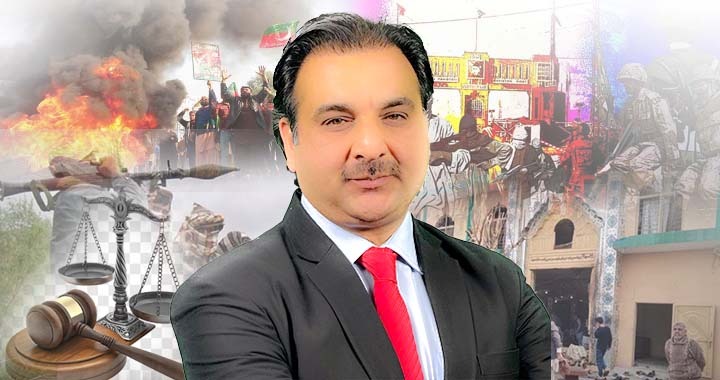
This was a deeply tragic incident. According to the initial investigations conducted by the police and intelligence agencies, the suicide bomber belonged to Peshawar’s Ganj area and was residing in Mohallah Qazian. He had been staying in Nowshera for four to five days prior to carrying out the attack on the Tarlai mosque. His relatives and facilitators were also present in Nowshera during this period.
According to reports that emerged yesterday, ISPP—a faction of ISKP, also known as Daesh—has claimed responsibility for the attack. It is also being reported that the suicide bomber, Yasir, had spent five months in Afghanistan prior to the attack. During this period, he reportedly received training on how suicide bombers are prepared and how such attacks are carried out. He was also trained in the use of weapons.
Further information reveals that on the day of the attack, when Yasir left Nowshera, he disembarked at Khanna Pul and walked to the mosque. He waited for nearly an hour at a local hotel before moving toward his target.
When investigations were carried out later that night and his facilitators were traced to Hakeemabad, Nowshera, intelligence agencies and the police launched an operation against them. During the operation, the facilitators opened fire on law-enforcement personnel. As a result, an Assistant Sub-Inspector and a constable were martyred, while two other officers sustained injuries. One terrorist was killed in the exchange.
This was clearly a well-organized network. Such incidents cannot occur without facilitation. The critical questions are: how are local individuals recruited, how are they facilitated, and how are they guided step by step to their targets?
Afghanistan’s Foreign Ministry and India are also linked to this attack. On the one hand, training schools and camps are being run where suicide attackers are prepared. Afghanistan has provided its land for these activities, while India’s RAW is funding them. On one side, these elements are financed and trained; on the other, the same actors condemn such attacks. This is nothing but a double standard.
Why are these elements being used in Pakistan? Given the deep cultural, traditional, and ethnic ties between Pakistan and Afghanistan—particularly among Pashtuns—it becomes easier to exploit people from either side of the border. It is not difficult for these networks to recruit Pashtuns from Afghanistan or Khyber Pakhtunkhwa and send them to Islamabad.
Whenever the Afghan Taliban face international pressure, restrictions, or sanctions, they issue statements to temporarily shield themselves. No matter how many press releases the acting Afghan Foreign Ministry issues or how strongly they condemn such attacks, the reality remains unchanged. Not only Pakistan, but the entire world insists that Afghan soil must not be used against any country—especially Pakistan.
Setting Pakistan aside for a moment, why is China saying that Afghanistan has become a hub for international terrorist organizations? Why are Russia, Iran, and the United States saying the same? All these countries agree that Afghanistan has become a safe haven for international terrorism.
This clearly indicates that terrorist organizations are being provided shelter and security. The Afghan authorities have allowed these groups safe haven, even as they publicly deny any involvement. The international community continues to issue statements opposing terrorism, but the reality on the ground is that these safe havens still exist.
On the other hand, if we recall the 2023 police lines bombing, one of the accused was granted bail just yesterday. This is an issue we must repeatedly discuss. What role are our courts playing? Shouldn’t the judiciary’s budget and performance be questioned when terrorists are granted bail?
In Khyber Pakhtunkhwa alone, more than 350,000 cases are pending in the Peshawar High Court and subordinate courts. When people fail to get justice through legal means, they begin forming their own systems of justice. We have seen cases where, immediately after an accused is released on bail, they are shot dead—an alarming sign that trust in the justice system is eroding.
This particular case has been ongoing for three years. More than 80 police officers were arrested following the police lines incident. The suspect arrested yesterday by the Counter Terrorism Department was granted bail by the High Court. When militants, terrorists, and extremists—or their facilitators—are released on bail, serious questions arise. Is the Peshawar High Court inadvertently acting as a facilitator?
If courts claim their decisions are evidence-based, then the nature and credibility of that evidence must also be questioned. If justice were truly being delivered, there would not be three to four hundred thousand pending cases.
This brings us back to the National Action Plan, where judicial reforms were a fundamental pillar. Why have these institutions—the High Courts and the Supreme Court—not reformed themselves? Why do judges consider themselves beyond accountability? No institution can claim absolute perfection.
There must be an independent, third-party accountability mechanism—separate from the Supreme Court or Judicial Commission—because internal accountability often protects insiders. Judges must be answerable for their decisions, particularly in cases involving terrorism and mass casualties.
Due to the lack of judicial reforms and the weak implementation of the National Action Plan, such decisions continue to be accepted without challenge.
Briefly, regarding the protest announced by PTI on February 8: it was a complete failure. No shops were closed, no shutter-down was observed, and people continued their daily routines as usual. While everyone has the right to protest, forcing traders to shut down businesses or blocking roads is unacceptable.
Blocking main roads humiliates ordinary citizens who have nothing to do with politics. Ambulances get stuck, patients suffer, and lives are lost. If protests are to be held, open grounds such as the Peshawar Ring Road should be used. Gather a million people if you want—but do not block roads.
Shutting down businesses only causes financial losses for traders. Instead of providing relief, such actions create more problems. Apart from a few politically compelled groups, traders have clearly rejected this narrative. Today’s complete lack of shutdown once again proved that PTI’s call was not supported by the public.