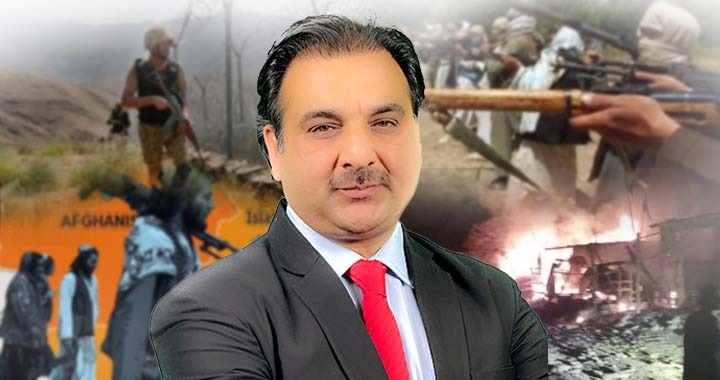
The United Nations report has drawn renewed global attention to the security situation in Afghanistan and the growing presence of militant networks operating across the region.
The report highlights the expansion of groups described as Khwarij, including elements associated with Jamaat-ul-Ahrar, which are reportedly maintaining training environments inside Afghan territory.
This is not a surprising revelation.
Rather, it confirms long-standing concerns raised by security analysts regarding militant mobility, logistical coordination, and recruitment pipelines operating in border ecosystems.
The fundamental question is moral, ideological, and theological.
In this blessed month of peace, where Islam teaches sanctity of life, what justification exists for killing Muslims?
The individuals who were martyred in attacks such as the incident in Bannu, including Lieutenant Colonel Sahibzada Gul Faraz and other security personnel, were born into Muslim families and raised within Islamic traditions.
What interpretation of religion allows violence against fellow Muslims?
Those who propagate extremist narratives under the banner of jihad while targeting Muslim societies must answer this contradiction.
At the same time, another disturbing dimension exists.
Funding, ideological guidance, and operational support are reportedly flowing through complex channels.
Is it permissible within Islamic ethical and jurisprudential principles that violence is financed through external actors and then directed against Muslim communities?
In my opinion, when religion is reduced to a war of dollars and geopolitical influence, faith itself becomes a casualty.
Reports associated with international monitoring structures, including United Nations analytical assessments, indicate that militant training infrastructures are present across multiple Afghan provinces.
These include Khost Province, Kunar Province, Nangarhar Province, Paktika Province, and Takhar Province.
The concern is not only ideological.
It is operational.
Logistics networks, financial channels, and recruitment mechanisms sustain militant continuity.
Groups such as Al-Qaeda are reported to provide ideological and training support to affiliated formations.
Suicide bomber preparation, according to security assessments, is conducted in remote camp environments.
More than seventy percent of recruits associated with networks described as Fitna-al-Khwarij formations are believed to receive training in such facilities.
These fighters subsequently cross into Pakistan and conduct attacks similar to the incidents witnessed in recent months.
Video material released from border regions has also shown militant presence in parts of the Khyber Valley, reinforcing concerns about territorial embedding of extremist elements.
If training centers remain operational, the trajectory of violence will likely continue.
Now, regarding international diplomacy.
The Prime Minister’s visit to the United States has been viewed as part of broader strategic consultations.
Discussions are expected to include regional security stability, counterterror cooperation, and future engagement frameworks.
There have been references in international commentary to the possibility of negotiations concerning military installations such as the Bagram facility, though final decisions remain unresolved.
The United States continues to view extremist organizations, including Al-Qaeda and the so-called Islamic State affiliates, as threats to global security.
If militant factions such as TTP-linked networks or the interim Afghan authorities fail to prevent cross-border militant facilitation, international pressure is likely to increase.
Some analysts argue that financial and logistical streams supporting militant ecosystems may involve regional actors, including concerns raised about external state-level influence.
At the geopolitical level, the United States is not the only stakeholder.
China has significant strategic investments across the region and is particularly sensitive to security disruptions affecting development projects in Khyber Pakhtunkhwa and surrounding corridors.
If instability threatens infrastructure and investment security, intelligence cooperation among major powers becomes more likely.
Russia, China, and Iran are also seen by some strategic observers as sharing concerns regarding extremist expansion and regional disorder.
The emerging possibility is that global and regional stakeholders may eventually converge on a unified security framework.
From that perspective, the interim Afghan administration may face increasing diplomatic pressure to demonstrate effective control over militant formations operating within its territory.
Afghanistan will likely be presented with a strategic choice.
Either cooperate in dismantling militant infrastructure or join regional stability efforts.
Or face escalating political, economic, and security consequences.
Because the future of this region cannot be built on networks that export violence while claiming legitimacy.
Peace requires responsibility.
And responsibility requires decisive action.