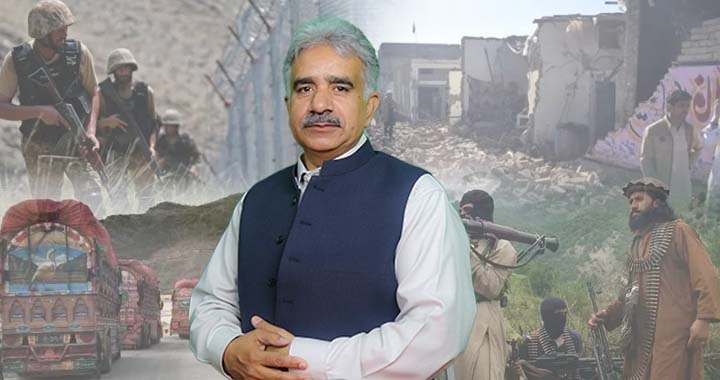
Pakistan’s position on terrorism is clear and unambiguous. This was once again underlined in the recent press briefing by DG ISPR Lieutenant General Ahmed Sharif Chaudhry, whose core message was that there is no confusion in Pakistan’s war against terrorism. He emphasized that the political leadership, military leadership, and state institutions are on the same page.
However, one political party stands apart: Pakistan Tehreek-e-Insaf (PTI).
PTI’s stance on terrorism, particularly regarding the Tehreek-e-Taliban Pakistan (TTP), remains deeply contradictory. On the one hand, the PTI-led government in Khyber Pakhtunkhwa publicly declares that intelligence-based operations (IBOs) will not be tolerated in the province. On the other hand, such operations continue to take place with the approval of the same provincial government. This duality raises a fundamental question: why does PTI adopt conflicting narratives on an issue as critical as terrorism?
The DG ISPR’s press conference can broadly be divided into three parts.
The first dealt with external factors—terrorism, radicalization, and cross-border threats. The message was clear: if Afghan territory has been used against Pakistan, or is used again, Pakistan will retaliate. If attacks originate from Afghanistan, Pakistan will target those responsible. There is no ambiguity or second opinion on this matter.
The second part addressed Pakistan’s alignment with the global narrative. Pakistan’s position today mirrors that of the international community: multiple terrorist organizations are operating from Afghanistan. These include the TTP, BLA, TIP, IMU, ETIM, ISKP, Al-Qaeda, Jaish, Ansar, and others. Afghanistan has effectively become a hub for non-state actors that pose a serious security threat to Pakistan and the wider region. The fact that the international community increasingly supports Pakistan’s narrative demonstrates that Pakistan’s position was correct.
The third part focused on internal security, particularly during 2025. Counter-terrorism efforts were carried out nationwide, with Khyber Pakhtunkhwa bearing the heaviest burden. The province witnessed the highest number of terrorist attacks as well as the largest number of counter-terrorism operations. While conditions improved comparatively in Balochistan, KP remained at the forefront of both the threat and the response.
At this point, the discussion entered political territory. In my view, questions regarding the stance of a political party should ideally be raised by the civilian leadership rather than through a military spokesperson. There are appropriate political forums for such matters, including the Apex Committee, parliamentary security committees, the National Security Committee, and the National Finance Commission.
That said, the substance of the concern remains valid. Why has the PTI-led government in Khyber Pakhtunkhwa not consistently aligned itself with the national consensus on counterterrorism when the entire country stands united?
PTI appears to be using the issue of terrorism—and even military operations—as a political tool. This politicization is dangerous and harmful, particularly for Khyber Pakhtunkhwa. If PTI truly opposes operations, then how were over 58,000 counter-terrorism operations conducted in the province? How did intelligence-based operations account for more than 70 percent of these actions? And how were most terrorists eliminated in KP if the provincial government was not cooperating?
The successful, targeted operation in Bajaur and planned actions in Tirah further illustrate that counter-terrorism efforts are being carried out in coordination, with assurances from the provincial government regarding compensation, rehabilitation, and financial support for affected populations. This raises another critical question: how can the federal and provincial governments not be on the same page when cooperation clearly exists on the ground?
The argument that provincial consent is required to conduct operations does not hold constitutional weight. Article 245 of the Constitution makes it clear that the armed forces are a federal institution responsible for maintaining law and order on the directions of the federal government. Provincial governments have neither the constitutional nor legal authority to block such operations.
Opposing action against groups that reject Pakistan’s constitution, laws, flag, and national identity amounts to political posturing. Terrorist organizations—whether TTP, BLA, ISKP, or others—are fighting the state of Pakistan. They are designated as terrorist groups by Pakistan’s courts, state institutions, and the international community. This is not a matter of debate.
The consequences of political inconsistency are real. Law and order challenges discourage investment, hinder development, and deepen instability in Khyber Pakhtunkhwa. Terrorism and economic progress cannot coexist.
Regionally, Pakistan is not alone in facing challenges linked to Afghanistan. Iran, Tajikistan, and Central Asian states also face security and governance issues emanating from Afghan territory. Under the Afghan Taliban regime, more than 20 terrorist organizations continue to operate. Reports of high-level TTP meetings in Kabul under Taliban protection only reinforce Pakistan’s concerns.
The choice for Afghanistan’s rulers is clear: stand with terrorists or stand with regional stability. Pakistan’s demand is straightforward and legitimate. Trade and connectivity projects cannot move forward unless terrorism ends.
The Afghan Taliban must act responsibly—for Afghanistan, for Afghans, and for the region. Afghanistan must cease to be a hub for terrorism. This chapter must be closed permanently.
Internally, Pakistan has no option but unity. A unified national front and full implementation of the National Action Plan are inevitable. The fight against terrorism requires clarity, consistency, and resolve. Any ambiguity only serves the enemies of the state.