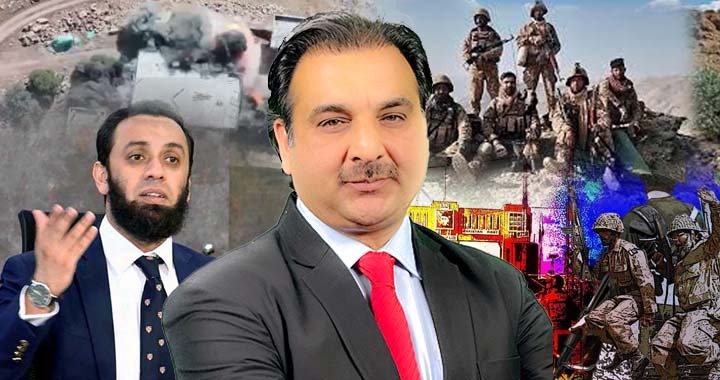
Pakistan’s senior security leadership recently held an in-camera briefing to explain the evolving security situation along the Pakistan-Afghanistan border and the objectives behind the ongoing Operation Ghazab Lil Haqq. The closed-door session offered rare insight into the scale of the operation, the intelligence behind it, the Bagram airbase and the Afghan Taliban regime, and the strategic choices Pakistan now faces.
Shortly before details of the briefing began circulating, Federal Information Minister Attaullah Tarar shared updated operational figures.
According to those figures, 527 Taliban fighters have been killed and 755 injured since the launch of Operation Ghazab Lil Haqq. Officials said many of those killed were either directly linked with or providing sanctuary to militants of the banned Tehreek-e-Taliban Pakistan.
The operation also resulted in the destruction of 237 militant checkpoints located near the Pakistan-Afghanistan border. These positions, according to the briefing, were allegedly being used jointly by Afghan Taliban elements and militants affiliated with the TTP as well as fighters linked with the Balochistan Liberation Army.
Security officials told lawmakers that several of these locations had been used to launch attacks on Pakistani territory, including mortar shelling, drone launches and assaults on security checkpoints and civilian settlements in border districts.
The briefing further revealed that 38 of those checkpoints have now been captured and brought under the control of Pakistani security forces, while 205 tanks, vehicles and other pieces of military equipment have been destroyed during the course of the operation.
Pakistan’s strategic position
During the in-camera session, officials emphasized that Pakistan has no intention of occupying Afghanistan or interfering in its internal political structure.
The Afghan people, they said, must decide for themselves which form of government they want. If the Afghan public chooses to live under the Taliban regime, that remains their internal matter. If they decide otherwise, that too is their sovereign decision.
Pakistan’s concern, according to the briefing, begins and ends with one issue: terrorism originating from Afghan soil.
Officials made it clear that as long as militant networks continue to plan and execute attacks against Pakistan from across the border, the locations where those militants train, operate or store weapons will remain legitimate targets.
One such installation discussed during the briefing was the Pak-Ram airbase, which officials said had been used to provide logistical support and ammunition supplies to militants linked with the TTP.
Intelligence-driven strikes
Security officials stressed that Pakistan’s operations are intelligence-based and carefully calibrated.
Authorities acknowledged that the leadership of several militant groups is believed to be hiding within densely populated urban areas in Afghanistan. However, officials said Pakistan is deliberately avoiding strikes in those locations because of the high risk of civilian casualties.
Even though intelligence agencies possess detailed information about where these individuals are believed to be sheltered, the decision so far has been to avoid actions that could result in collateral damage.
A message delivered to Kabul
One of the clearest points conveyed during the briefing was that Pakistan has delivered a direct message to the Afghan Taliban authorities: they must choose between supporting Pakistan or supporting militant groups operating against it.
The logic presented to lawmakers was blunt. Pakistan cannot continue to absorb attacks on its security forces, mosques and civilians while militant groups enjoy sanctuary across the border.
Officials indicated that retaliatory strikes would continue as long as cross-border attacks persist. According to the briefing, even a single attack originating from Afghan territory could trigger multiple retaliatory strikes against militant infrastructure.
Wanted militants and cross-border responsibility
Pakistan has also provided the Afghan authorities with a list of wanted militant leaders accused of orchestrating attacks inside Pakistan.
Officials said those individuals must either be handed over or neutralized under Afghan jurisdiction. If no action is taken, Pakistan reserves the right to target the locations where those militants are believed to be operating.
National Action Plan and internal fronts
The briefing also revisited the revised National Action Plan, which officials described as the broader framework guiding Pakistan’s counterterrorism strategy.
While kinetic operations fall within the mandate of security forces, the remaining elements of the plan involve civilian institutions, including provincial governments, the federal administration, law enforcement agencies and the judiciary.
Officials stressed that internal challenges such as narcotics networks, organized crime syndicates and extremist financing must also be addressed as part of the overall counterterrorism effort.
Threats of jihad and Pakistan’s response
Participants were also informed that the Afghan Taliban leadership is considering convening a gathering aimed at issuing a fatwa or call for jihad against Pakistan.
Security officials dismissed the move as a political gesture and indicated that Pakistan remains fully prepared to respond to any escalation.
At the same time, they reiterated that Pakistan holds no hostility toward the Afghan people, describing them as neighbors with whom economic cooperation and trade remain possible.
The problem, officials emphasized, lies not with the Afghan population but with militant networks and proxy warfare directed against Pakistan.
The shifting narrative of past wars
Another issue raised during the briefing concerned repeated claims by militant groups that they had previously defeated superpowers such as the Soviet Union and the United States and would eventually defeat Pakistan as well.
Officials responded by pointing out that those conflicts unfolded under very different geopolitical circumstances. Many of those wars, they noted, involved complex regional dynamics in which Pakistan itself had once played a role.
Today, however, the strategic landscape has changed.
Intelligence monitoring and the road ahead
Security officials said Pakistan’s intelligence agencies are closely monitoring militant communications, including intercepted calls and operational planning discussions.
Those intercepts, they said, provide detailed insight into how attacks are coordinated and who is directing them.
The message conveyed during the in-camera briefing was ultimately straightforward: Pakistan’s threshold of tolerance has been crossed.
Intelligence-based operations will continue both across the border and within Pakistan, while avoiding large-scale military campaigns that could inflict suffering on civilian populations.
For Pakistan’s security establishment, the conclusion now appears settled: if militant attacks continue, the response will continue as well.