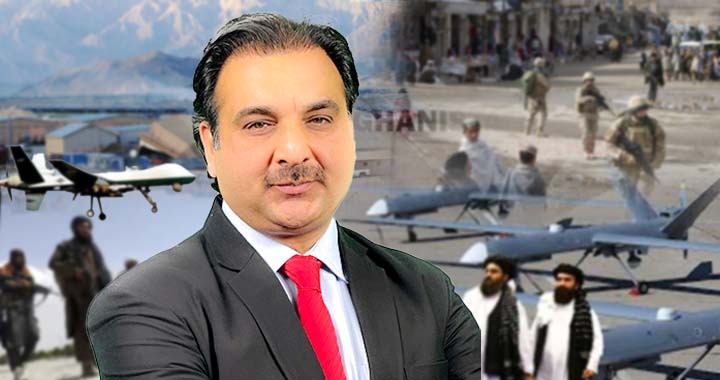
Reports of alleged contacts between Israel’s intelligence agency and the Taliban have revived a familiar question in regional geopolitics, is Afghanistan once again becoming a center of covert competition and intelligence operations?
In recent discussions and intelligence assessments circulating in the region, claims have surfaced suggesting that Israel’s intelligence agency, Mossad, may have established operational links within Afghanistan. These reports further suggest that modern drone technology and surveillance systems are being positioned in areas that could potentially monitor neighboring Iran.
While such reports remain difficult to independently verify, they have triggered renewed debate about Afghanistan’s evolving strategic role after the Taliban’s return to power in 2021.
A Pattern That Did Not Begin Today
From my perspective, this development did not emerge overnight. Some indications began to surface during regional tensions in mid-2025, when Iranian security agencies reportedly detained individuals described as foreign intelligence operatives, including agents allegedly linked to India’s external intelligence service, Research and Analysis Wing.
Iranian authorities suggested that these individuals were part of a wider intelligence network operating in the region. According to those accounts, certain Afghan nationals were also involved in facilitating the movement and operations of these agents.
These incidents fueled speculation that Afghanistan may have quietly become a new operational space for competing intelligence networks.
The Question of Mossad’s Presence
Subsequent intelligence reports circulating among regional analysts claimed that Mossad had expanded its reach into Afghanistan and possibly established operational infrastructure near the Iranian border.
According to these reports, certain locations in western Afghanistan could potentially serve as monitoring points or logistical nodes for intelligence gathering. If accurate, such developments would have significant implications for regional security dynamics.
The situation raises an important contradiction. The Taliban leadership frequently presents itself as a movement grounded in Islamic ideology and resistance to foreign influence. Yet at the same time, reports suggesting cooperation with non-Muslim states have prompted questions about the movement’s evolving political and strategic calculations.
Drone Technology and the Logistics Trail
One of the more striking claims in these reports concerns the alleged introduction of advanced drone technology into Afghanistan.
Critics argue that the Afghan Taliban do not possess a large-scale domestic technological base capable of independently developing sophisticated drone systems. This has led to speculation that external actors may be supplying such technology.
According to some intelligence narratives, drone components were allegedly moved through complex commercial routes designed to obscure their origin. The equipment was reportedly shipped through multiple ports, re-labeled as agricultural cargo, and eventually transferred across regional transit points before reaching Afghanistan.
While the precise details remain contested, analysts point to locations in western Afghanistan as possible operational hubs.
Among the sites frequently mentioned in discussions is Shindand Air Base in the western province of Herat. Historically a major military installation, the base has long been considered strategically significant because of its location and infrastructure.
Other areas mentioned include desert regions such as Dasht-e-Margoh, situated between the provinces of Nimruz and Helmand. The vast terrain there offers natural concealment for mobile launch platforms and temporary operational facilities.
Mountainous provinces such as Ghor and Farah have also been cited in speculative intelligence mapping because of their potential suitability for signal monitoring stations.
Afghanistan and the Intelligence Battlefield
The broader issue is not limited to a single intelligence agency or country. Afghanistan has historically been a theater for global intelligence competition.
During the Cold War it was a central battleground for rival intelligence networks. Even after the end of the Soviet American rivalry, the country continued to attract the attention of regional and global powers.
Today, Afghanistan’s strategic geography places it at the intersection of several competing interests involving the United States, China, Russia, Iran, Pakistan, and India.
For that reason, analysts believe that intelligence activity in the country is unlikely to disappear, regardless of which government controls Kabul.
Terror Networks and Regional Concerns
Another issue frequently raised by regional security institutions concerns the continued presence of militant groups inside Afghanistan.
Reports presented in forums linked to the United Nations Security Council have warned that thousands of militants belonging to various organizations remain active within Afghan territory.
Neighboring countries including Pakistan, Iran, China, and Russia have repeatedly expressed concern that these groups could pose cross-border security risks.
The Taliban leadership, however, maintains that such groups do not threaten Afghanistan’s internal security. This position has created persistent tension between Kabul and several regional governments.
Implications for Pakistan’s Security
For Pakistan, the security dimension is particularly sensitive. Islamabad has repeatedly accused militant networks operating from Afghan territory of carrying out attacks inside Pakistan.
In response, Pakistan has carried out targeted strikes against militant hideouts it claims were linked to cross-border terrorism. Notably, most countries in the region refrained from openly condemning these actions, which some analysts interpret as tacit recognition of Pakistan’s security concerns.
At the same time, Pakistan’s strategic capabilities, including its status as a nuclear power, act as a deterrent against any large-scale external military confrontation.
The Larger Geopolitical Chessboard
Ultimately, the issue surrounding Afghanistan cannot be separated from the wider geopolitical contest shaping Asia today.
The region sits at the crossroads of major economic corridors, strategic energy routes, and great-power competition involving the United States, China, and Russia.
In such an environment, intelligence operations, technological surveillance, and proxy networks often become tools used by competing powers to influence events without direct confrontation.
Whether the latest reports about intelligence cooperation in Afghanistan prove accurate or exaggerated, one conclusion remains difficult to ignore.
Afghanistan continues to occupy a pivotal place on the geopolitical chessboard, and the struggle for influence around it is far from over.