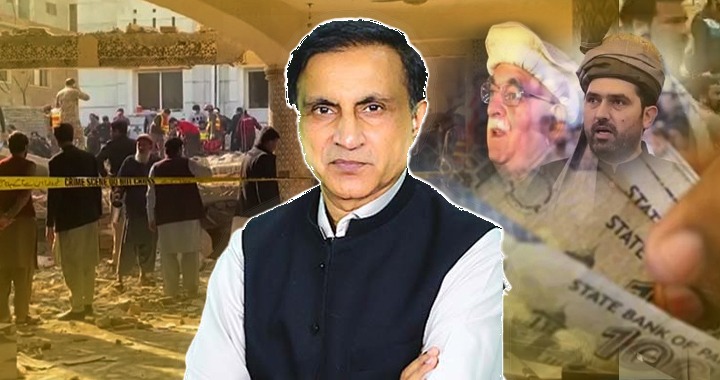
The suicide blast at the Tarlai mosque is not merely another entry in Pakistan’s long ledger of grief, it is a warning flare rising from the capital’s own skyline.
Dozens lost their lives; many more were wounded. The attacker, reportedly linked to Fitna al-Khwarij, was intercepted at the mosque gate. That single interruption prevented an even larger massacre. Had he penetrated the prayer hall, the scale of tragedy would have multiplied beyond imagination.
Yet even this partial prevention does not soften the core reality, a suicide bomber reached a place of worship in the federal capital.
Islamabad has previously worn the label of a “safe city.” Surveillance cameras blanket its arteries. Entry routes are regulated through vehicle stickers and digital tags. But technological grids alone cannot neutralize human bombs. When such an હુમલો unfolds despite layered policing, intelligence gaps must be examined with seriousness, not ceremony.
This is not the first such breach. Incidents near Kachehri Chowk and adjoining zones have already tested the capital’s shield. The recurrence signals systemic vulnerability.
Intelligence Before Interception
Policing can only react at the final mile. If a bomber reaches a checkpoint, the battle is already half lost. The true battlefield lies earlier, in intelligence penetration, surveillance of networks, and pre-emptive disruption.
Strengthening CTD units, special branches, and inter-agency coordination is no longer optional. These institutions require funding, manpower, and technological augmentation. Without anticipatory intelligence, security forces are left confronting explosions rather than preventing them.
Investigations will determine the attacker’s identity. In past incidents, Afghan nationals were involved. Early indicators again point toward cross-border facilitation. Militant sanctuaries operating from Afghan soil, coupled with proxy sponsorship by hostile intelligence networks, continue to target Pakistan.
India’s hybrid warfare model relies heavily on such deniable assets. Pakistan, as an atomic power with ideological and geopolitical fault lines, remains a prime target for proxy destabilization.
Border management steps, including closures, indicate Islamabad’s concern. Yet infiltration despite restrictions raises operational questions that investigations must answer.
Apex Committee and Governance Questions
Security crises inevitably circle back to governance.
The Apex Committee meeting marks a necessary, though delayed, convergence. Civil and military leadership sitting together in closed rooms is often more productive than rhetorical battles in public arenas.
Khyber Pakhtunkhwa’s law and order environment has deteriorated steadily. Repeated calls for high-level coordination went unanswered for months. The eventual convening of the committee reflects late realization rather than proactive governance.
Merged districts remain the starkest example. Years after integration, residents still face crumbling roads, fragile health systems, weak education infrastructure, and limited employment avenues. Even provincial leadership now acknowledges governance deficits there.
Allocations worth billions were announced. Their on-ground translation remains difficult to trace. Development without delivery fuels alienation, and alienation fertilizes militancy.
Politics, Protests, And Paralysis
Political turbulence compounds administrative fragility.
Calls for nationwide shutdowns, wheel-jam strikes, and long marches reveal deep fractures within opposition ranks themselves. Internal disagreements range from province-wide closures to road blockades linking KP with Punjab.
Yet the practical impact of such protests remains questionable, particularly when announced on public holidays where economic activity is already minimal.
More significantly, agitation politics risks diverting focus from counterterrorism preparedness. Protest is a democratic right, but when it mutates into disorder reminiscent of May 9 violence, it erodes institutional cohesion.
There exists a clear distinction between peaceful demonstration and attacks on state installations, particularly the military. Governance debates must remain political, not insurgent in tone or method.
Shifting Opposition Dynamics
Emerging parliamentary alignments further reshape the landscape.
Mahmood Khan Achakzai’s elevation as opposition leader signals a negotiation-oriented channel with the federal government. Dialogue through committees, electoral reforms, and institutional frameworks appears more likely than street confrontation.
Such negotiations, if sustained, could take years rather than weeks. Immediate outcomes, including prisoner releases, remain improbable within this framework.
This transition from road politics to room politics marks a strategic recalibration within opposition circles themselves.
The Larger Security Picture
An attack in Islamabad carries symbolism beyond geography. When the capital is struck, it conveys national exposure.
Khyber Pakhtunkhwa remains particularly vulnerable, with reports of areas where policing presence thins after dark, allowing militant mobility. This reality demands synchronized action between provincial authorities, federal institutions, and the armed forces.
Encouragingly, recent coordination signals a tentative shift toward unified response.
Pakistan’s security equation cannot afford fragmented governance, delayed decisions, or politicized counterterrorism. Intelligence strengthening, institutional funding, border vigilance, and political maturity must converge simultaneously.
Only then can the country move from reacting to attacks, toward preventing them.