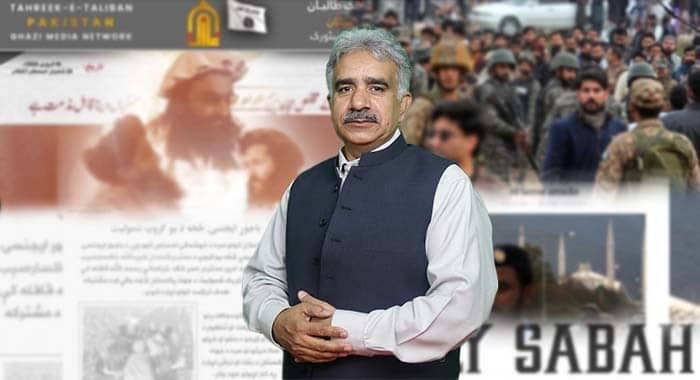
(Zahir Shah Sherazi)
Militant fragmentation in the Afghanistan-Pakistan region is neither new nor accidental. It is the inevitable outcome of a violent ecosystem built on competing egos, contested authority, foreign patronage, and the economics of insurgency. The recent resurfacing of tensions between Tehreek-e-Taliban Pakistan (TTP) and Jamaat-ul-Ahrar is therefore not an anomaly; it is a continuation of a long history of fissures embedded in the DNA of these organizations. To understand the present, we must revisit the origins. The formation of the TTP under the leadership of Tehreek-e-Taliban Pakistan in 2007 was not the birth of a unified ideological movement, but rather the consolidation of disparate militant factions operating across the erstwhile Federally Administered Tribal Areas (FATA). Under Baitullah Mehsud, multiple commanders from Bajaur, Mohmand, Khyber, and South Waziristan were brought under one umbrella. Yet unity was tactical, not structural.
From the outset, power politics defined the trajectory of the organization. Leadership was centralized, but operational autonomy remained in the hands of regional commanders. Figures such as Maulvi Faqir in Bajaur and Omar Khalid Khorasani in Mohmand exercised de facto territorial control. They collected funds, controlled recruitment, and shaped local militant agendas. What was marketed as “jihad” was, in many instances, an elaborate architecture of extortion, kidnapping-for-ransom, smuggling, and coercive taxation. When Hakimullah Mehsud succeeded Baitullah Mehsud, the internal balance shifted again. Drone strikes eliminated top leaders, but instead of dismantling the structure, they intensified competition among mid-tier commanders. Every assassination created a vacuum; every vacuum triggered rivalry. The split that formally produced Jamaat-ul-Ahrar in 2014 was rooted in this power struggle. Omar Khalid Khorasani, citing disagreements with TTP’s central leadership, announced the formation of a separate faction. Publicly, the dispute was framed in ideological terms. Privately, it revolved around hierarchy, influence, and access to resources.
Militant organizations are not monoliths. They are marketplaces of violence. At the core of the rift between TTP and Jamaat-ul-Ahrar lie two enduring variables: authority and revenue. Authority determines who commands fighters, dictates strategy, and negotiates alliances. Revenue determines survival. Whether through local criminal networks, transnational support systems, or shadow taxation, control over finances translates into power.
The emergence of Noor Wali Mehsud as TTP chief marked another attempt at restructuring. He introduced zonal divisions, reorganized operational hierarchies, and sought to reassert centralized control over factions that had grown increasingly autonomous. However, such restructuring inevitably marginalized certain commanders, including elements within Jamaat-ul-Ahrar who believed they deserved senior positions due to experience and battlefield prominence.
This is where distrust compounds division. Militant leaders often accuse each other of espionage, betrayal, or collusion in drone targeting. Allegations that rival factions leaked intelligence leading to the deaths of senior commanders have circulated for years. In such an environment, paranoia becomes institutionalized. Each faction views the other as both ally and potential assassin. Simultaneously, ideological narratives mask pragmatic calculations. While commanders publicly pledge allegiance to a unified “emirate” vision, they privately negotiate spheres of influence. Maulvi Faqir once referred to himself as “Ameer Bajaur,” while Omar Khalid Khorasani exercised authority in Mohmand. The idea of a centralized Islamic Emirate in Pakistan was less a coherent political project and more a mosaic of local fiefdoms. Beyond internal fractures, the regional context further complicates the equation.
Afghanistan’s shifting political landscape, particularly after the U.S. withdrawal in 2021, created renewed space for militant recalibration. The Afghan Taliban’s return to power altered cross-border dynamics but did not dissolve the presence of anti-Pakistan militant groups operating from Afghan soil. Pakistan has repeatedly expressed concerns regarding safe havens allegedly used by TTP elements inside Afghanistan. The Bajaur attack, which resulted in the martyrdom of soldiers and civilian casualties, marked a critical inflection point. The scale and sophistication of the vehicle-borne suicide attack underscored that these networks remain capable of coordinated, high-impact operations. Pakistan’s response, including targeted counterterrorism operations, signaled a shift toward a less tolerant posture. The government’s decision to prosecute all terrorist organizations without distinction reflects a broader recalibration of national security doctrine. Statements by senior officials, including Defense Minister Khawaja Asif, suggest that patience has limits. Diplomatic engagements reportedly included assurances that anti-Pakistan militants would be restrained, relocated, or disarmed. The 18th February deadline was viewed as a marker for evaluating those commitments. If such assurances fail to materialize, the calculus changes.
Pakistan is no longer viewing militancy solely as a bilateral issue with Afghanistan; it increasingly frames the threat within a regional security architecture. Reports by monitoring teams have identified multiple active groups destabilizing not only Pakistan but also Central Asian republics and China. Organizations such as Islamic State Khorasan Province and Al-Qaeda continue to operate within a complex web of alliances and rivalries. The inclusion of groups like Balochistan Liberation Army and the Turkestan Islamic Party in international monitoring discussions highlights the transnational dimension of the threat. China’s security concerns, particularly following attacks on Chinese nationals in Pakistan, have intensified coordination efforts. Russia and Central Asian states share similar apprehensions about cross-border militancy. Thus, the possibility of a collective or coordinated regional approach cannot be dismissed.
However, military action alone cannot fully address the underlying dynamics. The militant ecosystem thrives on ideological indoctrination, economic incentives, and governance vacuums. Foot soldiers often lack clarity about funding sources or strategic objectives. They are mobilized through narratives of religious obligation, personal empowerment, and financial gain. Radicalization operates like a self-replicating virus. Once embedded in vulnerable communities, it multiplies through local networks, online propaganda, and peer influence. Cutting off leadership without dismantling recruitment pipelines merely postpones resurgence. Equally important is confronting the mythologies that sustain militancy. Romanticized portrayals of commanders traveling with armed escorts and luxury vehicles create aspirational images for marginalized youth. When state institutions fail to offer viable socioeconomic mobility, militant structures fill the void with promises of status, income, and belonging. Internal rifts between TTP and Jamaat-ul-Ahrar may weaken operational coherence in the short term, but they do not eliminate the threat. Fragmentation can, in some cases, increase unpredictability. Competing factions may escalate violence to prove relevance, outbid rivals in brutality, or secure external patronage.
Moreover, attribution becomes murkier. When attacks occur, factions may deny responsibility, blame splinter groups, or strategically claim operations to amplify visibility. This ambiguity complicates counterterrorism strategy and public messaging. The state’s challenge is therefore multidimensional. First, it must maintain operational readiness and intelligence precision to neutralize imminent threats. Recent targeted operations demonstrate capability, but sustained vigilance is essential. Second, diplomatic channels must remain engaged. While cross-border strikes are sometimes debated as options, they carry escalatory risks. Regional cooperation particularly with China, Russia, and Central Asian states—offers leverage in pressuring stakeholders to curb militant sanctuaries. Third, internal resilience must be strengthened. Law enforcement reform, judicial efficiency in terrorism cases, financial tracking of illicit flows, and counter-radicalization programs are indispensable components of long-term stability. Finally, public discourse must be anchored in clarity rather than conspiracy. While foreign interference allegations frequently surface, overreliance on external blame can obscure domestic governance gaps. Accountability and institutional reform at home are as critical as strategic deterrence abroad.
As the February 18 deadline passes, Pakistan stands at a strategic crossroads. The era of ambiguous tolerance appears to be ending. The message from Islamabad is increasingly unambiguous: no armed group operating against the state will be exempt from action. Yet history cautions us that militancy in this region has proven adaptive. Leadership decapitations have not eradicated networks. Splintering has not dissolved ideology. External shifts have not neutralized internal grievances. The rift between TTP and Jamaat-ul-Ahrar is therefore a symptom, not a solution. It reflects deeper structural tensions within militant movements—tensions rooted in ambition, resources, and contested authority. Whether these fractures will meaningfully degrade operational capacity depends on how effectively the state capitalizes on them. Pakistan’s shrinking patience signals resolve. The coming months will reveal whether that resolve translates into sustained strategic coherence military, diplomatic, and ideological.
The stakes extend beyond one deadline, one attack, or one factional dispute. They concern the long-term security architecture of a region where power struggles, proxy wars, and ideological militancy have intersected for decades.
In this volatile landscape, clarity of purpose is the state’s greatest asset.