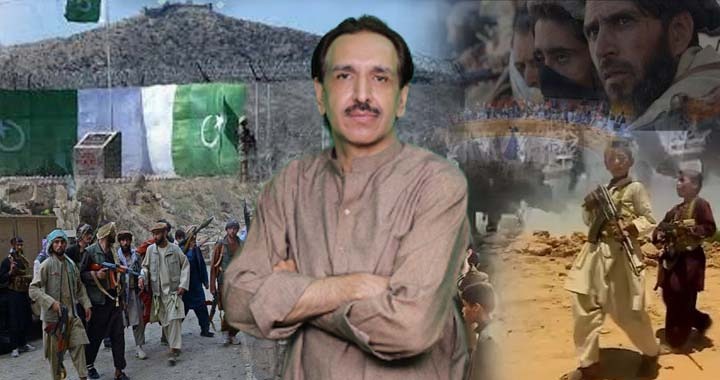
I think this has become a very alarming situation for the regime of the Afghan Taliban. On the one hand, there is growing tension on the Pakistan–Afghanistan frontier, where Pakistan has made it clear that its Operation Ghazab Lil Haq will continue until the objectives of neutralizing militant threats are achieved. On the other hand, the international discourse around Afghanistan is also shifting, as reflected in the recent remarks by US Secretary of State Marco Rubio, who warned that the situation in Afghanistan poses risks for the wider region.
This combination of developments suggests that the Afghan issue is once again gaining serious attention at the international level. For some time, the global focus had shifted to other crises, particularly tensions surrounding Iran and developments in the Middle East. However, the latest statements indicate that Afghanistan is returning to the strategic agenda of major powers.
Pakistan’s position on this matter has been consistent. For years Islamabad has raised the issue of militant groups using Afghan territory to plan and launch attacks against Pakistan. These concerns have repeatedly been presented at international forums. As a result, the discussion about Afghanistan today increasingly includes the question of terrorist sanctuaries and cross-border militancy.
There are also signs that political dynamics inside Afghanistan remain complex. Different opposition voices continue to express views about the future direction of the country. Some figures associated with the former Afghan political landscape have indicated that they remain in contact with regional actors and are observing developments closely. This suggests that internal debates about Afghanistan’s political trajectory are far from settled.
At the same time, propaganda campaigns are circulating on social media claiming that Pakistan has secretly sent delegations to Kabul for negotiations. These claims do not hold up under scrutiny. Individuals who travel to Afghanistan in a personal capacity cannot be presented as representatives of the Pakistani state. Such narratives appear to be part of a broader attempt to create confusion about Pakistan’s policy.
Another important dimension is the issue of perception management. Pakistan’s policy regarding Afghanistan has often been misrepresented through propaganda campaigns. In many cases these narratives attempt to portray Pakistan as responsible for instability, while ignoring the reality that Pakistan itself has suffered enormously from terrorism. Countering such disinformation requires coordinated efforts from the government, political stakeholders, and the media.
There are also indications that hostile propaganda networks may be attempting to exploit the Afghan situation to target Pakistan’s image internationally. When one examines certain narratives circulating in regional media ecosystems, the patterns often suggest organized campaigns designed to distort the facts and weaken Pakistan’s position.
Reports by respected journalists have also highlighted the presence of militant leadership figures inside Afghanistan. These developments are significant because they reinforce Pakistan’s long-standing concerns about terrorist networks operating from across the border. The presence of such figures poses a threat not only to Pakistan but also to the wider region.
Pakistan’s response has therefore been focused on eliminating threats to its security. Operations along the western frontier are aimed at groups that have targeted Pakistani citizens and security forces. At the same time, these actions send a clear message that Pakistan will not allow terrorist organizations to use neighboring territory as a base for destabilizing the country.
Regional diplomacy is also evolving. Several countries, including China, Turkey, and Qatar, have shown interest in facilitating dialogue or easing tensions where possible. These countries have economic and strategic interests in Afghanistan and therefore prefer stability in the region. Their engagement reflects the broader recognition that Afghanistan’s stability is closely linked with regional connectivity and economic initiatives.
However, meaningful progress will depend largely on whether the Afghan authorities address the core concerns that neighboring countries continue to raise. If the current situation persists, Pakistan is unlikely to show unlimited tolerance toward cross-border threats.
At the same time, developments within Khyber Pakhtunkhwa require serious attention. Recently a video circulated showing militants briefly appearing in a vehicle and reportedly establishing a temporary checkpoint in an area near Peshawar. Such incidents are not entirely new, but they highlight the need for stronger governance and improved security coordination at the provincial level.
When militants are able to stage such short-lived propaganda actions, it creates unnecessary anxiety among the public and raises questions about administrative response. The reality is that the security of districts like Khyber is directly connected to the safety of Peshawar. If militant networks are not effectively contained in those frontier districts, the impact can extend into urban areas.
Therefore, while Pakistan’s security institutions remain committed to protecting the country and responding to cross-border threats, the overall situation demands greater administrative focus and responsible governance. The challenges are serious, and they require coordinated action from all stakeholders.
In my view, this is an alarming situation, and it should be taken seriously.