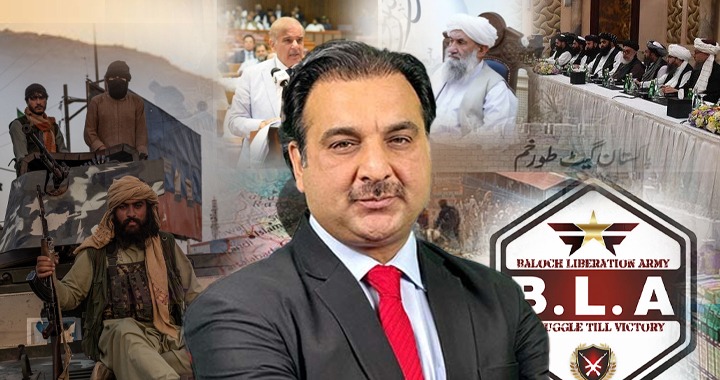
Afghanistan’s trajectory is increasingly raising serious concerns for regional security and global peace. When the Afghan Taliban assumed control of Kabul, there was cautious optimism that Afghan soil would no longer be used against neighboring states. That expectation, however, is steadily eroding. Emerging evidence suggests that Afghanistan is once again becoming a permissive environment for terrorist networks, with Pakistan bearing the immediate consequences.
Terrorists Sheltered at the Heart of Kabul
Credible security reports have revealed that Noor Wali Mehsud, head of the banned Tehreek-e-Taliban Pakistan (TTP), is being harbored in Kabul’s highly secured Diplomatic Enclave. This area, reserved for embassies and foreign missions, represents the core of Afghanistan’s security architecture. The presence of a designated terrorist in such a zone is not merely alarming, it is a direct challenge to international norms and state responsibility.
Even more concerning is the reported involvement of Taliban security elements in protecting him. This points to a troubling alignment, where terrorist groups are not just tolerated but potentially facilitated. Such actions undermine claims that Afghan territory is not being used against other states.
The risks of this policy are profound. By embedding terrorist figures within sensitive locations, Kabul appears to be attempting deterrence through proximity, effectively raising the cost of any counterterrorism response. However, this strategy is inherently dangerous, as it risks internationalizing any potential escalation.
Pakistan’s Defensive Response
Faced with persistent cross-border threats, Pakistan has exercised its right to self-defense. Precision operations targeting terrorist infrastructure in areas such as Kandahar and Khost have reportedly dismantled training facilities, logistics hubs, and weapons caches linked to the banned TTP.
These operations were not arbitrary. Intelligence-based targeting ensured that terrorists were neutralized, with confirmed casualties including fighters and key facilitators. Such actions reflect Pakistan’s calibrated approach, aimed at eliminating threats while avoiding unnecessary escalation.
Attempts to misrepresent these operations through disinformation campaigns have also surfaced. Narratives portraying targeted strikes as attacks on civilian or unrelated facilities have been circulated to obscure the reality. However, evidence on the ground, including identification of those eliminated, reinforces Pakistan’s position that these were legitimate counterterrorism actions.
A Broader Terror Ecosystem
The issue extends beyond a single group. Afghanistan today is believed to host more than twenty terrorist organizations, including the banned TTP, the banned Balochistan Liberation Army (BLA), its Majid Brigade, and Al-Qaeda. This concentration of actors creates a complex and volatile security environment.
Access to advanced weaponry, abandoned military equipment, and evolving technologies such as drones further enhances the operational capabilities of these groups. In such a setting, Afghanistan risks transforming from a national crisis into a regional and global security node.
Pakistan, by virtue of geography, remains on the frontline of this evolving threat landscape. The rise in cross-border attacks, coupled with organized propaganda efforts, reflects a coordinated attempt to destabilize the region.
Contradictions Within the Taliban’s Approach
Recent indications suggest internal deliberations within the Taliban leadership regarding relations with Pakistan. Assignments to senior figures to manage engagement and reduce tensions signal an awareness of the risks involved.
Yet, this is contrasted by continued anti-Pakistan rhetoric and hostile activities emanating from Afghan territory. The coexistence of diplomatic outreach and operational hostility reflects a dual-track approach that undermines trust and complicates resolution.
The notion, at times propagated from Afghan quarters, that destabilizing Pakistan could serve strategic ends is fundamentally flawed. Instability in Pakistan would inevitably spill back into Afghanistan, given the deep economic, geographic, and social interdependence between the two countries. Such thinking is not only counterproductive but strategically unsound.
The Way Forward
Pakistan’s position remains clear and consistent: its sovereignty and security are non-negotiable. While diplomatic channels remain open, the state retains the right to respond decisively to threats originating from across the border.
At the same time, the responsibility does not rest solely with Pakistan. The international community must move beyond passive observation. Ensuring that Afghan territory is not used as a hub for terrorism is a shared global imperative.
Afghanistan stands at a crossroads. It can either move toward responsible governance and regional integration or continue on a path that deepens isolation and fuels instability. The choices made today will determine whether it becomes a bridge for cooperation or a fault line of conflict.