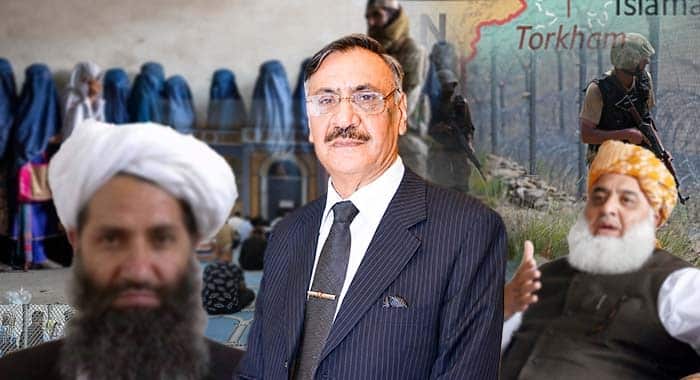
Pakistan’s national security is being placed at risk for political interests, and this is a deeply troubling trend that cannot be ignored any longer. An ugly game is being played in which anti-Pakistan narratives are allegedly being generated from within the country, often with the help of forces hostile to Pakistan, and then amplified by the same hostile elements.
The pattern is clear. State institutions are blamed, allegations are turned into political narratives, and those narratives are repeatedly propagated until they begin to look like established facts. This has increasingly become an organized political strategy for certain parties and groups.
We have to build a wall against this trend.
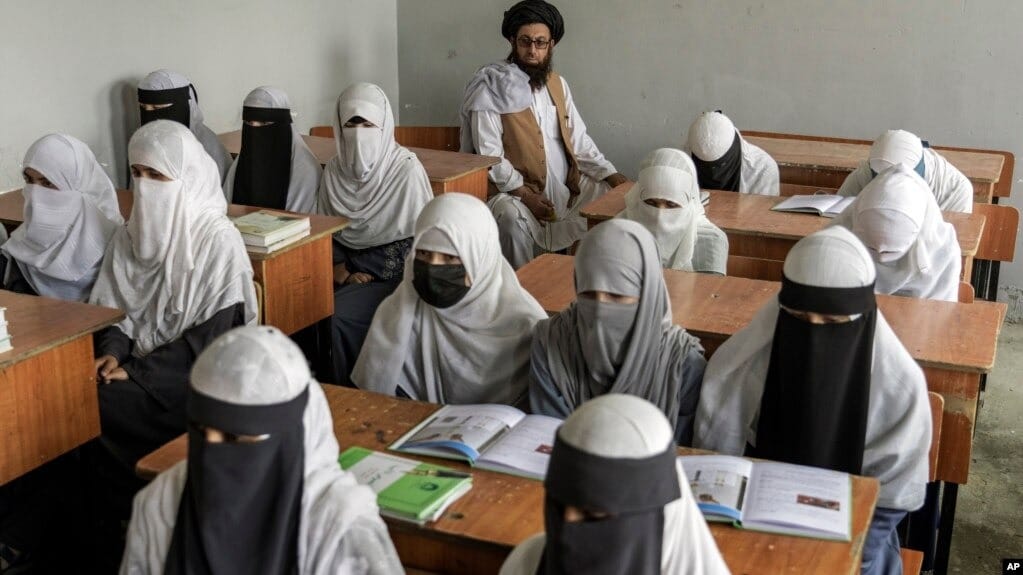
What is happening in Afghanistan is right before us. Religious elements came to power through guns and have since prevented the country from moving forward. Afghanistan remains stuck where it was, while the Taliban regime continues imposing restrictions that affect an enormous part of its population.
Girls are not allowed to receive education. Women face restrictions on leaving their homes. We are talking about almost half of the population. If women cannot be educated, if they cannot become doctors, then what will happen to women who need medical treatment in hospitals? Who will treat them?
This is the kind of situation that Pakistan cannot allow to be imposed on its own society.
When Religion Is Used for Politics
One of the fundamental problems we need to address is the use of religion for political purposes. Some religious parties are using religion as a political instrument, and this is something against which we have not done enough.
Mosques are being used for politics. Our people in neighborhoods and villages should be able to say to political leaders: if you want to do politics, go to the political arena. We come to the mosque to worship.
A person’s religious commitment cannot be judged simply by his appearance. If someone believes he is a better Muslim than another person, who gives him the authority to make that comparison?
I am educated. I have read the Quran. I know Arabic. I may not be standing in a mosque with a beard, but that does not mean that I have no religious emotions or religious education.
Our children go to mosques. They read the Quran, learn its translation, offer prayers and practice their religion. Parents themselves encourage their children to learn the Quran. This is part of our society and our faith.
The problem begins when religion is politicized and religious ideas are deliberately brought into political competition. Political leaders then seek to acquire government power while presenting their political ambitions through a religious lens.
We have seen this phenomenon around us. Questions have been raised about the wealth and lifestyles of certain religious political leaders, including the construction of large properties in D.I. Khan. Where does this money come from? What are the sources of income? What are the educational and professional backgrounds of their family members?
If religion itself becomes the source of political and financial power, we have to ask where this process is taking us.
If such power is not checked, it can continue expanding until it seeks control over the entire country. And if that happens, Pakistan could eventually find itself facing a system resembling the one we see in Afghanistan.
The Afghan Model Cannot Be Imported
There is another issue that demands serious attention. Some political and religious actors in Pakistan appear sympathetic towards the Taliban regime in Afghanistan, while continuing to operate within Pakistan’s democratic political system.
The contradiction is obvious. If Afghanistan has a Sharia-based system in which political parties and conventional political activity are restricted, then why participate in politics here while supporting or defending that model there?
There is a huge python in Afghanistan, and these people are not completely disconnected from the environment around us.
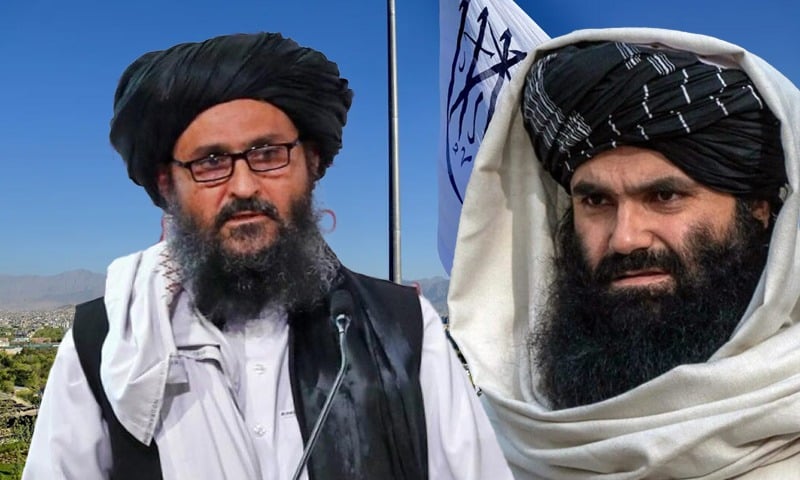
The Taliban leader, Sheikh Hibatullah, has a madrasa in Kuchlak, only a few kilometers from Quetta. His madrasa is located along the road and can still be seen. Around two decades ago, while passing through the area, I asked about the madrasa and was told that it belonged to Hibatullah.
At that time, there was no proof available to us that this man was involved in terrorism. But when the opportunity for leadership emerged, he went on to become the leader of the Taliban.
This should tell us something.
A person who had been sitting here eventually became the leader of the entire Taliban movement. If someone with such ideological roots can move from this environment to the highest leadership of the Taliban, we cannot simply dismiss the broader phenomenon as something happening somewhere far away.
The danger is that such tendencies can spread. First they appear in Khyber Pakhtunkhwa, then in Balochistan, and eventually their influence can extend across the country.
I believe their intentions can be extremely dangerous, and we must oppose any attempt to replicate such a system in Pakistan.
We need to sit down and make one thing absolutely clear: there is a difference between politics and religion.
Pakistan’s 1973 Constitution already provides a framework for the country’s Islamic identity. There are constitutional institutions for religious matters, including the Council of Islamic Ideology. If someone believes that a law is against the Quran or Sunnah, there is a constitutional mechanism through which that question can be raised.
We do not need to abandon the constitutional system to address religious questions.
Politics, Power and the Question of Land
There is also a broader question of political dealings and the use of state resources.
During the period when the MMA government was in power, around 1,200 acres of land in D.I. Khan was allocated in a manner that raised serious objections. There were letters from the A.G. branch concerning the matter.
I was in government at the time and objected to the allocation. I was told to step back because a deal was being worked out with the political leadership.
This land was associated with the interests of martyrs. A large number of Pashtuns serve in Pakistan’s armed forces, and many have sacrificed their lives for the country. In other parts of the country, including Sukkur, land has been allotted to martyrs and their families.
The land in Sukkur is largely desert, and the armed forces have worked hard to make such land productive. If land exists here that can similarly benefit the families of martyrs, why should they be deprived of their share? Where is our share?
These questions cannot simply be brushed aside because a powerful political or religious figure is involved.
A Soft Approach Towards the Taliban
Another question is why certain political parties appear to place their political interests ahead of national security.
Pakistan has made its position clear that terrorist organizations are operating from Afghan territory. Despite this, some actors maintain a soft attitude towards the Taliban regime or remain committed to it.
Why?
The answer, in my view, is that they are caught in the middle because they cannot confront the Taliban. They understand that the religious ideas being implemented there are problematic, but they are reluctant to say so openly because doing so could create hostility with the Taliban.
But if you genuinely speak in the name of Islam, then you should be able to tell the Taliban what they are doing wrong.
Come forward and question them. Tell them what they are doing to Islam. If you understand Islam, then it is your responsibility to speak against policies that are contrary to its principles.
It is not your responsibility to tell them to come here and impose the same system on us.
Yet this is precisely the ambiguity we continue to witness.
The Madrasa Question
The same political dynamic can also be seen in the debate over religious seminaries.
Whenever the government says that madrasas should be brought into the mainstream, that their students should receive broader education and that the system should be integrated with the country’s educational framework, opposition emerges.
But what is wrong with giving madrasa students both religious and contemporary education?
These students are being educated, and they deserve opportunities to move forward in life. They should not be confined to one narrow educational path. They should be able to receive religious education while also learning subjects that enable them to enter the wider professional and economic world.
If students are brought into the mainstream, they can go out and work. They can become productive members of society.
The government is not saying that religious education should disappear. It is saying that religious education should exist alongside other forms of education.
That is a positive approach.
But resistance to mainstreaming creates division rather than integration.
I have seen how this can develop into something even more dangerous. On one occasion in Balochistan, I encountered a religious figure who had established three armed groups. We caught him. Later, he became a friend, and I told him directly: What are you doing?
You are creating a force against the army. Do you really want to take this country towards civil war?
The moment a parallel armed force is created, the foundations of civil conflict are laid. You have your own force, you can acquire weapons from Afghanistan and provide them to your people, while the state is also compelled to enforce its laws.
A country cannot function with parallel forces operating alongside the state.
There must be one lawful authority responsible for security.
Constitutional Politics or a Different System?
There is another contradiction that needs to be exposed.
Some people strongly oppose the constitutional system internally, yet whenever they speak publicly, they present themselves as defenders of the 1973 Constitution.
People can be misled by such rhetoric.
But what does the Constitution actually say? What does it provide for? What mechanisms does it establish for religious questions?
If we speak to scholars in Afghanistan, many of them themselves question the Taliban’s approach. They ask: What era are you living in?
Why should girls not be educated? Why should women be prevented from contributing to society?
We are not interested in interfering in anyone’s private life. But we are saying that children should be educated so they can move forward in life.
Where is the rest of the world going, and where is Afghanistan going?
The Taliban regime remains isolated internationally, and its policies have created a system that is fundamentally at odds with the direction in which the modern world is moving.
Even countries that maintain dealings with Afghanistan have not simply embraced the Taliban model.
Pakistan must therefore be extremely careful that its own political and religious communities do not gradually adopt the same approach.
If our political and religious environment begins moving in that direction, the consequences will be serious.
Pakistan Has a Different Constitutional Tradition
This does not mean that every religious political party should be treated as a threat. Pakistan has had religious political leaders and parties that operated within the constitutional framework and understood the importance of political moderation.
Qazi Hussain Ahmed, for example, was a reasonable political and religious figure. He understood the realities of the region, and his approach earned recognition beyond Pakistan, including in the Arab world. His political thought influenced an entire generation within the religious political sphere.
That distinction is important.
The issue is not whether someone is religious or whether a political party has an Islamic identity. The real question is whether political and religious authority is being used responsibly, whether constitutional institutions are respected, and whether national security is being placed above narrow political interests.
A powerful religious-political network can become dangerous for the country if it begins challenging state authority, creating parallel structures, exploiting religious sentiment or aligning itself with forces whose interests are hostile to Pakistan.
Pakistan cannot afford that.
We must protect the constitutional system, distinguish between religion and political competition, prevent the creation of parallel centers of power and refuse to allow national security to become a bargaining chip in political deals.
Most importantly, we must learn from what has happened in Afghanistan.
A country does not suddenly wake up one morning to discover that its political and social system has been transformed. Such changes develop gradually, through narratives, influence networks, political compromises and the normalization of ideas that once appeared unacceptable.
Pakistan must recognize those warning signs before they become irreversible.
The debate is therefore not simply about one political party, one religious leader or one political disagreement. It is about whether Pakistan will remain a constitutional state in which religion, democracy and law operate within an established framework, or whether political ambitions will gradually turn religious influence into a parallel source of power.
National security cannot be subordinated to political interests, and Pakistan must not allow the Afghan model to be reproduced on its soil.