(Aqeel Yousafzai)
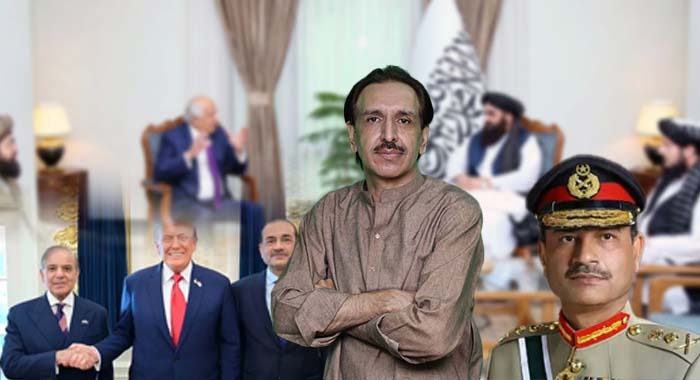
In an era defined by overlapping crises, contested narratives and rapidly shifting power alignments, Pakistan in 2025 finds itself at the centre of an unusually intense global conversation. At the heart of this conversation stands one individual: General Asim Munir. Rarely in Pakistan’s history has a serving military chief—or, as he is now widely described, the country’s most influential security strategist attracted such sustained attention from international media, strategic circles and domestic audiences alike. From the Financial Times to Foreign Policy, from Washington’s policy corridors to debates within Pakistan’s own civil society, Asim Munir has become a reference point for understanding Pakistan’s security posture, diplomatic recalibration and internal resilience.
The recent Financial Times report that triggered renewed debate was not, strictly speaking, about Pakistan alone. It focused on India’s strategic setbacks, regional recalculations and the consequences of May’s escalation. Yet embedded within that analysis was a recurring acknowledgement: Pakistan’s military leadership, under Asim Munir, had executed a policy framework that altered regional equations. This indirect validation is, in many ways, more significant than overt praise. When a global financial and strategic publication frames India’s difficulties through the prism of Pakistan’s military effectiveness, it signals a shift in how power is being assessed in South Asia.
This is not an isolated assessment. Over the past year, major Western outlets including the New York Times and the Washington Post have repeatedly returned to Asim Munir when analysing South Asian security, counter-terrorism dynamics and Pakistan’s evolving role in the Muslim world. In a media environment that has historically been sceptical, if not outright hostile, to Pakistan’s security establishment, such sustained engagement is noteworthy. It suggests that Pakistan is no longer being discussed merely as a problem to be managed, but as an actor shaping outcomes.
One reason for this shift lies in the doctrinal transformation of Pakistan’s counter-terrorism approach. For years, the state was criticised often justifiably for being reactive. Attacks would occur, condemnation would follow, and operations would be launched after the fact. Under Asim Munir’s leadership, that pattern has visibly changed. The emphasis has moved towards pre-emption, intelligence-led disruption and strategic messaging. Terror threats are increasingly neutralised before they mature into mass-casualty attacks, and this operational shift has had a tangible psychological impact on the public.
Public perception matters. Contrary to claims that a wide gulf exists between the Pakistani public and the military, available indicators suggest a more nuanced reality. Political polarisation, amplified by social media, has often been misread as a wholesale rejection of state institutions. In truth, much of this hostility has been driven by partisan narratives rather than broad-based public sentiment. Surveys, informal polling and on-ground observation point to a consistent trend: Asim Munir is widely seen as a professional soldier with a clear sense of purpose. His personal discipline, religious grounding and institutional focus resonate with a society fatigued by chaos and performative politics.
This domestic confidence is reinforced by how Pakistan has projected itself externally. One of the defining features of Asim Munir’s tenure has been strategic balance. In the Middle East, Pakistan has carefully navigated rivalries between Iran and Saudi Arabia, maintaining working relationships without being drawn into sectarian or proxy conflicts. Diplomatic sources credit Pakistan with quietly easing tensions during moments of heightened strain, including recent frictions involving Yemen and the Gulf states. Such mediation does not make headlines, but it builds trust arguably the most valuable currency in international relations.
Equally significant is Pakistan’s recalibrated engagement with the United States. After years of mistrust following the post-9/11 alliance and its bitter aftermath, Islamabad and Washington appear to have rediscovered a pragmatic working relationship. This is particularly evident in intelligence coordination. Contacts between Pakistan’s ISI and US security institutions, including CENTCOM-linked channels, have intensified. The language used by American officials carefully neutral but noticeably respectful reflects an acknowledgment that Pakistan’s security cooperation is once again indispensable.
This context is essential when assessing recent developments in Afghanistan, including the visit of Zalmay Khalilzad. Much speculation surrounded his meeting with the Afghan Taliban, with claims ranging from secret US agendas to attempts at reshaping Taliban positions on Middle Eastern conflicts. Such interpretations, however, overestimate Khalilzad’s current relevance. In Washington, policymaking is driven by institutional consensus, not freelance diplomacy. Khalilzad represents a specific lobby, not the US state. His legacy in Afghanistan is deeply contested, and among Afghans themselves he is often viewed as a symbol of externally imposed decisions that led to long-term instability.
The real levers of Afghan policy today lie elsewhere: within the US State Department, intelligence agencies and regional security frameworks where Pakistan plays a critical role. In this environment, Islamabad’s influence is not exercised through grandstanding but through sustained engagement. The notion that Afghanistan’s trajectory will be altered by isolated visits misunderstands the structural realities on the ground. What matters more is the evolving alignment between Pakistan, key Gulf states and major powers, all of whom share an interest in preventing Afghanistan from once again becoming a hub of transnational militancy.
Beyond security, Asim Munir’s leadership is increasingly associated fairly or otherwise with economic stabilisation efforts. While inflation control and economic reform are primarily civilian responsibilities, the military’s role in providing a stable environment cannot be discounted. Investor confidence, both domestic and foreign, is closely tied to perceptions of security and predictability. The relative easing of economic pressure in 2025, modest as it may be, has reinforced the narrative that stability and discipline at the top filter downwards.
Critics argue that such narratives risk over-personalising state success. This concern is not without merit. No individual, however capable, can substitute for institutional reform. Yet it is also true that leadership matters most during periods of systemic stress. Pakistan today faces a convergence of challenges unmatched in its history: internal political fragmentation, militant resurgence, economic vulnerability and relentless external pressure. Navigating this terrain requires decisiveness, coherence and the ability to communicate strength without recklessness.
The events of May 10 stand as a defining moment. The crisis tested Pakistan’s command-and-control structures, its diplomatic reflexes and its information strategy. The response measured militarily, assertive diplomatically and disciplined in messaging contrasted sharply with past episodes of escalation. International reactions, including subdued calls for restraint and an absence of punitive measures against Pakistan, indicated that Islamabad’s actions were understood, if not universally applauded.
This is why Asim Munir’s name now appears so frequently in global analyses. He has come to symbolise a Pakistan that is no longer content with reactive survival but is seeking strategic relevance. Whether this trajectory can be sustained depends on factors beyond any one individual: political reconciliation, economic reform and societal cohesion chief among them. Yet for now, the convergence of public confidence, operational effectiveness and international acknowledgment has created a rare moment of alignment.
History will ultimately judge the outcomes of 2025, not its headlines. But it is already clear that Pakistan’s image long defined by crisis and contradiction is being recalibrated. In that recalibration, Asim Munir occupies a central, if controversial, place. For supporters, he represents professionalism and resolve. For critics, he embodies the enduring dominance of the security establishment. For the international community, he is increasingly seen as a rational actor in an irrational region.
In a fractured world hungry for stability, such perceptions carry weight. And for Pakistan, a country perpetually negotiating its place between geography and destiny, that weight may yet prove decisive.