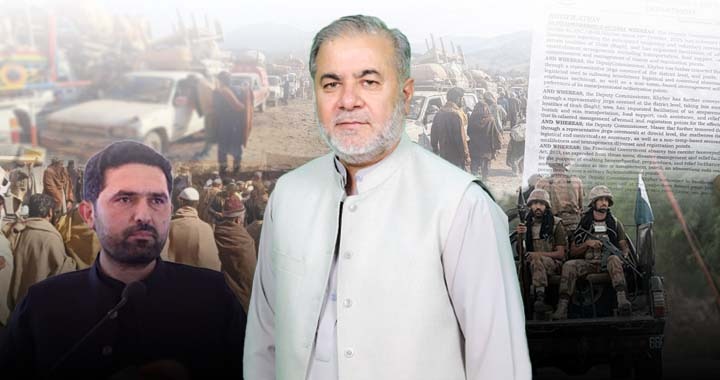
The tension between the government of Khyber Pakhtunkhwa, where the governance has miserably failed its citizens, and the federal government is clearly visible. But this tension and the effects of all these political disputes are only being raised by the people of Khyber Pakhtunkhwa. The province, which the government of Khyber Pakhtunkhwa was trying to make a model, is now full of political disputes, mismanagement, conflicting statements, and security issues.
A serious issue is unfolding today. During a rally in Swat, Sohail Afridi addressed the public and accused that a 12-member committee had forced him to relocate the tribesmen in Tirah. This raises a critical question: what is happening in Tirah? Contrary to this, the federal minister for Information stated that no such agreement with the provincial government had been made, and no migration deal exists. This creates a very serious problem: who is making these decisions? Are migration decisions being made by the federal or the provincial government?
Looking back, Tahreek-e-Insaf has ruled this province for 13 years, and on the ground, they have nothing to show or impress people. Except for a few slogans—if tied to Imran Khan, people gather. Regarding Tirah, when the situation was very bad, reports indicated that five militant organizations were active, attacking government facilities and Peshawar. There were bombings and civilian casualties.
The government created a 24-hour platform giving three options: negotiate with militants, form an army to remove them, or leave the area for security forces to handle. The Taliban did not cooperate, and the Jirga concluded that forming a local army was impossible, leaving migration as the only option. In October, the Deputy Commissioner issued a letter preparing the government machinery for displaced people, arranging tents and other essentials. This process fell under the cabinet of the minister, the Apex Committee chaired by the Chief Minister.
Unfortunately, perhaps the government did not anticipate harsh weather, or they misrepresented facts. People became trapped, some died, and yet no federal government or minister made a statement; the government carried out all actions themselves. When chaos increased, people accused a conspiracy, expressing distrust that the federal or Punjab government was involved. Citizens did not know who to believe.
Small Intelligence-Based Operations, aimed at targeting militants, were misrepresented by the provincial government as justification for large-scale migration. Security agencies cannot distinguish militants from common tribesmen in scattered homes, which complicates operations. This season’s heavy snow has made such operations even harder, leaving many displaced people stranded.
The government machinery and elected representatives are unable to function cohesively. The Minister of Information issues statements; the Chief Minister makes separate statements from containers, showing internal disunity. Small operations, like IBOs, do not warrant large-scale displacement, yet provincial claims create confusion.
This double narrative extends to militancy and governance. Leaders fear losing sympathy from militants if they openly support military action. They are internally divided, seeking power, but do not focus on solving public problems. Senior bureaucrats have described Tahreek-e-Insaf officials as “nabaligh”—immature and incapable of governance. When officials cannot work with bureaucrats, they fail to address citizens’ needs, resulting in public defamation of the government.
Sohail Afridi has publicly claimed death threats. If the provincial chief executive is threatened, it is unclear who is responsible. Leadership is ineffective: the Minister of Information failed to deliver on promises, including freeing Imran Khan from jail. Citizens are frustrated. Governor Raj’s potential election seems irrelevant if leadership cannot function effectively. The current governor is not fit for the province, and without addressing Waqf-e-Nau funding, the province cannot progress.
Hospitals, schools, and basic services remain neglected. Public sector hospitals are underfunded or inactive, roads are unrepaired, and the health card, though significant, burdens the province financially without improving ground-level service. Tourist areas like Swat see economic activity, but only from external visitors, not government facilitation.
Ultimately, KP’s governance has failed. Leaders hide behind Imran Khan’s popularity, abusing opponents and relying on votes in his name. When citizens recognize that in 13 years little has been done for the province, PTI members will face the reality of their failures. Meanwhile, their good fortune persists because people vote for Imran Khan, not their individual performance.