(Shamim Shahid)
For years, the dominant question surrounding militant violence in Pakistan has been deceptively simple: why do groups that claim to fight in the name of Islam increasingly behave like political and nationalist actors, selectively targeting some parties while sparing others? Yet beneath this apparent simplicity lies a long, complex history of ideological mutation, political expediency, and strategic calculation. The transformation of jihadi organizations into actors guided by a form of militant nationalism did not occur overnight, nor was it accidental. It is the outcome of decades of conflict, state policies, regional wars, and the deliberate choices of militant leaderships who learned to cloak power politics in religious language.
To understand this shift, one must return to the Afghan jihad period. During the war against the Soviet Union, militant groups were not monolithic. Even then, ideological and political divisions existed. There were clashes, protests, and rivalries between different factions, though violence among them was relatively limited. The idea of jihad served as an overarching narrative, but beneath it lay competing visions of power, leadership, and influence. These contradictions were present but contained, largely because the focus remained external.
After 9/11, the nature of militancy in the region fundamentally changed. Groups that once framed their struggle as transnational jihad increasingly redirected their violence inward. The Tehreek-e-Taliban Pakistan (TTP) is the clearest example. While continuing to invoke Islam, Shariah, and the idea of a caliphate, the TTP began to operate with a distinctly political logic: anyone perceived as an obstacle to its objectives became a legitimate target.
This is why, over the years, the bulk of attacks were carried out against leaders and workers of the Awami National Party (ANP), followed by sustained violence against factions of Jamiat Ulema-e-Islam (JUI). Scholars, political workers, and local leaders were assassinated, not because of theological disagreements alone, but because these parties represented political resistance in areas the Taliban sought to dominate. Their presence challenged the Taliban’s claim to authority, influence, and control.
At the same time, several other political actors remained conspicuously untouched. Mahmood Khan Achakzai’s political group, for instance, did not face Taliban violence. The Pashtun Tahafuz Movement (PTM), despite its vocal criticism of the state, was also not targeted. The reason is not ideological alignment but strategic calculation. These actors were not seen as immediate obstacles to Taliban objectives. Achakzai, in particular, had maintained a consistent policy since the Afghan jihad era of avoiding confrontation with the Taliban, even cultivating cordial relations with them in parts of Balochistan.
This selective targeting exposes the myth that Taliban violence is indiscriminate or purely doctrinal. It is neither. The Taliban attack those they consider to be in their way. Their actions are guided by a rigid worldview that seeks to impose a version of Islam of their own making, one that serves their political ambitions rather than the collective interests of Pakistan, Muslims, or even Pashtuns. In this sense, their struggle is not for faith, but for power.
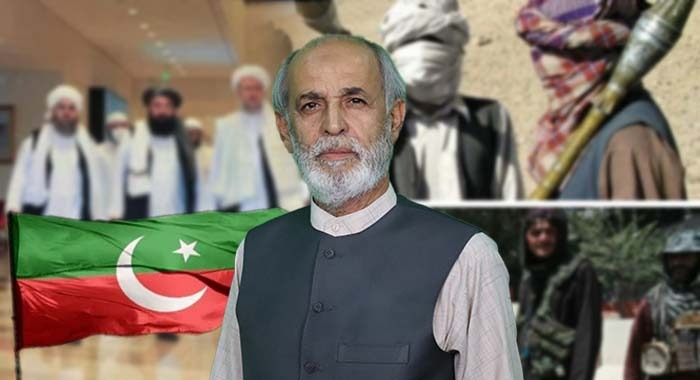
The question then arises: why has Pakistan Tehreek-e-Insaf (PTI) largely remained outside the Taliban’s line of fire? The answer lies in political history rather than coincidence. As early as 2011–12, when Imran Khan’s political popularity was rising, he publicly spoke of opening a Taliban office in Pakistan, similar to the Afghan Taliban’s political office in Qatar. Later, after PTI came to power in Khyber Pakhtunkhwa, senior leaders echoed this position, presenting themselves as facilitators rather than opponents of the Taliban.
Equally significant is PTI’s long-standing narrative on militancy. Rather than outright opposition, the party consistently emphasized dialogue and negotiation. Terrorism, in this framing, was something to be talked through, not confronted militarily. From the Taliban’s perspective, this meant there was no ideological or political obstruction coming from PTI. As a result, the party did not become a target.
This dynamic deepened further after the Taliban takeover of Afghanistan in 2021. Multiple engagements took place, involving Pakistani intermediaries and political figures from Khyber Pakhtunkhwa. Agreements were discussed, concessions were made, and understandings were reached—though not always formalized through state mechanisms. In these engagements, promises were reportedly extended regarding activities in tribal and northern districts, while hundreds of convicted militants were released following presidential pardons. Some senior commanders remained in custody, but the overall message was unmistakable: reconciliation was being prioritized over accountability.
Negotiation with militants is often defended as pragmatism, but history offers sobering lessons. Pakistan negotiated with militant groups in North Waziristan as early as 2005–06. Further talks followed in later years, including before Operation Zarb-e-Azb. Political leaders and religious figures were included in negotiation teams, and agreements were signed. Yet each round of talks only expanded militant space, granting them freedom of movement, resources, and legitimacy.
At one point, militants were reportedly allowed to travel freely, carry weapons, and even receive financial compensation. Some demands went as far as seeking official recognition of slain militants as martyrs, with compensation packages equivalent to those given to soldiers of the Pakistan Army. These demands reveal the extent to which negotiations drifted from reconciliation into appeasement.
The consequences were predictable. Militancy resurged. While Zarb-e-Azb significantly weakened Taliban infrastructure and influence, subsequent policies reversed many of those gains. Today, the Taliban’s presence and confidence are far stronger than they were immediately after the operation.
This resurgence has direct consequences on the ground. From Bannu to North Waziristan, from Mardan to Chakdara, attacks, kidnappings, and attempted assaults continue. In Lakki Marwat alone, recent incidents show both the persistence of militant threats and the growing role of local resistance. In one case, community protests forced the release of a kidnapped lawyer, demonstrating that while the state’s writ may be contested, public resolve has not entirely collapsed.
Yet these local acts of resistance cannot substitute for coherent state policy. Militancy is not confined to one district or province. It is a national issue, demanding national clarity. Political expediency, whether in the form of selective silence or tactical engagement, only emboldens militant actors.
The events of May 9 further complicate this landscape. Political protest crossed dangerous lines, with attacks on state symbols and institutions, including Radio Pakistan facilities in multiple cities. Politics has always been contentious in Pakistan, but there has historically been an unspoken boundary separating protest from the destruction of state institutions. That boundary was breached, and the consequences continue to unfold through courts and investigations.
At the same time, humanitarian crises persist. Displacement, difficult registration processes, and insecurity have made life unbearable for ordinary citizens in conflict-affected areas. Instead of addressing these urgent concerns, political energies remain consumed by rallies, power struggles, and attempts to secure the release of leaders. The disconnect between political priorities and public suffering has rarely been so stark.
Ultimately, the shift from jihad to selective nationalism among militant groups reveals a hard truth: ideology is a tool, not a goal. Islam, Shariah, and the caliphate are slogans deployed to justify violence, intimidate opponents, and mobilize followers. The real objective is control—over territory, populations, and narratives.
Pakistan’s experience shows that there is no shortcut to peace through accommodation of militancy. Negotiations without accountability weaken the state. Selective opposition fractures society. And political ambiguity creates spaces where violent actors thrive. The lesson is painful but clear: terrorism cannot be managed through politics; it must be confronted through principled, consistent policy rooted in law, justice, and the protection of citizens.
Until that clarity emerges, the cycle of violence will continue, wearing new ideological masks but pursuing the same old ambitions.