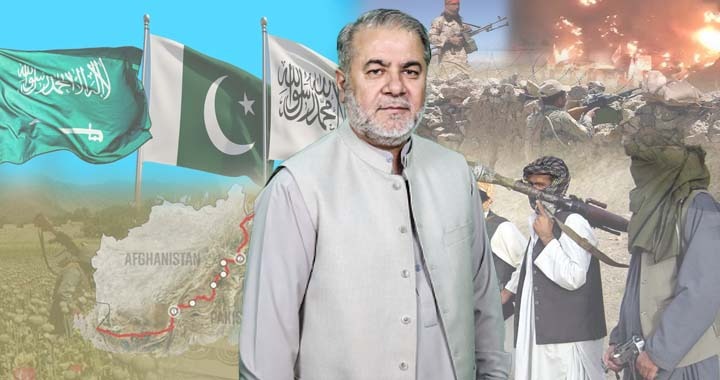
Qatar has once again stepped forward with an offer to mediate between Pakistan and Afghanistan, inviting both sides to resume inclusive political dialogue. The offer, made during the Doha Forum by Qatar’s prime minister and foreign minister, reflects Doha’s belief that renewed engagement might help deescalate rapidly worsening tensions between the two neighbours.
The crucial question remains. Will these talks produce any meaningful outcome, or will they collapse like previous rounds, leaving the two countries exactly where they started?
Recent developments only add urgency. A new SIGAR report has raised serious concern over advanced American weaponry left behind in Afghanistan, now in the hands of the Taliban and indirectly enhancing the militant capabilities of the banned Tehreek e Taliban Pakistan (TTP). At the same time, security conditions in Khyber Pakhtunkhwa continue to trigger public frustration, with two to three protests erupting in the last nine days. This raises another uncomfortable question. Is the provincial government serious about the worsening security situation, or is governance drifting further into neglect?
Relations between Pakistan and Afghanistan are at their lowest point in years. Borders have remained closed for all trade and movement since October twelve. Armed clashes have taken place at several crossing points, including fresh incidents at the Chaman border only days ago. In such a setting, the responsibility falls on friendly states and the United Nations to step in, reduce hostility and help the two sides find a workable path through dialogue. The fact that Qatar is making the effort again can be viewed as a positive development.
A Long History of Failed Talks
This is not the first attempt. Qatar has tried before. The Doha rounds failed to produce a breakthrough. Turkey attempted next, hosting a second and third round in Istanbul. At one point it seemed the process was stabilising, yet negotiations stalled again.
Saudi Arabia made another effort. It invited both sides, hosted discussions and managed to secure some important commitments. There was genuine optimism that Riyadh could succeed where others had not. Saudi Arabia carries stronger influence in the Muslim world and is viewed as relatively neutral. During those talks the two sides agreed that a ceasefire would continue and that negotiations would move into a new phase.
Now Qatar says it is trying again. The renewed push is welcome because wars and bombardment do not resolve tensions. Dialogue is the only option. Yet it is equally important to acknowledge the limits of Qatar’s approach. Doha holds significant influence over the Afghan Taliban, but it also carries a certain tilt toward them. It was Qatar that hosted the Taliban’s political office, the US Taliban negotiations and eventually the Doha Accord that paved the way for the American withdrawal. Influence is a strength, but a tilt can become a challenge for balanced mediation.
Why Saudi Arabia Still Matters
Saudi Arabia’s role deserves attention. Its influence is broader than Qatar’s and it enjoys more regional neutrality. Recent talks hosted in Riyadh had already produced certain commitments. Before shifting venues and restarting the process elsewhere, continuity demands revisiting those understandings. Whether the next round takes place in Doha or Istanbul, serious diplomacy requires that the groundwork laid in Saudi Arabia not be ignored.
Border Closure, Economic Costs and Missed Priorities
The border situation between Pakistan and Afghanistan has deteriorated to a troubling degree. Despite multiple wars with India and long standing rivalry, the Pakistan India border has rarely been closed for prolonged periods. Trade continues even in times of tension. The Pakistan Afghanistan border closure has hit economies on both sides, obstructed traders and damaged livelihoods. Every sensible observer, inside and outside the country, recognises that borders must remain open for trade. The current closure benefits no one except those who thrive in instability.
SIGAR’s Alarming Findings and the American Weapons in Militants’ Hands
The new SIGAR report is not the first of its kind. Earlier assessments had already warned of the concentration of militant groups inside Afghanistan. A UN report previously identified around twenty three organisations operating there, including Al Qaeda, TTP, IS-KP, Chinese and Uzbek groups. That report claimed there were six thousand armed terrorists on Afghan soil, a number that many analysts believe was an underestimate. Earlier studies suggested that more than twenty five thousand trained Pakistani militants were active on both sides of the border.
SIGAR’s latest findings detail how the United States spent one hundred forty four billion dollars in Afghanistan from 2002 to 2021 on infrastructure, bases and reconstruction. It left behind seven billion dollars worth of equipment, including one hundred sixty two aircraft, helicopters, large caches of weapons and nearly ninety six thousand vehicles. At the time, many wondered how Washington would transport such massive arsenals back through Pakistan. Few imagined that the United States would simply leave most of it behind.
According to a recent report in the Washington Post, some of this weaponry has now been recovered from TTP terrorists in Pakistan. Serial numbers confirm that it was originally supplied to Afghan security forces, seized by the Taliban after the 2021 collapse and eventually passed to TTP. The group has benefited significantly. TTP militants have purchased night vision gear and other advanced equipment at high prices, enabling them to target Pakistani security forces and police with greater precision.
TTP has maintained a strong presence in Afghanistan since 2014 and has built deep relationships within the Taliban ecosystem, including with Al Qaeda. Although most of the advanced weaponry has reached them after 2021, the group had long been buying American arms from the Afghan black market. Prices have surged since the Taliban takeover, but availability has increased. Today these weapons flow into Pakistan much like Kalashnikovs did during the Russian Afghan war. Smugglers charge an additional one and a half lakh rupees to deliver the equipment anywhere in the country.
The widespread availability of US made weapons in Pakistan is proof of a simple fact. The border remains fully open for smugglers. Geography works in their favour. Mountainous terrain and a porous frontier make enforcement extremely difficult. Pakistan has attempted to tighten border management, but Afghan governments, present and past, have never exercised effective control beyond major cities. Large rural areas remain outside Kabul’s writ, allowing groups like TTP to operate freely.
A Governance Failure in Khyber Pakhtunkhwa
The situation in Khyber Pakhtunkhwa is equally troubling. Political tensions have escalated to the point where federal and provincial governments openly campaign against each other. This is a dangerous distraction. When the chief minister held a press conference announcing protests outside the Islamabad High Court and Adiala Jail, concerns about security were brushed aside. When questioned about deteriorating conditions, he insisted the provincial writ was intact, even though almost half the province faces severe security pressure.
Governance has collapsed. The obsession with political confrontation has sidelined every core responsibility. A provincial official recently remarked that voters had not elected them to solve public problems, but to secure Imran Khan’s release. This mindset reveals the depth of the crisis.
Healthcare illustrates the failure. Patients referred to Peshawar cannot find beds in Lady Reading Hospital. They move to KTH, then HMC, and still find no space. The health system has broken down. The same applies to infrastructure. Roads across the province remain incomplete. When provincial leaders claim that their priorities do not include governance, they are telling the truth.
If the province receives federal funds, the leadership must reset its priorities. Previous administrations, including the ANP PPP coalition under Ameer Haider Khan Hoti, used funds to expand development across all sectors. Today there is nothing comparable to show. This is the third consecutive PTI government in Khyber Pakhtunkhwa, yet public services continue to decline.
Diplomacy, Security and Responsibility
The region is under strain, Afghanistan continues to host a dangerous mix of militant groups and Pakistan faces rising insecurity. Mediation efforts by Qatar or any other country are welcome only if they lead to a serious and sustained process. Dialogue without continuity has already failed multiple times.
The border must reopen, governance must return to Khyber Pakhtunkhwa and both sides must commit to enforcing security. The price of inaction will be paid by ordinary people on both sides of the Durand Line.