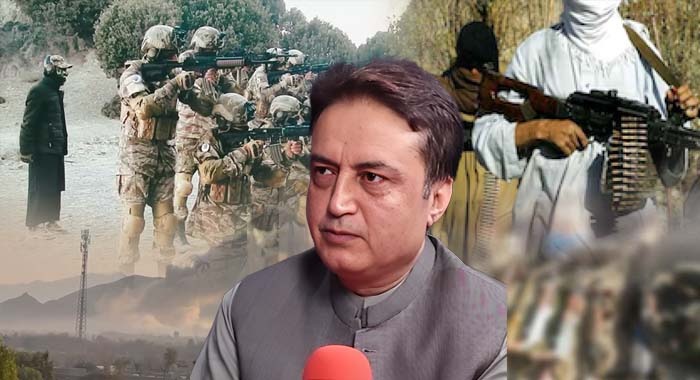
(Arif Yousafzai)
The recent terrorist attack on a security check post in North Waziristan, claimed by the Hafiz Gul Bahadur group, is not an isolated incident, nor is it an unexpected one. It is, rather, another loud reminder of a grim reality that Pakistan has been reluctant to confront honestly: militancy in Khyber Pakhtunkhwa and the former tribal districts has not only returned, it has evolved—faster, smarter, and more deeply embedded than before while the state’s response remains trapped in outdated assumptions, political confusion, and strategic hesitation.
For those who have followed militancy in Pakhtunkhwa over the past two decades, the pattern is painfully familiar. Attacks on security forces, sniper fire on remote mountain outposts, assaults on check posts, sabotage of gas pipelines, water supplies, and infrastructure projects these are not sporadic acts of desperation. They are coordinated, sustained pressure tactics designed to exhaust the state, undermine its writ, and signal control on the ground. What is different today is not the intent of the militants, but the confidence with which they operate.
North Waziristan is central to this resurgence. The presence of militant groups there never truly ended; it merely receded from headlines. Hafiz Gul Bahadur’s network, in particular, has maintained its organisational identity for more than two decades. Unlike many factions, it never formally merged into Tehreek-e-Taliban Pakistan (TTP), choosing instead to operate autonomously while collaborating tactically when interests converge. Its areas of influence stretching from North Waziristan to Bannu, Lakki Marwat, and parts of Dera Ismail Khan are not accidental. These are strategically vital corridors, linking tribal districts with settled areas and major highways.
Groups operating under banners such as Aswad-ul-Harb, Jabhat-ul-Ansar-ul-Mahdi, and even lesser-known names like Tehreek-e-Jihad-e-Islami Pakistan are not new actors; they are rebranded extensions of an old militant ecosystem. Their visible presence on highways, near major development projects including routes associated with the Pak-China Economic Corridor, is deliberate messaging: the militants want to be seen. They want the state and the public to know that territorial contestation is back.
At the core of this resurgence lies a factor that Pakistan has consistently underestimated: militant intelligence. For years, analysts have focused excessively on weapons, training camps, or cross-border sanctuaries, while ignoring the most potent weapon these groups possess human intelligence. Militants are deeply embedded within local communities. They know who is stationed where, which outpost lacks reinforcement, which convoy will pass at what hour. This ground-level awareness gives them a decisive operational advantage.
Over the last 20 to 25 years, one lesson has been repeatedly proven: militant strength does not primarily come from firepower, but from information. Just as police stations traditionally rely on informant networks to maintain local control, militant groups cultivate their own human intelligence through kinship ties, ideological influence, fear, and persuasion. As their networks expand, particularly by recruiting young people in southern districts of KP, their informational reach becomes even wider. This is why attacks are no longer random; they are precise, targeted, and psychologically calibrated.
Compounding this challenge is the changing technological dimension of militancy. A recent United Nations report has warned that terrorist organisations operating from Afghanistan particularly Daesh Khurasan—are becoming increasingly sophisticated. Their use of digital platforms, encrypted communications, artificial intelligence tools, and online bomb-making resources marks a dangerous shift. This is not science fiction; it is a reality that global intelligence agencies are already grappling with.
However, it would be a mistake to assume that this digital turn is entirely new. Militants have always adapted faster than states. Two decades ago, they were using IRC chatrooms and basic messaging platforms when many governments were still dismissing the internet as irrelevant to security. Today, platforms like Telegram offer militants encrypted, decentralised spaces to recruit, coordinate, and propagandise with minimal risk. They do not rely on lone actors randomly browsing the internet; they operate organised social media teams what they openly call “social media fighters” tasked solely with messaging, narrative control, and recruitment.
What is deeply troubling is Pakistan’s visible lack of a coherent counter-strategy in this digital domain. While intelligence agencies are aware of militant activity online and do track individuals, the sheer scale of social media makes comprehensive control impossible. This is not unique to Pakistan; even Western states failed to prevent hundreds of educated youths from Britain and Europe from joining Daesh at its peak. Yet acknowledging limitations should not translate into strategic paralysis. At present, militants are extracting disproportionate mileage from digital spaces because the state’s response remains reactive rather than anticipatory.
But militancy in Pakistan cannot be understood without confronting the Afghan factor an issue that policymakers continue to misread. Pak-Afghan relations are arguably at their worst point in decades. The prolonged closure of the Durand Line has inflicted severe economic losses, particularly on Pakistan. Trade disruptions, shortages of Afghan imports such as fruits, coal, and raw materials, and halted exports—especially medicines destined for Afghanistan and Central Asia have hurt Pakistan far more than is publicly acknowledged.
More damaging than economic loss, however, is the strategic confusion surrounding Pakistan’s engagement with Afghanistan. On one hand, Islamabad has not formally recognised the Islamic Emirate. On the other, it has chosen to internationalise bilateral security disputes by taking them to forums such as the UN, the US, and third countries including Qatar, Turkey, Iran, and Saudi Arabia. This contradiction has proven costly.
Internationalising what is essentially a neighbourhood security problem has weakened Pakistan’s leverage. By sitting with an unrecognised regime on global platforms, Pakistan has inadvertently conferred legitimacy while gaining little in return. The assumption that international pressure would compel Afghan authorities to act against TTP sanctuaries has not materialised and was unlikely to do so. History suggests that neither Afghanistan nor militant groups respond effectively to external pressure, particularly when it is filtered through global powers with their own agendas.
There is also a deeper strategic flaw in placing hope in institutions like the UN or the US to resolve Pakistan’s security dilemmas. These platforms do not operate on goodwill; they operate on interests. Expecting them to stabilise Pak-Afghan relations or neutralise militancy ignores the uncomfortable reality that prolonged instability often serves external geopolitical objectives. When conflicts are internationalised, they rarely become simpler; they become frozen, manipulated, and prolonged.
The most dangerous illusion confronting Pakistan today is the belief that it can manage militancy through politics alone, without matching the evolving sophistication of its adversaries. Militants are not just fighting with guns; they are fighting with narratives, technology, social networks, and long-term patience. Meanwhile, the state oscillates between kinetic responses, diplomatic appeals, and internal political distractions.
The fundamental question, therefore, is not why terrorist attacks are happening when militants are becoming smarter. The real question is whether Pakistan’s policy is becoming smarter at all.
Without a serious reassessment one that prioritises ground intelligence, invests in digital counter-narratives, rethinks engagement with Afghanistan, and abandons the false comfort of internationalisation Pakistan risks repeating the most costly mistake of its recent history: underestimating an enemy it has already faced, and failed to defeat decisively.
Militancy today is not louder than before; it is quieter, more calculated, and more confident. And unless policy catches up with reality, the space between smart terror and static strategy will only grow wider with consequences that Pakistan can ill afford.