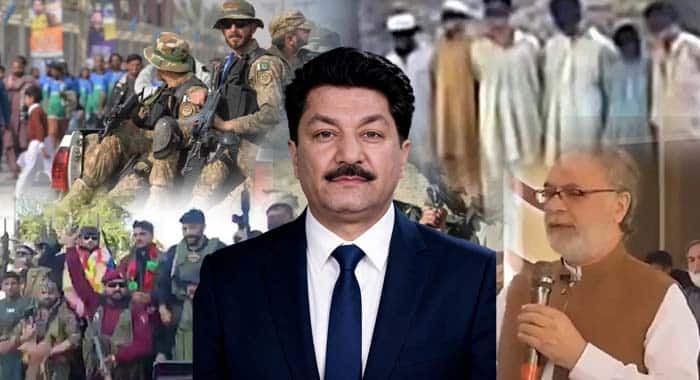
The situation surrounding police peace committees in southern Khyber Pakhtunkhwa requires careful handling by the state. The developments in Kohat should be viewed in light of what happened earlier in Bannu and Lakki Marwat, where police peace committees made demands that eventually disrupted the police administrative structure and created serious challenges for law enforcement.
First, it is important to distinguish between two different arrangements. There are public peace committees or peace lashkars formed at the community level, and then there are police peace committees formed by serving police personnel. The issue under discussion in Kohat concerns the latter. A disciplined force such as the police cannot be allowed to form internal organizations or unions that challenge its chain of command. Such activities are contrary to the discipline and institutional structure of the force.
The recent protest in Kohat’s Kacheri Chowk was triggered by the transfer of two police personnel. The protesters demanded that the transfers be reversed and also called for modern weapons and armored vehicles. Similar demands had been made by police peace committees in Bannu and Lakki Marwat. However, the situation in those districts eventually went beyond demands for better equipment. The established police administrative structure, from district police officers and regional police officers to circle-level officers and station house officers, was disturbed.
The Kohat situation must also be understood against the region’s deteriorating security environment. Several serious incidents have taken place across Kohat Division. In Karak’s Bahadur Khel area, CTD DSP Imranuddin was martyred, while the SHO of Latamber Police Station and four other personnel were also martyred in the attack on the team moving to assist him. In another incident, a police convoy returning after an operation against illegal gold mining activities was attacked, resulting in the martyrdom of a DSP and several other personnel.
These incidents demonstrate the significant terrorist presence in the Kohat region. The security situation is not as stable as it may appear in some other parts of the province. The region is facing both terrorism and organized criminal activity, particularly around illegal gold mining sites and areas near Khushal Garh Bridge. There is an emerging crime-terror nexus in which criminal networks and terrorist groups can operate in overlapping environments, creating additional challenges for the police.
Police personnel are on the front line. Their presence is visible through checkpoints, police stations, patrols and mobile units. Yet, visibility alone cannot protect them from sophisticated attacks. In the convoy attack, more than 30 police personnel were travelling together when terrorists positioned on elevated ground targeted them from the surrounding hills. Fighting an enemy with a tactical advantage and superior positioning is extremely difficult.
This raises a fundamental question: why was the police force not equipped and strengthened earlier? Why were modern weapons, armored vehicles and drone technology not provided to personnel operating in such sensitive areas? If terrorists possess advanced weapons, night-vision equipment and drones, the police cannot be expected to confront them effectively with outdated weapons and limited resources.
Some of the demands raised by police personnel are therefore legitimate and deserve consideration. They need adequate manpower, modern weapons, protective equipment and technology. Night-vision goggles, armored vehicles and drones for surveillance and operational support should be part of the police modernization process. However, legitimate demands cannot justify violations of institutional discipline.
The conduct of the Kohat police peace committee has crossed important boundaries. Its members appeared in uniform, carrying government-issued weapons, and staged a protest by blocking a major road. Videos also surfaced in which they threatened to surround the homes of officers if disciplinary action was initiated against them. Such conduct is fundamentally different from a protest by ordinary government employees. Police personnel represent the state, wear its uniform and carry its weapons. When they use these privileges to challenge the authority of their own institution, the state’s writ itself comes under pressure.
The police leadership has reportedly transferred around 30 personnel associated with the Kohat committee, including some of its members, to other districts. Some have been posted to distant locations, including Kohistan. The issue should now be resolved through dialogue and institutional channels. Police leadership must listen to genuine concerns, particularly those relating to security and equipment, while making it clear that discipline is non-negotiable.
Kohat Division has become one of the province’s most sensitive security regions. Orakzai, Hangu, Karak and Kohat have all witnessed serious incidents. The attacks in the region, including those in Kurram and Thall, demonstrate the breadth of the challenge. There have also been questions about why Kohat Division has not received the same level of administrative and security focus as other designated sensitive districts.
The cancellation of gold-mining leases and the government’s deadline for removing heavy machinery from the affected sites are also important developments. Thousands of pieces of machinery, including excavators, tractors and trailers, were reportedly involved in these operations. The government has directed those who brought the machinery to remove it, warning that they would be responsible for any losses if action was taken. Illegal mining cannot be allowed to continue in an environment where terrorist activity and criminal networks are already creating serious security problems.
The experience of Bannu and Lakki Marwat offers an important lesson. The situation in Bannu had deteriorated to the point where the police peace committee refused to provide security to the then chief minister during his visit. Police personnel were also withdrawn from sensitive installations, including the offices of senior police officials. The situation had become so serious that the institutional chain of command was being undermined.
The regional police leadership eventually handled the matter through negotiations, and the situation subsequently improved in both Bannu and Lakki Marwat. That experience should guide the authorities in dealing with Kohat. Local elders, members of advisory councils, police leadership and district administration should engage with the personnel concerned. Demands that are reasonable should be accepted, while those that cross institutional boundaries must be rejected firmly. Police personnel must understand that disciplinary violations will invite action.
The security situation across Khyber Pakhtunkhwa, meanwhile, requires a broader assessment. There is a difference between claims about a decline in terrorism and the actual situation on the ground. One indicator is the number of attacks claimed by terrorist organizations themselves. A review of statements issued by the banned Tehreek-e-Taliban Pakistan (TTP) over the past month suggests a decline in the number of attacks for which it has claimed responsibility. Where the group previously claimed 15 to 20 attacks, the number has reportedly fallen to around five or six daily.
At the same time, intelligence-based operations have increased across the province. Actions in Shangla, Kohat, Karak and Bajaur, as well as operations in Peshawar and Bannu, demonstrate sustained pressure on terrorist networks. In Bajaur, a Daesh-Khorasan operative was eliminated along with a suicide bomber. CTD operations in Peshawar also resulted in the elimination of several terrorists, while further operations were conducted in Bannu.
The improvement in Mir Ali, North Waziristan, is another important indicator. Business activities are being restored, children are returning to schools and movement on roads has improved. These developments suggest that security operations are producing results beyond the immediate elimination of terrorists.
An important change in the operational strategy is that security forces are no longer focusing only on the location where terrorists are initially identified. Areas into which they might escape are also being monitored and targeted through coordinated operations. Escape routes are blocked, and surveillance is maintained through ground and aerial monitoring, including drones. This reduces the ability of terrorist groups to move from one area to another after an operation.
Terrorists are also attempting to exploit civilian settlements. They hide in populated areas, use residential buildings and establish facilities near mosques, making operations more complicated for security forces. They may deliberately seek civilian casualties or damage to provoke public anger against the state and security forces. This is why residents must remain alert and avoid providing terrorists with opportunities to use civilian spaces as cover.
Local communities know their surroundings better than anyone else. They can identify unfamiliar individuals, suspicious activities and unexplained sources of income. If an unemployed young man without a clear source of livelihood suddenly begins receiving a regular monthly payment, purchases a motorcycle and has money for fuel, people should ask where these resources are coming from. Such observations do not establish guilt, but they can help identify suspicious patterns that deserve verification by the relevant authorities.
People must also ensure that their hujras, mosques and community gathering places are not misused by suspicious individuals. Public cooperation is essential. Security cannot be treated as the sole responsibility of the police or security forces. Citizens must share credible information with the authorities and play their part in protecting their communities.
Finally, the present political and administrative arrangement has created greater coordination between the provincial government and the security establishment. In the previous setup, security forces continued their operations, but the political government did not provide the same level of public ownership and support. The current administration appears to be more aligned with the security effort.
If this coordination produces a sustained improvement in the security situation, the provincial leadership, including Governor Faisal Karim Kundi, would deserve credit for its role. However, that credit must ultimately be judged by developments on the ground, rather than political claims.