An unsubstantiated and highly emotive allegation circulating online claims that Pakistani Rangers killed a 14-year-old girl and seriously injured her 12-year-old sister. The claim has been disputed, with allegations that unrelated photographs of private individuals are being misrepresented as images of supposed victims.
THE VIRAL CLAIM
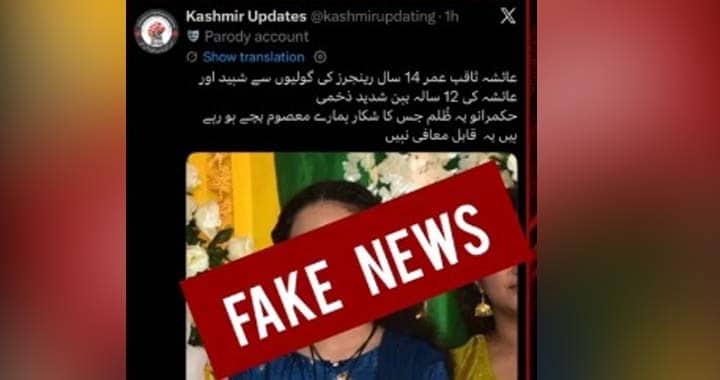
An India-based social media account, identified as @kashmirupdating, is reportedly circulating an emotionally charged allegation claiming that a 14-year-old girl named Ayesha Saqib was killed and her 12-year-old sister seriously injured by gunfire allegedly fired by Pakistani Rangers.
The allegation seeks to portray the incident as an example of violence against children by Pakistani security personnel. However, the material presented alongside the claim has been challenged, with serious questions raised about the authenticity of the photographs and the identities of the individuals being portrayed as victims.
FACT-CHECK FINDINGS: SERIOUS QUESTIONS OVER THE AUTHENTICITY OF THE CLAIM
Information provided for this fact-check disputes the alleged incident and states that local administrative records and ground-level accounts do not confirm any such incident involving Pakistani Rangers firing on children.
More importantly, concerns have been raised regarding the photographs circulated alongside the allegation. The images are alleged to have been taken from unrelated social media profiles and subsequently presented as photographs of children supposedly killed or injured in the alleged incident.
If independently established, such manipulation would constitute a serious case of digital identity misuse and the exploitation of private individuals for the dissemination of disinformation.
No independently verifiable evidence has been provided with the original allegation to establish the identities of the supposed victims, the circumstances of the alleged shooting or the authenticity of the accompanying photographs.
IDENTITY MISUSE: PRIVATE PHOTOGRAPHS ALLEGEDLY REPACKAGED AS CASUALTY IMAGES
One of the most serious aspects of the allegations concerns the reported misuse of photographs belonging to unrelated individuals.
The alleged practice involves:
- Taking photographs from unrelated or private social media accounts.
- Reusing those photographs without the individuals’ consent.
- Assigning fabricated identities and casualty descriptions to the people shown.
- Presenting unrelated images as evidence of an alleged security-force incident.
- Circulating emotionally charged narratives to generate public outrage.
Such practices, if verified, represent a particularly harmful form of digital deception because they exploit the identities and privacy of ordinary citizens, including children.
THE ROLE OF EMOTIONAL MANIPULATION IN DISINFORMATION
The allegation involving two minor girls carries an exceptionally powerful emotional dimension. Claims involving children, civilian casualties and alleged state violence can generate immediate public reactions, particularly when accompanied by photographs.
This makes the independent verification of such claims essential.
Misrepresenting unrelated individuals as victims of violence can undermine genuine human rights reporting, damage public trust and create confusion about actual security incidents.
The use of emotionally charged imagery without establishing its origin, date, location and identity can turn social media platforms into channels for the rapid spread of misleading narratives.
ATTRIBUTION AND ACCOUNTABILITY
The account identified as @kashmirupdating has been named in connection with the circulation of the disputed allegation.
However, establishing whether the account deliberately fabricated the narrative, knowingly used unrelated photographs or coordinated with other accounts would require examination of the original posts, image origins, publication history and relevant digital evidence.
Claims of foreign sponsorship, intelligence coordination or involvement of organized proxy networks should not be treated as established without independently verifiable evidence.