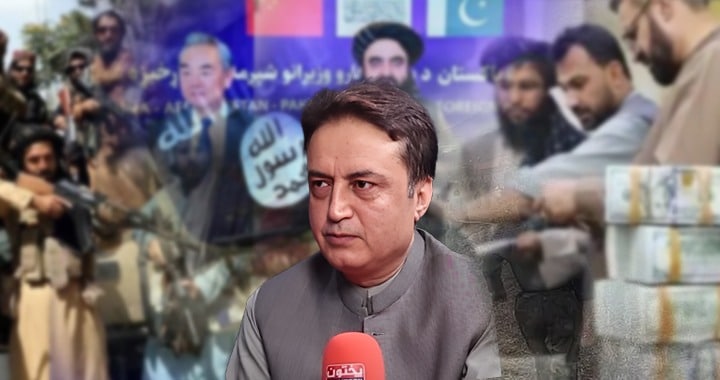
The debate over Afghanistan’s security has once again moved beyond Kabul’s borders. The presence and activities of terrorist organizations such as the Tehreek-e-Taliban Pakistan (TTP) and Islamic State Khorasan Province (ISKP) have increasingly become a regional security concern, while Pakistan continues to bear a particularly heavy cost because of its geographical proximity and long, difficult border with Afghanistan.
The central question is therefore not simply whether the international community is providing financial assistance to Afghanistan. The more important question is whether international engagement is producing the security conditions required to prevent Afghan territory from becoming a platform for terrorism.
As discussed in the programme, the Afghan conflict cannot be understood without looking at its long history. Afghanistan has spent decades caught between foreign intervention, proxy competition, armed groups and internal instability. Pakistan, sharing a long border and deep social and economic links with Afghanistan, has repeatedly suffered the spillover.
But historical explanations cannot become excuses for present-day security failures.
The TTP Question Remains Central
The TTP emerged as a Pakistani terrorist organization in 2007 and has since carried out a prolonged campaign of violence against Pakistan. Its attacks have targeted security personnel, police, civilians and state institutions.
Its presence and operational activity from Afghan territory therefore cannot be dismissed as merely an internal Pakistani matter.
Pakistan has consistently called for concrete action against TTP networks operating from Afghanistan. The issue becomes even more significant when reports emerge about the alleged relocation or arrest of TTP figures inside Afghanistan.
Such reports should be treated carefully. Claims of arrests, restrictions or relocation need independent verification and, more importantly, sustained evidence on the ground.
A temporary movement of individuals from one Afghan province to another cannot be presented as a strategic defeat of the TTP. Nor can an isolated arrest demonstrate a fundamental policy reversal.
The real test is whether TTP leadership, financing, recruitment, training, communications and operational networks are actually being dismantled.
International Assistance Must Come With Accountability
The discussion over international funding for Afghanistan also deserves a more precise treatment.
Humanitarian assistance to the Afghan population is one matter. Financial mechanisms involving Afghan state resources, international assistance or other forms of economic support are another. These should not automatically be equated with direct funding for terrorist organizations.
At the same time, international assistance should not become a substitute for accountability.
If international institutions recognize the terrorist threat emanating from Afghanistan, their engagement with Kabul should include measurable security benchmarks. Afghan territory must not be used to facilitate attacks against Pakistan or any other country.
The Afghan population should not be punished for the failures of those governing them. But neither should the governing authorities be allowed to invoke humanitarian needs whenever questions are raised about terrorism, governance or security.
Pakistan Cannot Afford Another Proxy Battlefield
Pakistan’s own experience demonstrates the consequences of instability in Afghanistan.
For decades, international powers have pursued competing interests in the region. Afghanistan became a battlefield for rival agendas, while Pakistan repeatedly absorbed the consequences through terrorism, displacement, economic disruption and insecurity along its western frontier.
That history makes Pakistan’s current security concerns neither theoretical nor optional.
For Islamabad, the TTP question is ultimately about lives and national security. A terrorist attack planned from Afghan territory does not become less dangerous because the organization operating it describes itself as an Afghan-based or Pakistani group.
The same principle applies to every terrorist organization.
Trade and Security Must Move Together
The possibility of improving Pakistan-Afghanistan trade and reopening border crossings is important for both countries. Prolonged border closures hurt traders, transporters, ordinary families and regional commerce.
China’s interest in regional connectivity also gives economic cooperation an important strategic dimension.
But trade routes cannot flourish in an environment where terrorist networks retain freedom of movement.
Economic connectivity and counterterrorism therefore need to advance together. A secure border is not an obstacle to trade. It is its foundation.
If Kabul genuinely wants stronger economic relations with Pakistan and greater regional connectivity, it has an opportunity to demonstrate that commitment through verifiable security measures.
Kabul’s Choices Will Define the Next Phase
The reported claims about TTP relocation are therefore less important than what follows them.
Will TTP commanders actually lose their operational freedom? Will their safe havens disappear? Will recruitment and financing networks be disrupted? Will cross-border attacks decline? And will Kabul take action consistently rather than temporarily responding to diplomatic pressure?
These are the questions that matter.
There may indeed be backchannel contacts and discussions aimed at reducing tensions between Pakistan and Afghanistan. Dialogue is preferable to confrontation, particularly when two neighboring countries have such extensive economic and social ties.
But dialogue cannot succeed if security concerns remain unresolved.
Pakistan has repeatedly made its position clear: Afghanistan’s territory must not be used for terrorism against Pakistan.
If Kabul wants normalization, regional trade and greater international engagement, the path forward is not another narrative campaign. It is demonstrable action against terrorism.
Until that happens, Pakistan will have every reason to judge Afghan commitments by what happens on the ground rather than by what is said in statements.