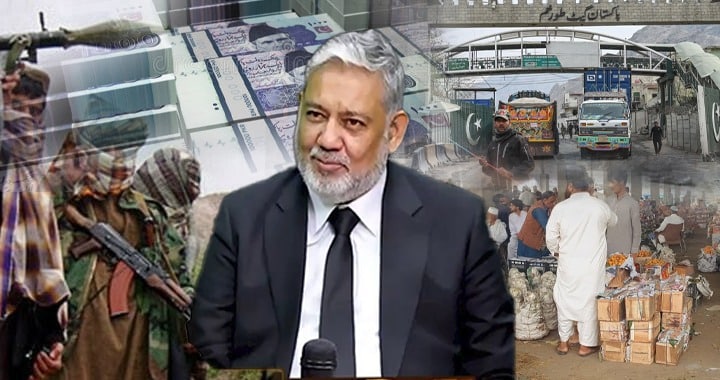
For terrorism to thrive, continuous financing is required.
Terrorism is not an individual act. It is the product of an ideology, a mission, and a carefully structured system. This entire infrastructure, including mobilization, strategy, planning and execution, is run by organizations. In many cases, it is state-sponsored, while in others it operates through networks and affiliated groups.
If we look at Pakistan, we see a wave of terrorism emanating from Afghanistan. At the same time, India has also been accused of exploiting that route to create instability here. These activities are not random. The explosions in the country, the attacks on state institutions, and the conduct of front-line operatives are all part of deliberate planning. Such organized operations cannot survive without funding.
This is an international issue, not merely an individual or domestic one. Its dimensions can be seen globally. That is why the institutions dealing with it are also federal and international in nature. At the global level, countries are monitored and indexed. Data is collected, vulnerable areas are identified, and lists are prepared to determine which regions pose risks to international peace and security.
Pakistan itself remained on the FATF grey list for a long time. Conditions were imposed, and Pakistan had to work extremely hard to address these concerns. On one hand, Pakistan was a frontline state against terrorism; on the other, financial mobilization for terrorism had become a serious challenge.
To address this, Pakistan integrated international laws with local legislation, increased transparency in banking systems, and placed transactions under strict observation. NADRA, the banking system, online banking platforms, all are monitored and remain open to international scrutiny.
The reason is simple: unequal distribution of money and unnatural transactions raise red flags. Suspicious financial activity is tracked through intelligence agencies, the FIA, and military intelligence institutions. Together, they monitor money flows through electronic systems, banking channels and conventional financial orders.
I studied this issue six or seven years ago. I will give an example.
I focused on vegetable and fruit markets. Legally, the government regulates only a limited number of food committees and markets. Yet every day before Fajr prayer, massive transactions involving vegetables and fruits take place there. Many Afghan migrants were active in these markets. They would arrive early in the morning and conduct large-scale undocumented business.
There is no proper documented record in these markets. Money is collected and later transferred to Afghanistan through hundi or hawala systems. These are transactions worth billions of rupees every day. If properly taxed and documented, the revenue generated would be enormous.
We tried to investigate this. We approached the FIA and filed applications through legal channels, including at Chamkani Police Station and other offices. But those applications did not move. That in itself answers many questions.
Despite transactions worth billions, why are these activities not properly investigated?
When the issue became sensitive, cases were registered in NAB against certain market officers and association leaders. Yet many of these individuals remained influential, continued collecting money, and even expanded into private markets. Billions of rupees continue to move through these informal channels.
Then there are jewelers, another major factor. International watchdogs now focus on such non-designated professionals and business entities. You may be surprised to know that accountants and even lawyers can play roles in these financial structures.
This is a vulnerability.
Smuggling, undocumented business, informal economies, white-collar crime, all of these intersect with terrorism financing. These proceeds, once generated, can become terror proceeds. To prove such links requires extensive vigilance and investigation.
Despite institutions like FIA, NACTA, CTD and others working under counter-terror financing policies, illegal smuggling continues in Peshawar and elsewhere.
Why?
Because there are enforcement gaps.
If there were no enforcement gaps from inception to execution, these activities would not continue. Transparency in business activities, stronger mobilization, and capacity-building are essential.
Where there are no punishments, there is usually weak prosecution. Complaints are not pursued. Powerful people influence the system. These enforcement gaps create opportunities for terror financing, making our country increasingly vulnerable.
Smuggling is not limited to one sector. It includes vehicles, petroleum products, drugs and many other goods. Everyone knows that some influential political figures may have links to these networks.
Another major issue is the lack of uniformity between provincial and federal governments. These enforcement gaps are born when there is no coordination. Illegal business shifts between provincial and federal jurisdictions and continues unchecked.
We often hear that when the federal government announces an operation, the provincial government resists it on one ground or another. This resistance creates space for illegal activities.
During operations, people are displaced. Movement increases. In that movement come smuggling, human trafficking, weapons trafficking, and many other illegal businesses. All of these involve money.
Dealing with borders and terrorism is a federal subject. Law and order inside districts is the domain of provincial governments. The question is: why is there often disagreement between the two?
If competent, clear-minded and law-abiding people are in power, they will perform their duties effectively. But when powerful individuals have questionable backgrounds or criminal records, the system becomes compromised.
You have to examine these backgrounds. You have to unfold the layers. Only then will you understand whether it is money laundering or the many stages of such illegal activities.
And when you unfold all these things, then you will know whether it is money laundering, or all the stages of such activities, all these people are included in it, who have the power.