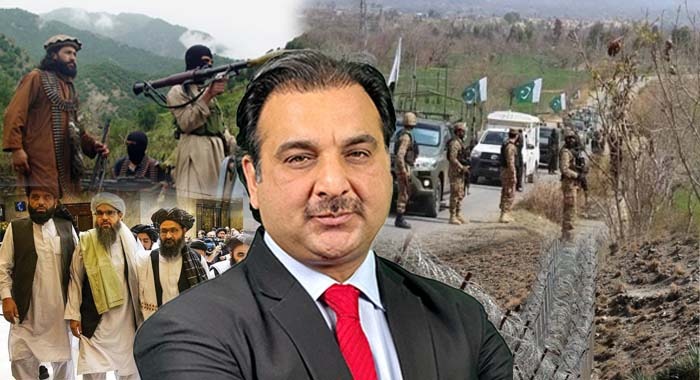
(Irfan Khan)
The recent statements by the Director-General of Inter-Services Public Relations (DG ISPR) have once again brought to the forefront the complex and precarious security situation in Afghanistan. In an interview with a private television channel, the DG ISPR emphasized a stark reality: as long as elements within Afghanistan engage in terrorism on the ground, and the Taliban regime or the Afghan Taliban continues to function as a conduit for extremist activities, meaningful negotiations with these actors remain out of reach. This warning is not merely rhetorical; it reflects a persistent pattern of militant operations and governance challenges that have serious regional and global consequences.
Over the past several months, intelligence reports and field observations have consistently documented the Taliban’s entanglement with terrorist groups. Seven to eight months ago, multiple reports surfaced detailing the operational presence of Al-Qaeda, Daesh, and other transnational terrorist organizations within Afghan territory. These reports highlight not only the organizational structures but also the strategic coordination of these groups with elements of the Taliban, suggesting that the regime’s governance is intrinsically linked to sustaining militant networks. Despite the Taliban’s public rhetoric of moderation and international engagement, evidence from these reports indicates that the situation on the ground remains deeply troubling.
The DG ISPR’s repeated emphasis on these reports underscores a broader intelligence assessment: the Taliban regime, far from being a neutral political actor, continues to facilitate terrorism. This assessment is corroborated by other international intelligence agencies, including the recent alarming report issued by the United States National Intelligence Office, which identified the Taliban as a growing threat in the region. These findings suggest that Afghanistan under Taliban leadership is not only failing to curb extremism but may, in fact, be enabling it. The implications of this reality are manifold, affecting regional security, counterterrorism strategies, and international diplomatic engagement.
One of the key concerns revolves around the operational capabilities of the Taliban and their alignment with foreign terrorist groups. According to intelligence assessments, drone operations and covert logistical networks have been developed to support militant activities, often hidden from the public eye. These operations are meticulously organized to prevent exposure, even in cases of technical failures, which demonstrates the sophistication of Taliban-aligned networks. Such clandestine operations not only endanger the Afghan population but also pose a direct challenge to neighboring countries, particularly Pakistan, which shares a porous border with Afghanistan.
The intelligence reports also raise concerns about the Taliban’s historical and ongoing affiliations with extremist organizations. During the era of Mullah Omar’s leadership, decisions made by the Taliban had profound implications for Afghanistan, resulting in political isolation and international sanctions. History appears to be repeating itself under the current leadership, with the Supreme Leader of the Taliban pursuing policies that could further isolate Afghanistan. The regime’s alignment with groups like Al-Qaeda, Daesh, the Baloch Liberation Army (BLA), and the East Turkestan Islamic Movement (ETIM) signals a continuation of these destabilizing strategies. The DG ISPR’s remarks highlight that these decisions are not only ideologically driven but also strategically calculated to consolidate power and maintain influence over militant networks.
Another dimension of concern is the Taliban’s control over Afghan soil, which continues to serve as a launchpad for terrorist operations. Even in provinces like Helmand, where attacks have been reported against religious sites and local communities, the Taliban’s governance structures appear incapable—or unwilling—to prevent such activities. The repeated references to attacks on locations such as the Al-Aqsa Mosque illustrate the persistence of militant operations under the Taliban’s watch. These incidents underscore the regime’s inability to separate state governance from terrorist facilitation, raising profound questions about the feasibility of any negotiations with the Taliban in the current context.
From a regional perspective, the Taliban’s continued collaboration with extremist groups complicates security dynamics in South and Central Asia. Neighboring countries are increasingly concerned about cross-border terrorism, arms smuggling, and radicalization. Pakistan, in particular, faces direct challenges due to its shared border and historical entanglements with Afghan militant networks. The repeated DG ISPR statements reinforce the necessity for vigilance and proactive counterterrorism measures, including intelligence sharing, border security enhancements, and regional cooperation to mitigate the risks posed by an unrestrained Taliban regime.
Internationally, the Taliban’s alignment with terrorist organizations threatens to trigger a broader geopolitical response. The DG ISPR warned that continued Taliban support for groups like Al-Qaeda and Daesh could result in intensified global sanctions and restrictions, further isolating Afghanistan. The regime’s current trajectory, therefore, not only undermines domestic governance but also jeopardizes Afghanistan’s potential engagement with the international community. For foreign governments and international organizations, the challenge is twofold: maintaining pressure on the Taliban while simultaneously addressing humanitarian and development concerns in a country facing decades of conflict.
A critical aspect of the Taliban’s strategy, as highlighted in the intelligence reports, is secrecy. Operations, including drone deployments and coordination with extremist groups, are conducted with deliberate concealment from the Afghan public and the international community. This secrecy, coupled with technical sophistication, indicates that the Taliban is not merely a passive enabler but an active participant in orchestrating militant activities. Such a dual strategy—governing publicly while supporting militancy covertly—presents a significant obstacle to peace and stability in the region.
The humanitarian implications of these dynamics are profound. Afghan citizens continue to endure violence, insecurity, and limited access to essential services due to ongoing militant operations. Religious and cultural sites have become targets, further destabilizing the social fabric and undermining any prospects for peaceful coexistence. The international community must recognize that addressing Afghanistan’s security challenges requires more than diplomatic engagement; it necessitates robust monitoring, intelligence cooperation, and contingency planning to prevent the country from becoming a sanctuary for terrorism.
The DG ISPR’s repeated references to the reports from seven to eight months ago serve as a stark reminder that the security threats emanating from Afghanistan are neither new nor isolated. Instead, they are part of a persistent pattern of Taliban-aligned militancy that has evolved over decades. This pattern includes operational coordination with transnational terrorist groups, the strategic use of Afghan territory for cross-border attacks, and a deliberate approach to conceal critical military and intelligence activities from both the public and international observers. Recognizing this pattern is essential for policymakers, analysts, and security practitioners in formulating effective responses.
The ongoing presence of extremist groups under the Taliban regime also highlights the limitations of negotiation as a policy tool. The DG ISPR’s statement that “no kind of negotiations will be held” as long as terrorist activities continue reflects a pragmatic approach grounded in the reality of Afghanistan’s security environment. Engagement with a regime that simultaneously governs and sponsors terrorism carries inherent risks, including legitimizing extremist actors, undermining regional stability, and complicating international counterterrorism efforts. For Pakistan and other regional stakeholders, this reality necessitates a cautious, evidence-based approach to diplomacy that prioritizes security while remaining mindful of the humanitarian consequences.
From a broader perspective, Afghanistan’s current trajectory has significant implications for global counterterrorism efforts. The persistence of Taliban-aligned terrorism challenges the efficacy of international sanctions, peace initiatives, and stabilization programs. The international community faces a dilemma: how to incentivize the Taliban to moderate its policies while preventing Afghanistan from becoming a hub for global terrorist operations. Historical precedent demonstrates that Taliban decisions can have far-reaching consequences, as seen during the 1990s when Afghanistan under Mullah Omar became a sanctuary for Al-Qaeda and a focal point for international military intervention. Current intelligence suggests that the regime’s actions today may be steering Afghanistan down a similarly perilous path.
In conclusion, the DG ISPR’s remarks highlight a critical juncture in Afghanistan’s ongoing conflict. The Taliban regime’s alignment with terrorist organizations, its concealment of military and intelligence operations, and its inability to separate governance from militancy pose severe risks to regional and global security. Seven to eight months of intelligence reports consistently indicate that the Taliban is not merely a political entity but a regime with operational ties to extremist networks. As long as this situation persists, negotiation and diplomatic engagement remain fraught with risks, and the international community must calibrate its responses accordingly.
Afghanistan stands at a crossroads: one path leads toward further isolation, militant consolidation, and regional destabilization; the other offers a potential, albeit uncertain, route toward peace and international reintegration, contingent upon the Taliban’s willingness to sever ties with terrorist organizations and govern responsibly. For Pakistan, neighboring states, and the wider international community, vigilance, intelligence coordination, and strategic foresight will be critical in navigating the complexities of Afghanistan’s security landscape. The DG ISPR’s insights, grounded in repeated intelligence references, provide a vital framework for understanding the ongoing challenges and the urgent need for comprehensive, informed policy responses.
Afghanistan’s future will not be determined solely by internal actors; the regional and global implications of Taliban-aligned terrorism make it a matter of international concern. Only a sustained and multidimensional strategy combining intelligence, diplomacy, security operations, and humanitarian support can offer a realistic chance of mitigating the risks and promoting stability in a country long beset by conflict. As the world watches, the decisions of the Taliban leadership will continue to shape the fate of Afghanistan and the security architecture of South and Central Asia.