
(Aqeel Yousafzai)
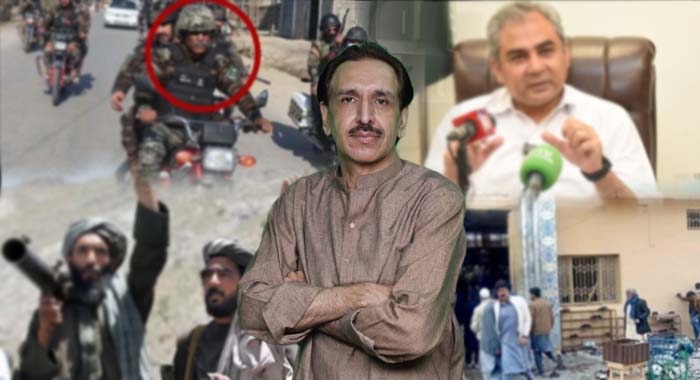
Pakistan stands at a perilous crossroads. A sharp escalation in militant violence across Khyber Pakhtunkhwa, Balochistan and even the federal capital has reignited debate over whether Islamabad should move beyond defensive containment and consider retaliatory measures against militant sanctuaries allegedly operating from Afghan soil. The debate intensified after Interior Minister Mohsin Naqvi, while speaking to the media in Lahore, indicated that the time may have come to take decisive action against terrorist organizations present in Afghanistan. His remarks have opened a new chapter in an already complex security and political landscape. The core question is no longer whether Pakistan faces a grave security threat. That is self-evident. The question now is what strategic path the state will choose calibrated containment, covert pressure, diplomatic engagement, or overt retaliatory action.
February proved to be one of the most alarming months in recent memory. Militant attacks intensified across multiple districts of Khyber Pakhtunkhwa. Urban centers once considered relatively insulated from insurgent violence have become vulnerable again. The psychological barrier was broken when a deadly attack targeted a mosque in Islamabad, demonstrating that even the capital is not immune. The message from militant networks was unmistakable: geography is no longer a constraint. Recent weeks have witnessed attacks in Bannu, Tank, Shangla and Bajaur. In Bannu, police came under heavy assault. Shangla saw the martyrdom of multiple police officials, including senior officers. In Bajaur, a Frontier Corps checkpost was targeted using a vehicle-borne improvised explosive device. Civilians, including a young girl, were among the casualties. Within a span of 24 to 48 hours, multiple coordinated attacks occurred across different districts, signaling not isolated incidents but a pattern of operational synchronization. Such a tempo of violence reflects organizational resilience among militant groups. It also suggests logistical depth, access to safe havens, and sustained recruitment pipelines.
For months, security analysts have warned that the resurgence of the Tehrik-i-Taliban Pakistan (TTP) and affiliated networks is linked to their freedom of movement across the border. The Afghan Taliban’s return to power in Kabul altered the regional security calculus. Whether through inability or unwillingness, Kabul has not effectively restrained anti-Pakistan militant groups. It is within this context that Mohsin Naqvi’s statement must be interpreted. His assertion that retaliatory action against terrorist organizations in Afghanistan may be necessary reflects growing frustration within segments of Pakistan’s security establishment. However, cross-border military action is not a simple option. It carries diplomatic, economic and regional consequences. According to informed sources, there were moments when Pakistan appeared ready to conduct limited strikes across the border. Yet regional actors, including China and Saudi Arabia, reportedly urged restraint to prevent escalation. Their concerns are understandable: a new theatre of conflict could destabilize not only Pakistan and Afghanistan but the broader region. Pakistan must therefore weigh immediate tactical gains against long-term strategic costs. A miscalculated move could trigger a prolonged cycle of retaliation.
Security challenges rarely exist in a vacuum. They intersect with governance, administrative focus and political priorities. In Khyber Pakhtunkhwa, critics argue that administrative mismanagement and political distraction have exacerbated vulnerabilities. At moments when coordinated militant attacks were unfolding, political activity and road blockades dominated headlines. The Pakistan Tehreek-e-Insaf (PTI) organized protests and road closures across Khyber Pakhtunkhwa and beyond. While political dissent is a democratic right, critics contend that the timing was deeply problematic given the security emergency. More controversially, PTI leader Sohail Afridi announced the formation of a “force” aimed at securing the release of party founder Imran Khan. The terminology of a “Liberation Force” alarmed observers. In a province already struggling with militant insurgency, the introduction of quasi-militarized political language risks blurring lines between civic mobilization and coercive mobilization. The optics are troubling. When police and security forces are stretched thin combating insurgents, diverting administrative energy toward political mobilization undermines cohesion. Security operations require unity of command, clarity of purpose and institutional discipline.
The Director General of Inter-Services Public Relations (ISPR) has repeatedly emphasized the need to address mismanagement and ensure institutional alignment. When civil administrations appear preoccupied with political point-scoring, operational focus suffers. The Peshawar High Court, during a recent hearing, questioned law enforcement authorities about arrests and administrative preparedness on the very day major attacks occurred. Such judicial scrutiny reflects broader public anxiety. If Islamabad is vulnerable and district headquarters are repeatedly targeted, confidence erodes. Security professionals argue that police and paramilitary forces have demonstrated professionalism and sacrifice. Casualty figures alone testify to their commitment. But professionalism cannot compensate for policy fragmentation. Counterterrorism demands political consensus.
Pakistan faces three interlocking dilemmas: External Pressure vs Diplomatic Prudence Direct action against militant sanctuaries in Afghanistan could disrupt operational networks. Yet it risks diplomatic rupture with Kabul and possible international criticism. The Afghan Taliban, despite ideological affinities with some factions, are sensitive to sovereignty violations. Internal Political Cohesion vs Partisan Mobilization Road blockades and forceful political rhetoric weaken state coherence during wartime conditions. The state cannot project strength externally if it is fragmented internally. Tactical strikes may provide immediate satisfaction but could provoke asymmetric retaliation. Sustainable stability requires dismantling recruitment pipelines, financial networks and ideological ecosystems.
Pakistan has confronted insurgencies before. Military operations such as Zarb-e-Azb and Radd-ul-Fasaad dismantled infrastructure within tribal districts. However, counterinsurgency is cyclical. Gains must be consolidated through governance, economic development and border management. The reemergence of militant networks indicates that territorial clearance alone is insufficient. Ideological narratives, cross-border mobility and local grievances persist. The Afghan file is particularly delicate. Islamabad once hoped that a friendly administration in Kabul would neutralize anti-Pakistan groups. Instead, the post-2021 environment has produced ambiguity. Kabul denies harboring anti-Pakistan militants, yet operational evidence suggests cross-border linkages.
What Options Lie Ahead?
Several pathways are conceivable:
Targeted Intelligence-Based Operations
Instead of broad military incursions, Pakistan could intensify intelligence-driven precision operations, both internally and, if necessary, through covert channels.
Diplomatic Leverage and Conditional Engagement
Islamabad may escalate diplomatic pressure on Kabul while coordinating with regional stakeholders such as Beijing and Riyadh.
Border Hardening
Enhanced fencing, surveillance technology and biometric systems can reduce infiltration. However, no border is impermeable without cooperative neighbors.
National Political Compact
Perhaps the most urgent need is a unified counterterrorism framework endorsed by all major political actors. Security cannot become collateral damage in political rivalry.
The Federal Government’s Calculus
Though Mohsin Naqvi’s remarks were assertive, the federal government appears to be pursuing a calibrated approach. Some observers argue that Naqvi carries significant institutional weight and would not issue such a statement lightly. Yet rhetoric does not always translate into immediate action.
The Apex Committee meeting earlier this month created expectations of unity. Political leaders publicly declared that they were on the same page against terrorism. However, subsequent protests and renewed confrontational politics diluted that consensus. The federal government must now decide whether to escalate externally or consolidate internally. The two strategies are not mutually exclusive, but sequencing matters.
The Public Mood
Public sentiment in Khyber Pakhtunkhwa is complex. On one hand, there is anger at militant brutality. On the other, there is fatigue from decades of conflict. Citizens demand security but fear a return to large-scale warfare.
When funerals of security personnel coincide with political rallies, the optics deepen frustration. In times of crisis, symbolic gestures matter. Leaders attending funerals, coordinating emergency meetings and suspending political theatrics send a message of seriousness.
A Moment of Decision
Pakistan’s security trajectory will be shaped in the coming weeks. If militant attacks continue at the current pace, pressure for decisive action will mount. Conversely, a reduction in violence could buy space for diplomacy. Yet one reality is inescapable: fragmentation emboldens adversaries. Whether the threat emanates from the TTP or splinter factions, their strategy thrives on exploiting internal divisions. The formation of politically branded “forces” risks normalizing militarized rhetoric in civilian politics. History shows that once political actors adopt paramilitary symbolism, institutional boundaries blur.
Pakistan’s predicament cannot be solved by rhetoric alone. Retaliatory action across borders, if undertaken, must be grounded in clear objectives, legal justification and regional coordination. Equally, domestic governance must align with security priorities. The state’s credibility depends on its ability to protect citizens from Bannu to Islamabad. Police and soldiers have paid with their lives. Their sacrifice demands strategic clarity.
Mohsin Naqvi’s statement may mark the beginning of a new phase in Pakistan’s counterterrorism posture. Whether that phase involves overt cross-border action or intensified internal consolidation remains to be seen. What is certain is that indecision carries its own cost. At this defining juncture, Pakistan requires unity of command, political maturity and calibrated strength. Without these, militant networks will continue to exploit gaps — geographic, political and psychological. The coming months will reveal whether Pakistan chooses fragmentation or cohesion, reaction or strategy, rhetoric or resolve.



