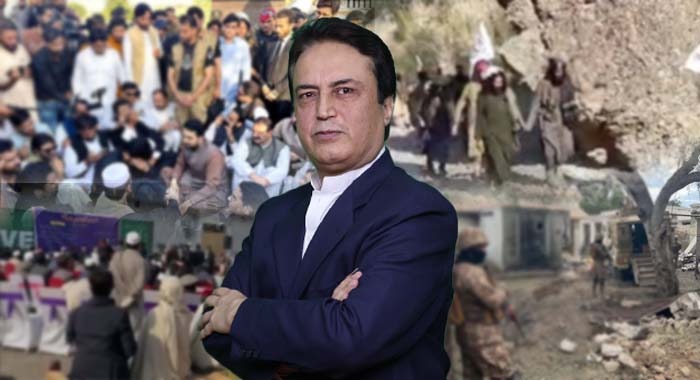
(Arif Yousafzai)
In politics, moments of crisis often separate rhetoric from reality. The events unfolding around Adiala Jail in recent days, followed by the Pakistan Tehreek-e-Insaf’s renewed call for a street movement on February 8, offer precisely such a moment. What was projected as an emergency mobilization around Imran Khan’s health instead exposed deeper cracks within the party, a widening disconnect with its support base, and a leadership struggling to translate emotional narratives into actual public action.
The central question now is straightforward: if the public did not come out when PTI claimed its founding chairman’s health was at serious risk, why would it come out on February 8 for yet another call to protest?
To answer this, one must examine not just the failure of a single night outside Adiala Jail, but the broader political context in which PTI currently operates marked by internal divisions, credibility gaps, governance failures in Khyber Pakhtunkhwa, and an overreliance on unstructured, last-minute calls that exhaust rather than energize supporters.
Late-night scenes outside Adiala Jail were meant to convey urgency. Reports unverified, contradictory, and poorly explained suggested that Imran Khan had been moved to PIMS Hospital due to an eye problem. The narrative escalated rapidly: from a routine check-up to claims of severe retinal damage, and even allegations that Khan had lost vision in one eye. Social media accounts linked to PTI amplified these claims, urging party officials and workers to remain on alert and be ready to “reach immediately” upon instruction. Yet the instruction itself remained unclear. Where were people supposed to go? Adiala Jail? The hospital? The courts? This lack of clarity proved fatal. Despite dramatic messaging, no significant number of party leaders, MNAs, MPAs, or workers arrived neither during the night nor the following morning.
What made this failure particularly damaging was not just the absence of the public, but the visible absence of PTI’s own senior leadership. Social media, instead of showcasing resistance, turned into a platform of internal accountability, with workers openly questioning where their leaders were and why those who issue calls from behind screens hesitate to appear on the ground. This episode did more than fizzle out; it punctured a long-standing PTI claim—that a single call from its leadership can bring millions onto the streets.
No humane or responsible political analysis can dismiss concerns over Imran Khan’s health. Regardless of political differences, Khan remains a major national leader, and his well-being should be treated with seriousness, transparency, and dignity. If he requires treatment, hospitalization, or surgery, it should be provided without delay or political point-scoring. However, the manner in which PTI handled this issue raises uncomfortable questions. Health matters are sensitive by nature. They require clarity, verified information, and restraint. Instead, what emerged was a cascade of rumors, half-truths, and exaggerated claims—none of which were supported by official medical bulletins or consistent statements. In Pakistan, when a prisoner is taken to a hospital, it is not announced through mosque loudspeakers, nor is the public summoned for agitation. The state does not—and should not—operate that way. Turning a medical check-up into a political spectacle risks harming the very person it claims to defend. It also erodes public trust, especially when subsequent developments fail to match the initial alarm.
The conflicting narratives some claiming the family was uninformed, others suggesting they were satisfied with Khan’s condition—only deepened confusion. In the absence of transparency, speculation thrives. But speculation does not mobilize crowds; credibility does.
PTI now links the failure outside Adiala to a larger promise: that February 8 will mark a decisive street movement. Yet political mobilization does not occur in a vacuum. It depends on timing, clarity of purpose, leadership unity, and public belief that participation will lead somewhere meaningful. The Adiala episode suggests that these elements are currently missing. If a party cannot mobilize its own lawmakers and office-bearers on short notice for an issue as emotive as its leader’s health, expecting ordinary citizens facing inflation, unemployment, and security concerns to come out in large numbers appears unrealistic. Public fatigue is real. Repeated calls that lead nowhere gradually lose their power.
Moreover, PTI’s definition of “success” has narrowed dangerously. Blocking a road with a handful of people or placing a few obstacles is now presented as “jamming the system.” This is a far cry from the mass movements the party once prided itself on. When expectations are lowered to such symbolic acts, it signals not strength, but strategic retreat. Perhaps the most critical factor undermining February 8 is PTI’s internal fragmentation. The party is no longer a cohesive force; it is a collection of competing factions. The rift between those aligned with Ali Amin Gandapur and those backing Sohail Afridi has become increasingly visible, with both sides questioning each other’s sincerity, effectiveness, and motives. Within PTI’s own support base, there is growing skepticism about whether current leadership is genuinely working for Imran Khan’s release or merely issuing statements to maintain relevance. Many workers now openly argue that rhetoric has replaced strategy, and slogans have substituted serious political effort.
Comparisons with past leaders only sharpen this critique. Even critics concede that Ali Amin Gandapur, for all his controversies, possessed sharper political timing and stronger street-level engagement than the current leadership. Today, PTI appears trapped in a cycle of press statements without follow-through. Any street movement ultimately draws strength from governance performance. This is where PTI faces its most serious credibility crisis particularly in Khyber Pakhtunkhwa. The situation in Tirah is emblematic. Displacement, harsh winters, inadequate facilities, and allegations of massive corruption in relief funds have generated anger and despair among affected communities. Claims that Rs4 billion were allocated, but only a fraction reached the people, have not been convincingly rebutted by the provincial government. Transparency is not optional in such circumstances. If there is no corruption, the government should publish detailed, rupee-by-rupee accounts of expenditure. Silence only strengthens suspicion. For families forced out of their homes in freezing conditions, political speeches in Islamabad or Lahore mean little when basic needs remain unmet.
A government that struggles to convincingly defend its performance at home cannot easily mobilize people for abstract political causes. Another reality PTI must confront is its current political isolation. Relations with the federal government are strained. Channels with the establishment, once central to PTI’s political calculus, appear limited or non-existent. Whether one views this as victimization or consequence, the effect is the same: PTI lacks leverage.
Street movements historically succeed when they complement broader political negotiations or apply pressure within an already fluid power equation. At present, PTI’s calls appear disconnected from any visible strategy, dialogue, or institutional pathway. Protest, in this context, risks becoming an end in itself rather than a means to achieve change.
February 8 is unlikely to succeed not because public grievances have vanished, but because PTI has failed to convert those grievances into a coherent, credible movement. The Adiala Jail episode was not an anomaly; it was a warning. Emotional appeals without organization, clarity, and trust do not mobilize societies they exhaust them. If PTI genuinely seeks to regain political momentum, it must move beyond dramatic midnight calls and social media alarms. It must address governance failures, heal internal divisions, speak with one voice, and treat serious issues especially health and humanitarian crises with responsibility rather than opportunism.
Until then, calls for street power will continue to echo loudly online and fall quietly on empty roads.