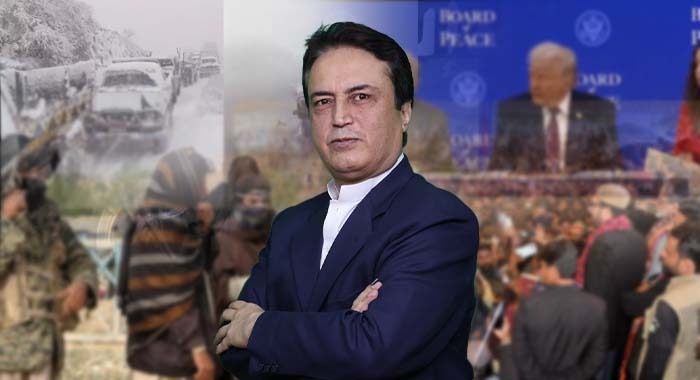
(Arif Yousafzai)
Khyber Pakhtunkhwa today presents a grim paradox. At a time when militancy is visibly resurging, governance in the province appears to be deteriorating with equal speed. This dual crisis is not unfolding in isolation; it is deeply connected to the nature of contemporary politics in Pakistan, where symbolism increasingly substitutes substance, and protest rhetoric replaces policy-driven governance. The call for protests on February 8, the role of seasoned politicians like Mehmood Khan Achakzai, and the performance or lack thereof of the Pakhtunkhwa government together offer a revealing snapshot of a system trapped in political theatre while the ground realities worsen by the day.
The question that must be asked at the outset is simple but uncomfortable: at a time when Khyber Pakhtunkhwa is grappling with deteriorating security, economic stress, and administrative paralysis, what exactly is the political class offering to the people solutions or spectacles? The proposed protest on February 8 has been framed as a defining political moment. Yet, beyond slogans, there appears to be little clarity about its objectives. Is the protest aimed at Islamabad? Is it meant to paralyse governance in the province itself? Or is it simply another performative act meant to keep political relevance alive?
From what has been articulated so far, there is no coherent plan. Closing borders in Khyber Pakhtunkhwa has been casually floated as a tactic, without any serious consideration of its consequences. These borders are not merely political pressure points; they are lifelines for trade, employment, and regional connectivity. Shutting them down would not punish the federal government as much as it would hurt ordinary Pakistanis traders in Punjab, manufacturers in Sindh, exporters linked to Central Asia, and border communities whose survival depends on cross-border movement. A protest without a roadmap is not resistance; it is confusion. And confusion in a volatile province like Khyber Pakhtunkhwa carries a cost far higher than political embarrassment.
This brings us to Mehmood Khan Achakzai, a veteran politician whose name inevitably surfaces whenever questions of protest politics and Pashtun representation arise. Reports suggesting that he may have distanced himself from, or even discouraged, the February 8 call for protest have generated speculation about his role. But whether Achakzai supports the protest or opposes it is, in many ways, beside the point. Even if he were to fully endorse it, the outcome would likely remain the same: negligible. And even if he were to successfully stop it, the political impact would still be minimal. The problem is not the presence or absence of a protest; it is the absence of credibility.
Senior politicians, particularly those who have held power or enjoyed proximity to it, can no longer convincingly claim the mantle of resistance simply by standing in opposition. Public memory is longer than many assume. When such leaders were in positions of authority whether in the province or at the centre Pakistan was not transformed into the “garden of flowers” that opposition rhetoric now implies should have existed. Governance failures did not begin yesterday, nor can they be blamed solely on those currently in office.
If there is one charge that resonates most strongly in Khyber Pakhtunkhwa today, it is this: the ruling party is no longer perceived as a governing party at all. Pakistan Tehreek-e-Insaf (PTI), at least in the eyes of many, has been reduced to a movement defined by loyalty to a single personality rather than responsibility to the electorate. The performance of the Pakhtunkhwa government cannot be assessed in isolation from the conduct of its leadership. In the initial months of the current setup, the chief executive’s priorities appeared unmistakably political rather than administrative. Rallies across Peshawar, Khyber, Charsadda, Dir, Swabi, Lahore, and Karachi dominated the calendar, while governance remained conspicuously absent from the agenda.
This was not merely about public mobilisation; it was about misplaced focus. A province confronting militancy, bureaucratic inertia, and service delivery breakdowns requires hands-on leadership, not perpetual campaigning.
Governance by Absence. Perhaps the most damning indictment of the current setup is the perception that, even in two and a half months, meaningful time was not devoted to resolving provincial issues. There was little evidence of sustained engagement with governance mechanisms, administrative reform, or policy execution. The selection of capable governors, empowerment of ministers, and enforcement of accountability within the bureaucracy were either delayed or ignored. Instead, the province appeared to be run not by a political cabinet with a clear vision, but by an unchallenged bureaucracy operating in a vacuum of leadership. This is governance by default, not by design.
One of the most troubling developments in recent political discourse is the repeated assertion that the public did not vote for governance, performance, or service delivery but solely for the release of Imran Khan. This narrative, while emotionally charged, is politically corrosive. If accepted, it amounts to an open admission of abdication. It suggests that elected representatives feel neither obligated nor accountable to deliver results. More dangerously, it implies that public suffering is secondary to personal or party-centric causes. If this is truly the belief of those in power, then honesty demands that it be stated directly to Imran Khan himself, not merely to television audiences. Political courage is not demonstrated by repeating slogans, but by confronting leadership with uncomfortable truths. History offers a stark contrast. During PTI’s earlier tenure in Khyber Pakhtunkhwa after 2013, Imran Khan whatever one’s assessment of his successes or failures remained deeply engaged with governance. He issued direct instructions, monitored key sectors, and emphasised welfare initiatives aimed at the poorest segments of society. There was, at the very least, an attempt to govern.
While political actors remain absorbed in narrative-building, militancy is quietly regaining ground in Khyber Pakhtunkhwa. This resurgence cannot be divorced from governance failures. Weak administration, distracted leadership, and eroding public trust create precisely the environment in which militant groups thrive. Security is not merely a military challenge; it is a governance challenge. Without effective civilian oversight, functional institutions, and credible political leadership, counterterrorism efforts remain reactive and unsustainable.
What will happen on February 8? Most likely, very little. No march on Islamabad has been clearly articulated. No unified strategy has been shared. And no endgame has been defined. The day may pass with speeches, symbolic closures, and social media noise only to be followed by the same inertia. The tragedy is that Pakistan can no longer afford such emptiness. Politics has become a cycle of agitation without outcomes, power without responsibility, and opposition without introspection. The public, contrary to political assumptions, is not oblivious. People have seen this pattern before: parties that celebrate when in power, declaring the nation prosperous and stable, only to describe it as irreparably broken when seated in opposition. This selective perception has lost its persuasive power. Whether it is Mehmood Khan Achakzai, PTI, or any other political actor, recycled rhetoric no longer resonates. Credibility today depends not on the loudness of one’s opposition, but on the consistency of one’s principles across power and opposition alike.
Khyber Pakhtunkhwa stands at a dangerous crossroads. Militancy is increasing. Governance is weakening. Economic and social pressures are intensifying. In such circumstances, protest politics devoid of substance is not merely ineffective it is irresponsible. Pakistan does not need more calls for symbolic shutdowns or directionless agitation. It needs leadership willing to prioritise governance over grandstanding, policy over personality, and responsibility over rhetoric. If February 8 is to mean anything at all, it must serve as a moment of introspection rather than mobilisation. Otherwise, it will join a long list of political dates remembered not for change, but for missed opportunity.
And the cost of those missed opportunities, as always, will be paid not by politicians but by the people.