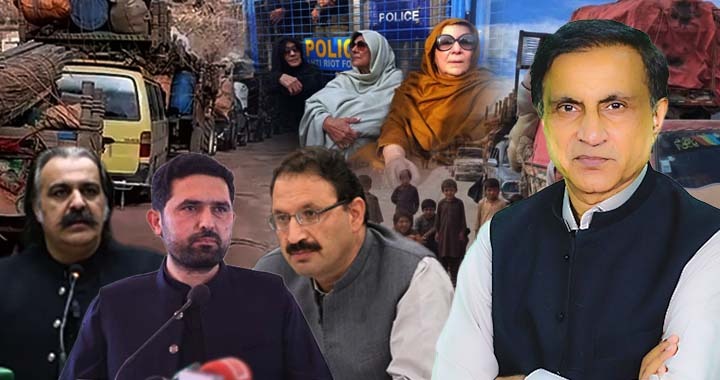
The announcement of nationwide protests on 8 February, by Pakistan Tehreek-e-Insaf (PTI), once again raises a basic and unavoidable question: can street agitation resolve the problems ordinary people face in Khyber Pakhtunkhwa, or has protest itself become a substitute for governance?
The declared objective of these rallies is clear, to apply pressure on the center for the release of Imran Khan. Yet even before assessing the likelihood of success, it is necessary to ask what such a strategy actually delivers for a province that already has a government formed by the same party calling for protest. If a wheel‑jam strike is announced across Pakistan, daily life outside Khyber Pakhtunkhwa is unlikely to halt. Within the province, however, where the party is in power, it can certainly mobilize administration and workers. The real question then becomes not whether disruption is possible, but whether it produces any tangible outcome.
Even if such protests were to succeed symbolically, the core demand would still remain unmet. Imran Khan would not be released through street pressure alone. And if the protests fail, the question of responsibility arises. Who answers for the failure? Who resigns? Who accepts political accountability? This question is already being asked publicly, including by supporters themselves.
Within the party, two parallel realities now exist. One revolves around the leadership associated with Adiala Jail, where appeals are made daily for mobilization and sacrifice. The other exists within the parliamentary structure, where ministers, lawmakers, and officeholders enjoy power, privileges, and stability. This divide is no longer subtle. It is visible in participation levels, in the absence of workers at calls for protest, and in the silence of figures who once claimed to represent street politics.
Those holding executive office today owe their position to the political capital of Imran Khan. They do not possess independent vote banks capable of sustaining them outside that umbrella. Yet while Imran Khan has spent nearly 900 days in jail, those governing in his name continue to enjoy the benefits of office. Promises were made publicly that he would be brought out, that pressure would be applied decisively, that resistance would be sustained. None of this has materialized.
If these promises cannot be fulfilled, then the moral burden shifts to those who made them. If release is impossible through protest, then what exactly is the purpose of repeatedly calling people to the streets?
At the same time, governance has suffered. Achievements promised during the transition of power have not appeared. Drone strikes continue despite assurances they would stop. Operations continue despite claims they would not. Displacement has occurred despite repeated denials that it would ever happen. Police raids on workers’ homes have not ended. Officers accused of misconduct remain in service. Threats of accountability have not translated into action.
Good governance is not an abstract concept. It is the primary responsibility of the chief executive. When governance fails, responsibility cannot be outsourced to party presidents, protest coordinators, or media campaigns. Leadership requires presence, direction, and decision‑making.
Within the party structure itself, leadership gaps have widened. Figures who once dominated screens and rallies have faded from view. Internal conflicts, accusations, and conditions placed on participation have resulted in paralysis. When leadership retreats, governance cannot advance.
Meanwhile, the security situation in the province continues to deteriorate. Targeted operations are ongoing. Law and order remain fragile in multiple districts. Institutions issue directives, but public services remain inaccessible. The burden falls not on rhetoric, but on citizens.
Nowhere is this more visible than in healthcare. After more than a decade of governance, no new general hospital has been built in Peshawar. The city relies on three major hospitals constructed decades ago, when the population was a fraction of what it is today. Peshawar now serves not only its own residents but patients from Mohmand, Bajaur, Khyber, Dara Adam Khel, Charsadda, and beyond. The pressure is crushing.
Bed capacity is catastrophically insufficient. ICU beds are counted in dozens for millions of people. Children share beds. Patients lie on floors. Families bring pillows from home. Mothers hold sick children in their laps while treatment is administered. These are not anecdotes, they are daily realities observed repeatedly, including by the chief minister himself during hospital visits prompted by public complaints.
Doctors are not the problem. They cannot create beds where none exist. They cannot stretch ICUs beyond capacity. They work extended shifts under extreme strain. The structural failure lies elsewhere.
The introduction of the Medical Teaching Institutions framework was presented as reform. In practice, it dismantled accountability. Hospitals were placed under boards with sweeping authority, insulated from public oversight, unaudited for years, and disconnected from elected governance. Government funds continue to flow, health cards are billed, insurance payments are collected, yet service delivery continues to collapse. Double funding has not translated into double capacity.
Private ICUs are now being discussed as a solution, but their costs are beyond the reach of ordinary citizens. A single day can cost more than many families earn in months. Without comprehensive coverage, this is not relief, it is exclusion.
The crisis extends beyond health. Universities struggle to pay salaries. Institutions run at a loss. Pensioners wait. Provincial autonomy promised under constitutional amendments has not translated into fiscal responsibility or planning. The center is blamed, but the province exercises authority and must accept ownership of outcomes.
This failure of governance intersects dangerously with security policy, particularly in Tirah. Public messaging and private actions diverge sharply. Statements opposing operations coexist with logistical cooperation behind closed doors. Cabinet summaries approving compensation and displacement were discussed, understood, and recorded. Yet when the consequences unfolded, denial replaced responsibility.
For days, affected populations were left without leadership presence. Only after public anger intensified did visits occur. Those initial days of absence deepened resentment. Jirgas attempted engagement, even carrying the Quran to seek peaceful resolution. When militants refused to withdraw or surrender, the jirga itself acknowledged that an operation was inevitable to prevent greater civilian harm. Everyone knew what was coming.
What followed was not confusion, but political calculation. Public perception was managed to suggest opposition to operations, while private assurances were extended elsewhere. This duality is not accidental. It reflects fear, survival instinct, and an overriding concern with self‑preservation.
The reality is stark. Political actors fear becoming targets themselves. They recall the cost paid by others who confronted militant groups directly. On one side, they seek to signal resistance to operations for public consumption. On the other, they quietly distance themselves from responsibility.
In the end, this is not about protest versus silence, or center versus province. It is about leadership versus avoidance. When governance is replaced by slogans, when accountability is deferred indefinitely, when suffering is acknowledged only after outrage erupts, then politics loses its moral claim.
At its core, the entire strategy collapses into one motive alone: their politics’ whole and sole aim is to save their own lives.