Claim:
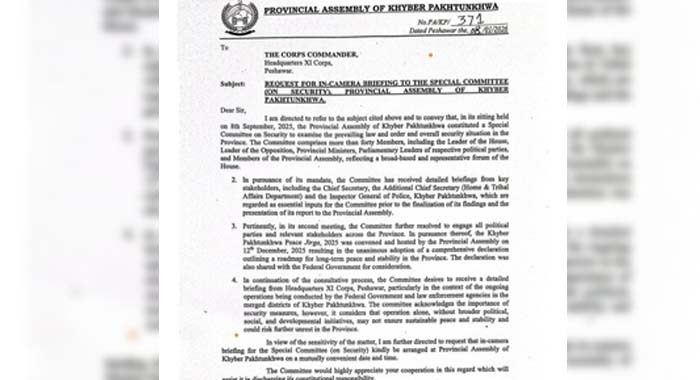
A letter purportedly issued by the Khyber Pakhtunkhwa Provincial Assembly and addressed to the Peshawar Corps Commander has been circulating on social media.
Fact-Check:
Verification from Security Sources:
Security sources have confirmed that no such letter has been received at the Corps Headquarters so far.
Legal and Procedural Context:
Under the law, it is a violation of established government procedures for the Khyber Pakhtunkhwa Provincial Assembly to directly send correspondence to the Peshawar Corps Commander for an in-camera briefing on law and order.
The constitutionally and administratively correct, acceptable, and legal procedure for the provincial assembly would have been to approach the federal government and formally request a briefing through the Ministry of Defense. Under this recognized institutional channel, the matter would then be forwarded to General Headquarters (GHQ), from where instructions would be issued to the relevant military formation.
Assessment of Provincial Government’s Conduct:
This step taken by the Khyber Pakhtunkhwa government indicates that the provincial administration is not serious about the issue of terrorism but instead is resorting to another form of media gimmickry.
Alternatively, it reflects such a degree of incompetence that the government appears to lack even a basic understanding of state affairs.
Rather than assuming political responsibility for the deteriorating law and order situation in Khyber Pakhtunkhwa, the PTI-led government is attempting to divert attention from its failures through symbolic actions and non-serious correspondence. Had the government genuinely been serious about law and order, it would have fulfilled the legal requirements.
Clarification on Authority and Process:
It must be noted that under the constitutional and administrative framework, a provincial government does not have the authority to directly contact a Corps Commander or GHQ for any formal, in-camera, or institutional briefing.
The legally recognized procedure requires the provincial government to send the matter in writing to the federal government, which then forwards it to GHQ through the Ministry of Defence. Subsequently, formal instructions are issued to the relevant formation.
By disregarding this clear, established, and legal procedure, the PTI government’s act of directly writing to GHQ constitutes not only a violation of constitutional order but also a deviation from accepted institutional principles governing civil-military relations.
Routine Coordination vs Institutional Briefing:
While it is correct that GHQ has granted prior permission for routine contact or day-to-day coordination, an in-camera briefing on law and order in a provincial assembly cannot be classified as a routine matter.
Such a briefing is a formal, sensitive, and institutional process, for which federal approval is mandatory. The PTI government has failed to understand this fundamental distinction.
Verdict
Misleading/Procedurally Invalid
The claim regarding a legitimate letter from the Khyber Pakhtunkhwa Provincial Assembly to the Peshawar Corps Commander is misleading. Security sources deny receiving such correspondence, and any such direct communication would constitute a violation of established constitutional and administrative procedures.