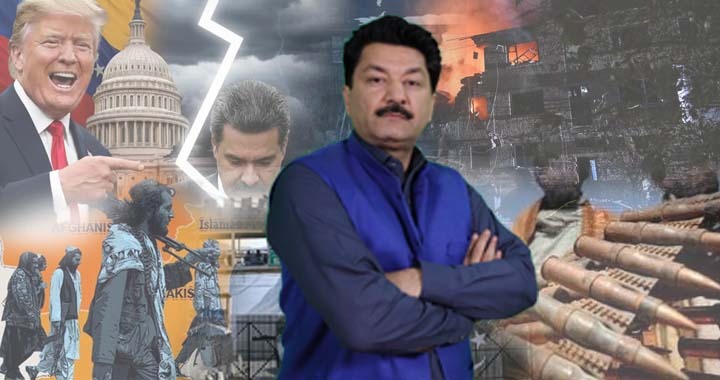
The recent attack on Venezuela by the United States underscores a troubling pattern in global geopolitics. Donald Trump, once a self-styled torchbearer of peace and a candidate for the Nobel Peace Prize, now stands accused of targeting countries far from American borders. Venezuela’s plight is emblematic of how nations without strong defense mechanisms or stable governance structures can become vulnerable to superpower interventions. Allegations of drug smuggling and terrorism were leveled against its president, yet he has maintained his position and authority, rejecting these claims as unfounded.
Historically, powerful nations have repeatedly imposed their will on weaker countries, often disregarding international norms and local sovereignty. Today, we witness a similar trend unfolding with threats against Greenland and other strategic locations, drawing criticism not only from local governments but also from allies of the United States. These developments highlight the delicate balance of power in an increasingly multipolar world, where diplomacy often clashes with military might.
Turning to Pakistan, the country faces its own set of security challenges. Despite having a well-organized army and strong defense capabilities, internal threats persist. The rise of militancy, coupled with new technologies such as drones, has transformed the nature of conflict. Khyber Pakhtunkhwa, for example, has witnessed over 400 drone attacks, targeting mosques, madrasas, and civilian areas alike. These are not conventional wars fought in open fields; rather, they are battles waged in our streets, neighborhoods, and communities, where citizens and security forces alike confront insurgents directly.
The management of Pakistan’s borders, particularly with Afghanistan, remains a complex issue. While border closures have reportedly reduced infiltration and terrorist incidents by 17%, militants continue to exploit secret and less-monitored routes, often circumventing official checkpoints. These dynamics demonstrate that security cannot be achieved solely through physical barriers. Effective border management requires coordination with neighboring states, shared intelligence, and political will from all parties involved.
The Afghan Taliban, now functioning as a governing authority, face both external and internal challenges. Externally, their inability or unwillingness to control militant movements from Afghan soil poses risks not only to Pakistan but to the broader region. Countries such as China, Iran, Russia, and Pakistan have repeatedly offered cooperation to ensure Afghan territory is not used as a launchpad for terrorism. Internally, the Afghan government must contend with the return of millions of displaced citizens and the economic hardships that follow. Trade interruptions with Pakistan further exacerbate these problems, impacting merchants, students, and ordinary Afghan families.
Afghanistan’s international image is also at stake. Afghans abroad, whether in Europe or North America, often face suspicion due to militancy and security concerns. This perception can only be changed if the Afghan leadership, along with intellectuals and youth, actively works to portray a responsible, law-abiding, and development-oriented state. A government that thinks like a true state—not merely a faction or movement—can secure international legitimacy, improve regional relations, and ensure stability for its citizens.
Reports from institutions like SIGAR have highlighted misappropriation of international aid in Afghanistan, with funding failing to reach essential services such as education and healthcare. Such failures inadvertently strengthen militant networks, which capitalize on the vacuum created by weak governance and limited opportunities. The Afghan Taliban must therefore prioritize not only security but also governance and development, ensuring that foreign aid benefits the population rather than fueling further instability.
Finally, Pakistan’s role in managing cross-border security, maintaining trade, and providing humanitarian assistance is critical. While border closures have curtailed illegal activities and infiltration to some extent, they have also disrupted legitimate trade and placed additional burdens on Afghan citizens and merchants. Constructive dialogue and collaboration between Pakistan and Afghanistan remain essential to balance security imperatives with economic and humanitarian needs.
In conclusion, the challenges of terrorism, border management, and regional diplomacy are deeply intertwined. The Afghan Taliban must evolve from a militant organization to a responsible governing entity, while Pakistan continues to strengthen its defense, monitor its borders, and engage in proactive diplomacy. Only through a combination of robust security measures, effective governance, and regional cooperation can lasting peace and stability be achieved.